Why Additional Capital Is Required: How Startups Should Justify Their Funding Needs to Investors
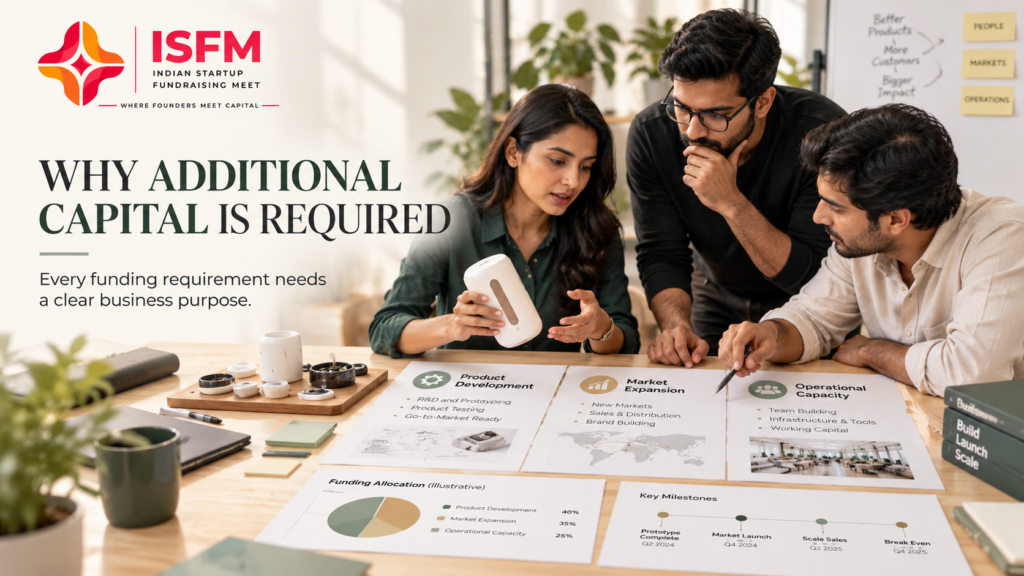
Why does your startup need additional capital? This is one of the most important questions investors ask during fundraising. A strong answer must go beyond general statements about business growth and explain the specific financial requirements, operational priorities, expected outcomes and measurable milestones that make additional funding necessary.
Every startup requires resources to build, operate and grow its business.
During the early stages, founders may rely on personal savings, initial sales, grants, existing investments or other available resources.
As the business develops, additional capital may become necessary to support product development, expand operational capacity, acquire customers, recruit skilled employees or enter new markets.
However, the requirement for more money does not automatically establish a strong investment opportunity.
Investors want to understand what the startup has already achieved, why its existing financial resources are insufficient and how the proposed funding will create meaningful business progress.
For example, saying “We need ₹2 crore to grow our startup” provides very little information.
A more credible explanation would identify how much capital is required for product commercialisation, recruitment, customer acquisition and working capital, and explain which milestones these investments are expected to support.
In this comprehensive guide, ISFM – Indian Startup Fundraising Meet explains why additional capital is required by startups, how founders can justify their funding requirements, how to calculate the amount needed and how to demonstrate that new investment can create measurable business value.
What Is Additional Capital in Startup Fundraising?
Additional capital refers to new financial resources obtained by a business to support requirements that cannot be adequately financed through its existing available funds and expected operating cash flows.
It may come from different sources, including:
- Equity investment.
- Angel investors.
- Venture capital.
- Suitable business loans.
- Venture debt.
- Eligible government grants.
- Strategic investments.
- Founder contributions.
- Internal cash generation.
Each funding source has different characteristics, eligibility requirements, costs and obligations.
Additional capital is not necessarily the same as emergency funding.
A startup may seek new investment from a position of relative financial strength because it has identified a credible opportunity to develop a product faster, serve more customers or expand its operating capacity.
Alternatively, a company may require additional financing because its planned activities involve substantial upfront costs.
The underlying reason must be clearly explained.
Why Do Startups Need Additional Capital?
Startup financing requirements usually arise from identifiable business activities.
The most common reasons include product development, technology investment, hiring, market expansion and working capital.
However, these purposes should be supported by realistic operational plans.
1. Product Development and Innovation
Many startups require capital to design, develop, test and improve their products.
This is particularly important for technology-driven businesses.
Funding may be required for:
- Product engineering.
- Software development.
- Prototype creation.
- Research and development.
- Technical testing.
- User experience improvements.
- Product security.
- Product trials.
- Regulatory validation where applicable.
Example: A MedTech startup has completed an initial prototype but needs further testing, engineering improvements and applicable regulatory work before commercialisation.
Additional capital may help finance these activities.
The startup should explain which development milestones the financing will support and what evidence will demonstrate completion.
2. Customer Acquisition and Market Expansion
A startup with a functional product may require additional resources to reach its target customers.
Potential expenditures include:
- Sales team recruitment.
- Marketing campaigns.
- Distribution partnerships.
- Customer onboarding.
- Market research.
- Regional expansion.
- Customer support infrastructure.
However, founders should avoid assuming that increased marketing expenditure will automatically produce profitable growth.
Investors may examine customer acquisition costs, conversion rates, margins and retention.
Additional capital is easier to justify when there is credible evidence that increased expenditure can support meaningful commercial progress.
3. Hiring and Team Development
As startups grow, founders may need specialised professionals who can improve execution.
Important roles may include:
- Software developers.
- Product managers.
- Research professionals.
- Sales executives.
- Finance specialists.
- Operations managers.
- Compliance professionals.
- Customer success teams.
A strong funding proposal should explain why each important role is needed and how the recruitment plan connects to business milestones.
For example, hiring engineers may enable completion of a product release, while recruiting sales professionals may support a validated commercial pipeline.
4. Technology Infrastructure
Technology startups often require infrastructure capable of supporting product reliability, security and increasing usage.
Capital may be used for:
- Cloud computing.
- Software infrastructure.
- Data storage.
- Cybersecurity.
- Development tools.
- Platform maintenance.
- Testing environments.
- Approved AI computing resources.
The amount required should be linked to actual or realistically projected technical demands.
5. Working Capital Requirements
Working capital supports the normal operating cycle of a business.
A company may need to purchase materials, pay suppliers or meet payroll before collecting payment from customers.
This creates a timing gap between cash outflows and inflows.
Working capital requirements can become particularly important in manufacturing, distribution, logistics and businesses operating with extended customer payment terms.
However, recurring working capital shortages may also indicate weaknesses in collections, inventory management or operating economics.
Founders should distinguish financing a healthy growing business from repeatedly funding an unsustainable cash deficit.
6. Manufacturing and Operational Expansion
Product-oriented startups may require capital to increase their production capacity.
Potential requirements include:
- Machinery.
- Manufacturing equipment.
- Production facilities.
- Quality assurance systems.
- Warehouse infrastructure.
- Supply chain improvements.
- Inventory.
- Operational technology.
A manufacturing startup should demonstrate how the proposed investment relates to available demand, production efficiency or expected business capacity.
7. Research, Testing and Regulatory Requirements
Some sectors require substantial investment before products can enter commercial markets.
Examples include biotechnology, medical devices, clean energy, advanced manufacturing and research-intensive technologies.
The specific expenditure depends on the industry and applicable requirements.
Where relevant, investors may want to understand technical risks, expected testing outcomes, approval processes and the resources required to achieve the next development stage.
8. Entering New Markets
A startup may seek capital to expand into new locations, customer segments or international markets.
Expansion can require expenditure on distribution, localisation, recruitment, compliance and commercial partnerships.
But market expansion should follow credible evidence of demand and operational readiness.
Raising funds merely to enter more cities does not prove that expansion will be economically beneficial.
9. Strengthening Business Operations
As a company grows, operational processes may require improvement.
Possible investments include:
- Financial reporting systems.
- Internal controls.
- Customer relationship management.
- Supply chain technology.
- Enterprise software.
- Compliance infrastructure.
- Customer service processes.
Such investments may improve the organisation’s ability to manage scale, although their benefits should be evaluated against their costs.
Additional Capital vs Business Revenue
A fundamental fundraising question is why the startup cannot finance its requirements entirely through existing revenue.
Revenue and available investment capital serve different purposes.
Revenue represents business income generated under applicable accounting principles.
Available cash represents financial resources that may be used to meet obligations.
A company can report revenue while having insufficient available cash to finance expansion.
For example, a business might generate ₹1 crore in annual revenue but need additional funds to purchase machinery worth ₹60 lakh.
Alternatively, a pre-revenue technology company may require capital to complete development before commercial sales are possible.
However, an investor may reasonably ask whether the company could finance part of its requirements through existing cash, customer payments, supplier credit or a smaller financing round.
The strongest capital requirement is one that considers available alternatives rather than automatically assuming external investment is necessary.
What Investors Want to Know About Additional Capital
When evaluating a financing proposal, investors may ask several important questions.
Why Is the Capital Required Now?
Founders should explain why the financing need has become relevant at the current stage.
Possible reasons include completed technical validation, identifiable commercial demand or readiness for a defined expansion milestone.
What Has the Startup Achieved So Far?
Investors may examine progress made using existing resources.
Relevant evidence could include a prototype, customer validation, revenue, operational improvements or technical milestones.
What Is Preventing Further Progress?
Founders should identify the specific limitation.
Examples include insufficient production capacity, development resources or working capital.
How Much Funding Is Actually Required?
The requested amount should be supported by a detailed financial plan.
Where Will the Money Be Spent?
Capital allocation should be transparent and aligned with operating priorities.
What Will the Funding Achieve?
Founders should identify measurable milestones and explain how they will assess progress.
What Happens if Funding Is Delayed?
A realistic fundraising plan should include cash-flow scenarios and operational contingencies.
How to Calculate Your Startup’s Additional Capital Requirement
Funding requirements should be based on a structured financial assessment.
A simplified approach is:
Additional Capital Required = Planned Funding-Period Cash Outflows + Contingency Requirement − Available Allocable Cash − Expected Cash Inflows During the Period
This formula is only a starting point.
An accurate funding model should consider the timing of every major cash flow.
For example, revenue expected in December cannot necessarily cover expenses payable in August.
Founders should therefore prepare a month-by-month cash-flow forecast.
Step 1: Define the Funding Period
Determine the planning horizon relevant to the company’s milestones.
It may be 12, 18 or 24 months, or another period appropriate to the business.
Step 2: Estimate Development and Operating Costs
Prepare realistic budgets for product development, hiring, marketing, infrastructure, operations and other activities.
Step 3: Estimate Expected Cash Inflows
Identify expected customer collections, available financing and other appropriate cash inflows.
Do not treat uncertain future funding approvals as guaranteed cash.
Step 4: Assess Existing Cash Resources
Determine how much unrestricted cash can be allocated without undermining necessary operating reserves.
Step 5: Include Relevant Contingencies
Identify potential delays, cost overruns and working capital needs.
Step 6: Calculate the Peak Cash Shortfall
Model the timing of receipts and payments to identify the maximum amount of external financing required.
Step 7: Match Financing to Business Milestones
Determine whether the calculated capital amount can support the intended operating outcomes.
Illustrative Example: A Startup Seeking ₹2 Crore
Consider a fictional technology startup that has developed an MVP and completed initial customer validation.
The company intends to commercialise the product and expand its customer base.
Its proposed financing requirement is as follows:
| Planned use of capital | Amount | Allocation |
|---|---|---|
| Product and technology development | ₹60 lakh | 30% |
| Sales and customer acquisition | ₹50 lakh | 25% |
| Team recruitment | ₹40 lakh | 20% |
| Infrastructure and operations | ₹30 lakh | 15% |
| Working capital and contingency | ₹20 lakh | 10% |
| Total | ₹2 crore | 100% |
The figures above are illustrative and do not represent a real company’s funding plan.
The startup should explain how each expenditure supports an outcome.
For example, the product development budget may support commercial platform readiness.
The sales allocation may support customer acquisition and distribution.
The hiring budget may support execution capacity.
A detailed use-of-funds plan should demonstrate why the full amount is needed and why the proposed spending schedule is appropriate.
How to Link Additional Capital With Business Milestones
Investors often prefer financing proposals linked to outcomes rather than broad expenditure categories.
Consider the following illustrative milestones:
| Funding period | Proposed milestone | Evidence of completion |
|---|---|---|
| Months 1–3 | Product improvements | Technical delivery and testing records |
| Months 4–6 | Customer validation | Completed pilots and documented feedback |
| Months 7–9 | Commercial rollout | Paying customers and relevant sales activity |
| Months 10–12 | Acquisition optimisation | Customer acquisition and retention metrics |
| Months 13–18 | Market expansion assessment | Commercial performance and operating readiness |
These milestones should be tailored to the business.
A biotechnology startup may require laboratory validation rather than rapid customer acquisition.
A manufacturing company may focus on equipment commissioning and production output.
A software company may focus on retention, recurring revenue and product usage.
The important principle is consistency between funding, execution and evidence.
What Evidence Shows That Additional Capital Can Create Growth?
Investors may examine evidence suggesting that a financing proposal has a credible commercial or operational rationale.
Product Validation
Has the startup demonstrated that its product or technology can address the intended problem?
Customer Demand
Have prospective customers shown meaningful interest through legitimate trials, contracts, purchases or other verifiable activity?
Commercial Traction
Is there evidence of paying customers, repeat business, retention or growing revenue?
Operational Capacity
Can the startup realistically execute its proposed plan?
Unit Economics
Does the business understand the costs and financial benefits associated with its customers or transactions?
Founder Capability
Does the team possess the skills and experience necessary to manage the planned activities?
Financial Planning
Are expenditure assumptions, projections and cash-flow requirements reasonable?
No single indicator guarantees that investment will produce growth.
However, stronger evidence can improve the credibility of the proposed use of additional capital.
Is Additional Capital Always Necessary for Startup Growth?
No.
Not every startup requires external funding to achieve its next milestone.
Some businesses can grow using customer revenue, retained earnings or founder capital.
Others may improve cash availability by reducing unnecessary expenses, managing inventory or collecting receivables more efficiently.
Before seeking additional capital, founders should consider:
- Can the next milestone be achieved using existing resources?
- Can the development plan be reduced to a smaller initial phase?
- Can customers finance part of the operating cycle?
- Can costs be reduced without harming product quality?
- Are there appropriate grants or non-dilutive programmes?
- Is external capital justified by the expected business benefit?
The purpose is not to avoid fundraising at all costs.
It is to ensure that the company seeks external financing when it serves a clear strategic purpose.
Choosing the Right Type of Additional Capital
The appropriate financing instrument depends on the company’s stage, business model, risks and financial position.
Equity Funding
Equity capital may support innovation and growth where fixed repayment obligations would not be appropriate.
However, it usually involves ownership dilution and investor rights.
Debt Funding
Debt may support businesses with credible repayment capacity and well-defined financing needs.
It generally involves interest, repayment obligations and other contractual terms.
Venture Debt
Certain eligible startups may explore specialised venture debt.
Terms can include interest, covenants and potential equity-linked features.
Government Grants
Grants may help finance approved project activities where eligibility requirements are satisfied.
They are not generally unrestricted business financing.
Internal Funding
Founders may use existing business cash generation or other available internal resources where appropriate.
The capital structure should reflect the business requirement rather than simply prioritising the largest available funding amount.
Common Mistakes When Justifying Additional Capital
1. Requesting Capital Without Calculating the Amount
An unsupported funding ask can create questions about financial discipline.
2. Treating Every Expense as a Growth Investment
Some costs are necessary for operations but do not automatically create additional business value.
Founders should explain their purpose accurately.
3. Ignoring Existing Cash Flow
A company should understand how much of its planned expenditure can be financed internally.
4. Using Unrealistic Revenue Forecasts
Financial projections should be linked to credible assumptions.
5. Raising Too Little Capital
Insufficient financing may prevent the company from completing its intended milestones.
6. Raising More Capital Than Necessary
Excessive equity fundraising can create avoidable dilution, while excessive borrowing can increase repayment pressure.
7. Failing to Prepare a Contingency Plan
The financing and operating strategy should account for material delays or weaker-than-expected results.
8. Confusing Funding Approval With Cash Received
An investment discussion, application, sanction or signed commitment may not mean funds are immediately available.
9. Failing to Measure Outcomes
A use-of-funds plan should include performance monitoring and expenditure accountability.
10. Presenting Capital as a Substitute for Customer Demand
More money cannot automatically create a viable market for an unwanted product.
How to Explain Your Funding Requirement in a Pitch Deck
The funding requirement should be presented clearly and concisely.
A good pitch deck section may include:
Funding Amount: The capital being sought.
Funding Instrument: Equity, debt or another appropriate structure.
Use of Funds: The primary expenditure categories.
Funding Horizon: The period the financing is expected to support.
Business Milestones: The outcomes the company intends to achieve.
Expected Evidence: The metrics or records that will demonstrate progress.
Example Investor-Ready Funding Statement
“Our startup is seeking ₹1.5 crore in equity funding to complete product commercialisation, strengthen our core technology and sales teams, execute customer acquisition initiatives and support working capital over the planned 18-month period.
The proposed investment is intended to support defined product, customer validation and commercial growth milestones. Our detailed financial model explains the proposed allocation, assumptions and expected cash requirements.”
This is a fictional example.
Founders should replace the amount, timeline and milestones with their actual information.
How Investors Evaluate the Use of Additional Capital
Investors may assess the relationship between the proposed capital and the startup’s ability to achieve its objectives.
Important considerations can include:
Execution feasibility: Can the team realistically complete the plan?
Capital efficiency: Is the company using resources responsibly?
Market evidence: Does customer demand support the proposed expansion?
Commercial assumptions: Are revenue projections consistent with available evidence?
Risk management: Have the founders identified major uncertainties?
Financial sustainability: How does the financing affect cash flow and future capital requirements?
Investor fit: Does the opportunity align with the investor’s financing mandate?
The evaluation differs according to the startup’s development stage and type of funding.
Additional Capital for Pre-Revenue Startups
Pre-revenue startups may require financing to complete technical development, establish feasibility or conduct customer validation.
A lack of revenue does not automatically make additional capital unjustified.
However, founders should identify other supporting evidence.
For example:
- Customer discovery results.
- Technical feasibility work.
- Prototype development.
- Pilot testing.
- Industry research.
- Team expertise.
- Development milestones.
- A credible commercialisation plan.
Pre-revenue financing is often more dependent on the strength of the opportunity and the quality of the proposed execution plan.
Additional Capital for Revenue-Generating Startups
Revenue-generating companies may have different financing priorities.
Potential requirements include:
- Increasing production capacity.
- Expanding distribution.
- Financing customer acquisition.
- Improving infrastructure.
- Entering new markets.
- Supporting working capital.
- Strengthening technology and operations.
Investors and lenders may examine historical financial performance, revenue quality, cash collections, margins and operating efficiency.
A growing company should explain why the expected benefits of additional capital justify its economic cost.
Additional Capital vs Poor Cash Management
Founders should distinguish a genuine financing requirement from problems caused by inefficient operations.
For example, a startup may require capital because it has received substantial customer orders but must purchase inventory before receiving payment.
This can represent an identifiable working capital need.
Another startup may repeatedly require new funding because its product has low customer retention and unsustainable acquisition costs.
In the second situation, additional capital may temporarily extend operations without solving the underlying commercial problem.
Before fundraising, founders should assess whether the business requires more capital, improved execution or both.
A Practical Additional Capital Readiness Checklist
Before approaching investors, founders should answer the following questions:
- What is the startup’s current development stage?
- What has been achieved using existing resources?
- What specific limitation is preventing the next milestone?
- Why is additional capital required now?
- How much financing is needed?
- How has the amount been calculated?
- What existing financial resources are available?
- Which financing instrument is appropriate?
- Where will the capital be allocated?
- What milestones will be achieved?
- How long is the funding expected to support operations?
- What assumptions support the financial projections?
- What are the main execution risks?
- What happens if funding is delayed?
- What evidence will demonstrate successful capital utilisation?
- Is the pitch deck consistent with the financial model?
- Are relevant legal and financial records organised?
- Are suitable funding providers identified?
The checklist supports internal readiness assessment and should be adapted to the business.
How ISFM Supports Structured Funding Readiness
ISFM – Indian Startup Fundraising Meet is a private startup fundraising facilitation initiative focused on structured startup evaluation and relevant ecosystem connections.
A central part of fundraising readiness is understanding why capital is required and whether the proposed financing is appropriate for the startup’s development stage.
Relevant evaluation areas may include:
- Business model.
- Product readiness.
- Market validation.
- Commercial traction.
- Financial projections.
- Funding requirements.
- Fund utilisation.
- Planned business milestones.
- Documentation readiness.
- Appropriate capital pathways.
Through structured assessment and ecosystem engagement, ISFM aims to support more informed discussions between startups and relevant investors, incubators, accelerators and other stakeholders.
Startups may participate in initial evaluation to identify fundraising-readiness gaps and areas requiring improvement.
Personalised mentoring, pitch deck preparation, financial modelling and other done-for-you professional services, where offered, may involve separate charges.
ISFM is a private fundraising facilitation initiative. Startup nomination, evaluation or participation does not guarantee investor meetings, funding approval, grants, loans or capital disbursement.
Frequently Asked Questions About Additional Capital
1. Why is additional capital required for a startup?
A startup may require additional capital for product development, working capital, customer acquisition, recruitment, technology infrastructure or expansion.
2. How do founders justify additional funding?
They should connect the funding amount to specific business activities, financial assumptions, milestones and expected outcomes.
3. Is additional capital necessary for every startup?
No. Some companies can finance growth through existing cash flow, internal resources or a smaller operating plan.
4. Can pre-revenue startups raise additional capital?
Yes. Some investors finance pre-revenue businesses where the opportunity, technical progress, validation and team are sufficiently compelling.
5. How much additional capital should a startup raise?
The amount should be based on realistic cash-flow forecasts, existing resources, expenditure requirements and defined milestones.
6. Should additional capital come from equity or debt?
The appropriate choice depends on repayment capacity, development stage, risk, ownership considerations and financing terms.
7. What is a fund utilisation plan?
It is a structured explanation of how the proposed financing will be allocated across business activities.
8. What evidence can demonstrate a need for additional capital?
Examples include validated product requirements, genuine customer demand, commercial opportunities, operating forecasts and realistic capacity constraints.
9. Does additional funding guarantee growth?
No. Outcomes depend on execution quality, market conditions, commercial demand and many other factors.
10. Can government grants provide additional capital?
Certain eligible programmes support specified project activities, subject to their own rules, application procedures and approvals.
11. Can additional funding improve startup valuation?
Funding may support value creation when it enables meaningful business progress. It does not automatically increase the company’s economic value.
12. What do investors want to see before funding expansion?
They may examine traction, business economics, market evidence, operating plans, financial forecasts and management capabilities.
13. Why is working capital important?
Working capital helps businesses manage the timing difference between operational payments and customer collections.
14. What happens if a startup raises more capital than it needs?
Unnecessary equity financing may increase dilution, while excessive debt can create additional repayment obligations.
15. What happens if a startup raises insufficient capital?
The company may be unable to complete its planned activities or may need to seek additional financing sooner than expected.
16. Is a pitch deck enough to justify additional funding?
No. A pitch deck introduces the investment case, while financial models and supporting records provide more detailed evidence.
17. Should the funding amount be connected to milestones?
Yes. Defined milestones help explain what the capital is intended to achieve.
18. Can ISFM guarantee additional funding?
No. ISFM facilitates structured evaluation and relevant ecosystem engagement but does not guarantee investment or financing approval.
Conclusion: Additional Capital Must Have a Clear Purpose
Additional capital can help startups develop innovative products, build capable teams, serve more customers and expand operations.
However, raising money is not an achievement in isolation.
The important question is whether the financing supports a credible business strategy and creates an opportunity for measurable progress.
Founders should determine why capital is required, calculate the amount realistically, select a suitable financing structure and identify the milestones it will support.
They should also consider whether existing resources can achieve part of the same objectives and whether the business is operationally prepared to use new funding effectively.
The strongest answer to “Why is additional capital required?” is not “Because we want to grow.” It is a clear explanation of what the company has achieved, what is preventing further progress and how the proposed financing will help overcome that limitation.
A well-defined capital requirement can make investor discussions more transparent, professional and focused on business outcomes.
Raise for a Reason. Invest in Milestones. Build for Sustainable Growth.
ISFM – Indian Startup Fundraising Meet
Where Founders Meet Capital
Official Website: https://www.indianstartupfundraisingmeet.com
Startup Nomination: https://zfrmz.in/A1pyKmrRj1s9OIsgPR4I
Investor & Partner Collaboration: https://zfrmz.in/p5cGk97nqrKp2ZXaJqjl
WhatsApp Community: https://chat.whatsapp.com/BNFh80tJsCtJEvgCQsW2i4
Official WhatsApp Channel: https://whatsapp.com/channel/0029VbDbOmr2ZjCkYLBeIw1T
Contact: +91 7014264283
Disclaimer: This article provides general educational information and does not constitute legal, financial, tax or investment advice. Capital requirements, funding instruments and financing decisions depend on individual business circumstances and applicable conditions. ISFM does not guarantee investor meetings, funding approval or fund disbursement.