What Do Investors Look for Before Investing in a Startup?
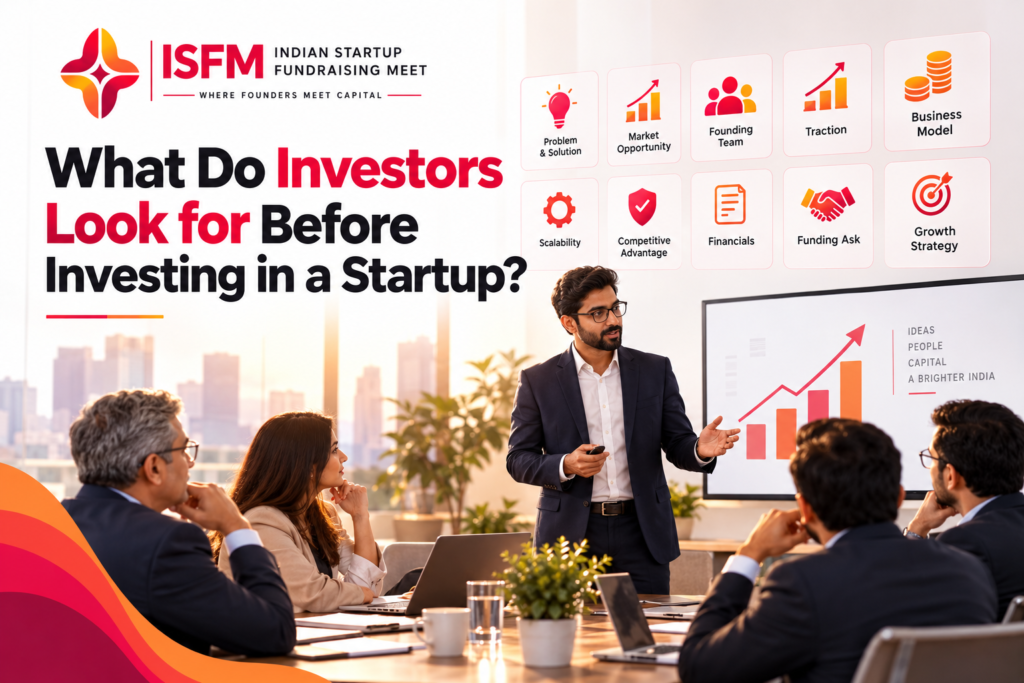
Raising capital is not simply about having an exciting idea or preparing an impressive pitch deck. Before investing in a startup, investors typically examine the business from multiple angles—from the problem being solved and the size of the opportunity to traction, founders, financials, scalability and the proposed investment terms.
For founders, understanding what investors look for before investing in a startup can make fundraising more structured and realistic. Different investors have different mandates, risk appetites and investment stages, but many of the fundamental questions they ask are similar.
Is there a real problem? Is the solution valuable? Is there evidence that customers want it? Can this business scale? Is this the right team to build it? And does the potential opportunity justify the investment risk?
This guide explains the major areas investors commonly evaluate and how founders can prepare before approaching them.
1. A Real and Clearly Defined Problem
Investors generally want to understand the problem before they become interested in the solution.
A startup may have impressive technology, attractive branding or an innovative product, but the fundamental question remains: does it solve a meaningful problem for a clearly identifiable customer?
Founders should be able to explain:
- Who experiences the problem?
- How significant or frequent is it?
- How are customers solving it today?
- Why are existing alternatives insufficient?
- Why is the problem important enough for customers to pay for a better solution?
A clear problem statement makes the rest of the investment story easier to understand. If an investor struggles to identify why the problem matters, explaining the market opportunity and business model becomes much harder.
2. A Solution That Creates Clear Customer Value
Once the problem is understood, attention moves to the startup’s solution.
Investors are not only evaluating whether the product works. They also want to understand why customers would choose it over available alternatives.
A strong solution should have a clear value proposition. Depending on the business, it may help customers save time, reduce costs, improve productivity, access something previously unavailable, increase convenience or achieve a better outcome.
Questions Founders Should Be Prepared to Answer
- What exactly does the product or service do?
- Who is the primary customer?
- What measurable or practical value does it create?
- Why would customers switch from their current solution?
- What makes the product difficult to replace?
Founders should avoid relying entirely on technical descriptions. Investors need to understand both how the solution works and why the customer cares.
3. Market Size and the Potential to Build a Large Business
A good product does not automatically create an attractive investment opportunity. Investors also consider whether the addressable market is large enough to support meaningful growth.
This is particularly relevant for venture investors because their investment model generally depends on backing businesses capable of substantial expansion.
Founders commonly present:
- TAM — Total Addressable Market: The broad overall market opportunity.
- SAM — Serviceable Available Market: The portion of that market the startup can realistically serve.
- SOM — Serviceable Obtainable Market: The segment the startup could reasonably target or capture within a defined period.
However, large numbers alone are not persuasive. Investors may examine how those estimates were calculated and whether they reflect the startup’s actual customer segment.
A smaller but well-supported market estimate can be more credible than an enormous market figure with little connection to the startup’s actual business.
4. Traction and Evidence of Market Validation
One of the most important things investors may look for is evidence that the startup is progressing beyond assumptions.
Traction can take different forms depending on the company’s stage and business model.
Examples of Startup Traction
- Revenue
- Paying customers
- Active users
- Repeat purchases
- Customer retention
- Pilots or proof-of-concept deployments
- Signed contracts or purchase orders
- Waitlists or qualified demand
- Partnerships
- Month-on-month growth
An early-stage startup may not have significant revenue yet. In that case, investors may pay greater attention to product development, customer interviews, pilots, engagement, early adoption or other forms of validation.
The key is to demonstrate evidence appropriate to the startup’s stage.
Founders should also be careful not to present vanity metrics as meaningful traction. Downloads, social-media followers or registrations can be useful, but they become more valuable when connected to engagement, conversion, retention or revenue.
5. The Founder and the Team
Investors are investing in a company, but they are also placing significant confidence in the people building it.
At an early stage, when financial history and operating data may still be limited, the quality of the founding team can become particularly important.
Investors may evaluate:
- Relevant domain knowledge
- Technical or operational capabilities
- Understanding of customers
- Execution ability
- Complementary skills among co-founders
- Commitment to the venture
- Ability to recruit and lead a team
- How founders respond to difficult questions and feedback
Investors do not necessarily expect founders to know every answer. What matters is whether the team understands its business deeply, recognises its gaps and demonstrates an ability to learn and execute.
Why Founder-Market Fit Matters
A useful question for founders is: Why are we particularly suited to solve this problem?
The answer could come from professional experience, technical expertise, lived experience of the problem, customer access, industry relationships or years spent understanding a specific market.
6. A Business Model That Can Generate Sustainable Revenue
Investors need to understand how the startup intends to make money.
A founder should be able to explain the company’s revenue model in straightforward terms.
Depending on the startup, this could include:
- Subscription revenue
- Direct product sales
- Transaction fees
- Commissions
- Licensing
- Marketplace fees
- Enterprise contracts
- Usage-based pricing
- Freemium-to-paid conversion
Beyond identifying the model, investors may assess whether the economics behind it can become sustainable.
Important Business Metrics Investors May Examine
Customer Acquisition Cost (CAC): How much it costs to acquire a customer.
Lifetime Value (LTV): The economic value a customer may generate during the relationship.
Gross Margin: Revenue remaining after direct costs associated with delivering the product or service.
Burn Rate: The rate at which the startup is using cash.
Runway: Approximately how long the company can continue operating at its current spending level before requiring additional capital or reaching sustainability.
Not every early-stage company will have mature unit economics. Investors may instead examine whether the founders understand the variables that will eventually determine whether the model works.
7. Scalability: Can the Startup Grow Efficiently?
Investors often distinguish between a good small business and a potentially scalable startup.
Scalability asks whether revenue and market reach can increase significantly without costs, complexity and resources increasing at exactly the same rate.
Depending on the sector, investors may examine whether the startup can:
- Enter new cities or markets
- Serve significantly more customers
- Automate important processes
- Expand distribution
- Build repeatable sales channels
- Increase production efficiently
- Add products or services for existing customers
The answer will differ considerably between a SaaS startup, manufacturing company, D2C brand, marketplace, climate-tech venture or deep-tech company.
Founders should therefore explain scalability in the context of their own operating model rather than using generic claims.
8. Competitive Advantage and Defensibility
Almost every meaningful market has competition.
Saying that a startup has “no competitors” can create concern rather than confidence. Competition may come from direct startups, established companies, substitutes or even the customer’s decision to continue using the existing process.
Investors may ask:
- Who are the direct competitors?
- What alternatives do customers currently use?
- Why would customers choose this startup?
- How difficult would the solution be to replicate?
- Can the advantage become stronger as the company grows?
What Can Create Defensibility?
Depending on the business, differentiation or defensibility could come from technology, intellectual property, proprietary data, network effects, distribution, brand, operational expertise, customer relationships, cost advantages or deep domain knowledge.
The objective is not to claim that competition cannot exist. It is to explain why the startup can build and maintain a meaningful position within its market.
9. Financial Performance and Financial Discipline
Financial projections matter, but investors may be equally interested in the assumptions behind those projections.
Depending on the company’s stage, investors may review:
- Historical revenue
- Revenue growth
- Gross margins
- Operating expenses
- Cash burn
- Runway
- Receivables and liabilities
- Unit economics
- Future financial projections
Very early-stage startups may have limited historical financial data. That does not remove the need for financial discipline.
Founders should understand where money is being spent, what drives revenue, how much capital is required and what milestones that capital is expected to achieve.
Financial projections should be ambitious enough to communicate the opportunity but grounded enough that the assumptions can be explained.
10. The Funding Ask and Use of Funds
One of the simplest fundraising questions is also one that founders sometimes struggle to answer clearly:
How much are you raising, and what exactly will you do with the money?
A funding ask should ideally connect capital to measurable business objectives.
For example, funding might be allocated towards:
- Product development
- Technology infrastructure
- Hiring
- Sales and distribution
- Marketing
- Manufacturing capacity
- Inventory
- Regulatory requirements
- Geographic expansion
- Working capital
Simply saying that the company needs capital “for growth” provides limited information.
A stronger fundraising plan explains what the capital enables, how long it is expected to last and which milestones the startup intends to reach before the next financing stage.
11. Valuation and Investment Terms
Even when investors like a startup, the investment still needs to make sense within their mandate and return expectations.
They may consider the proposed valuation, investment structure, ownership being offered, existing cap table and rights attached to the investment.
There is no single valuation formula that works for every startup. Stage, sector, traction, growth, comparable transactions, market conditions, intellectual property and negotiating dynamics can all influence valuation.
Founders should therefore be prepared to explain the reasoning behind their expectations rather than relying only on an arbitrary number.
12. Cap Table and Founder Ownership
The capitalisation table, or cap table, shows who owns the company and in what proportion.
Investors may review:
- Founder ownership
- Existing investors
- Employee stock options
- Previous investment rounds
- Convertible instruments
- Any unusual or potentially problematic ownership arrangements
A complicated cap table is not automatically a problem, but unexplained ownership issues can make an investment harder to evaluate or complete.
Founders should maintain accurate ownership records from an early stage.
13. Legal, Compliance and Due Diligence Readiness
A compelling pitch can start a conversation, but investment generally requires deeper verification.
During due diligence, investors or their advisers may examine corporate, financial, legal, tax, intellectual-property and commercial documentation.
Depending on the company and transaction, relevant documents may include:
- Incorporation documents
- Shareholding and cap-table records
- Founder agreements
- Material customer or vendor contracts
- Intellectual-property ownership
- Financial statements
- Tax and statutory filings
- Employment agreements
- Licences and regulatory approvals where applicable
The exact requirements depend on the startup, sector, investor and investment structure.
Founders who organise important records before beginning serious investor discussions can make the due-diligence process considerably more efficient.
14. Growth Strategy and Go-to-Market Plan
Investors do not only want to know what has happened so far. They also want to understand how the company intends to grow from here.
A go-to-market strategy should explain how the startup plans to acquire, convert and retain customers.
This may involve:
- Direct sales
- Digital marketing
- Channel partners
- Enterprise sales
- Distributors
- Marketplaces
- Retail networks
- Strategic partnerships
- Community-led growth
- Product-led growth
The strongest strategy is not necessarily the one with the largest number of channels. It is the one where founders understand which channels work, what they cost and whether they can be repeated at scale.
15. Risks and the Founder’s Understanding of Them
Every startup carries risk.
Investors generally know this. Trying to present a business as if it has no meaningful risks can make a founder appear less prepared.
Risks may include:
- Market adoption
- Technology execution
- Competition
- Regulation
- Customer concentration
- Supply-chain dependency
- Hiring challenges
- Capital requirements
- Founder dependency
A thoughtful founder should be able to identify the most important risks and explain what the company is doing to manage them.
Understanding risk does not weaken an investment pitch. It demonstrates that the founders understand the business they are building.
What Investors Look for at Different Startup Stages
The relative importance of each factor changes as a startup develops.
Idea or Pre-Seed Stage
At this stage, investors may focus heavily on the founding team, problem, market opportunity, early product thinking and founder-market fit. There may be little or no revenue.
Seed Stage
As the company progresses, investors may expect stronger evidence of product-market validation, early traction, customer behaviour, a repeatable business model and a credible growth strategy.
Growth Stage
For more mature startups, greater attention may be placed on revenue growth, unit economics, retention, market expansion, operational systems, leadership depth and the path towards sustainable scale.
This is why founders should approach investors whose investment thesis and preferred stage align with where the startup actually stands.
Common Mistakes Founders Make Before Approaching Investors
Approaching Every Investor
Not every investor is relevant to every startup. Sector, stage, cheque size, geography and investment model should be researched before outreach.
Focusing Only on the Idea
An idea can start the conversation, but investors generally need to understand execution, market opportunity, business model and evidence of demand.
Using Unrealistic Market-Size Claims
Large market numbers without credible assumptions can weaken the presentation.
Not Knowing the Key Numbers
Founders should understand important financial and operating metrics relevant to their business rather than depending entirely on a pitch deck or financial adviser during discussions.
Having No Clear Use of Funds
The amount being raised should connect to a clear operating plan and identifiable milestones.
Ignoring Due-Diligence Preparation
Missing corporate records, unclear ownership, unresolved IP questions or inconsistent financial information can slow down an investment process.
Treating Fundraising as the Final Objective
Funding is capital for building the business. The underlying objective remains creating a company that delivers customer value and develops a sustainable path to growth.
How to Prepare Your Startup Before Meeting Investors
Before beginning investor outreach, founders can conduct a simple investment-readiness review.
Make sure you can clearly explain:
- The Problem: What important problem are you solving?
- The Solution: Why is your solution valuable?
- The Market: Who are the customers and how large is the opportunity?
- Traction: What evidence shows that the business is progressing?
- Business Model: How does or will the company make money?
- Competition: Why can your startup build a meaningful position?
- Team: Why is this team capable of executing the plan?
- Financials: What are the key numbers and assumptions?
- Funding Ask: How much capital is required?
- Use of Funds: What will that capital enable?
- Milestones: What should the company achieve with the funding?
- Documentation: Is the company prepared for due diligence?
If these questions cannot yet be answered clearly, it may be useful to strengthen those areas before beginning broad investor outreach.
Final Thoughts: Investors Evaluate the Business, Not Just the Pitch
A polished pitch deck can help founders communicate effectively, but investment decisions typically go much deeper than presentation quality.
Investors may evaluate the problem, solution, market, traction, team, business model, financials, competitive position, scalability, legal readiness and investment terms before deciding whether an opportunity fits their mandate.
Founders therefore benefit from treating fundraising as a process of becoming investment-ready, rather than simply becoming pitch-ready.
The objective is not to make every startup look perfect. It is to present the business clearly, support important claims with evidence, understand the risks and demonstrate a credible plan for using capital to reach the next stage of growth.
Indian Startup Fundraising Meet (ISFM) works to create structured opportunities for startups to engage with the broader fundraising and startup ecosystem. Founders exploring fundraising can continue learning about investment readiness, startup funding and investor engagement through ISFM’s startup resources and ecosystem initiatives.
Frequently Asked Questions
What is the first thing investors look for in a startup?
There is no single factor that applies to every investor, but investors commonly begin by understanding the problem, solution, market opportunity, founding team and evidence of demand or traction. The emphasis depends on the startup’s stage and the investor’s mandate.
Do investors invest in startups with no revenue?
Some investors do invest in pre-revenue startups, particularly at pre-seed or seed stages. In such cases, the team, market opportunity, product, technology, early validation and potential for future scale may receive greater attention.
How important is traction when raising startup funding?
Traction can provide evidence that assumptions about the market are becoming real. The appropriate form of traction depends on the stage and business model and may include customers, revenue, users, pilots, retention, contracts or other measurable validation.
What financial information do startup investors look at?
Depending on the stage, investors may review revenue, growth, margins, expenses, burn rate, runway, unit economics, cash flows and financial projections. Early-stage startups may have less historical data, but founders should still understand their core financial assumptions.
How much equity should a startup offer an investor?
There is no universal percentage. The outcome depends on factors such as the amount being raised, valuation, stage, traction, investor demand, existing ownership and negotiated investment terms.
Do investors check startup legal documents before investing?
Typically, serious investment processes involve due diligence. The scope varies, but investors or advisers may review incorporation records, ownership, contracts, financial information, intellectual property, statutory compliance and other relevant documentation.
What makes a startup investment-ready?
An investment-ready startup can clearly explain its problem, solution, market, business model, traction, team, financial position, funding requirement and use of funds, while maintaining the documentation required for an appropriate due-diligence process.
Does a Good Pitch Deck Guarantee Startup Funding?
No. A pitch deck is a communication tool. Investment decisions depend on multiple factors, including investor fit, market opportunity, team, traction, business fundamentals, risk, due diligence and investment terms.