Incubators and Accelerators: How They Help Startups Grow, Raise Funding and Become Investor-Ready
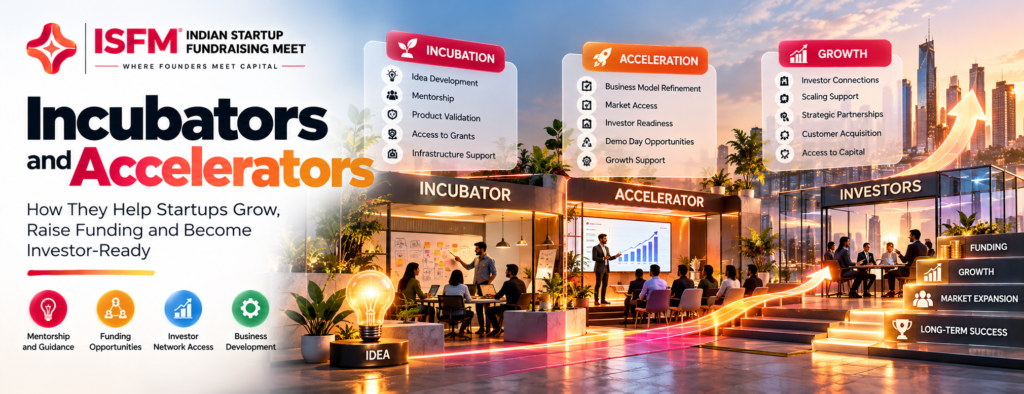
Every successful startup begins with an idea, but turning that idea into a sustainable business requires much more than innovation.
Founders need access to mentorship, industry expertise, product validation, business networks, financial resources and the right market opportunities.
This is where startup incubators and accelerators can play an important role.
Across India’s growing startup ecosystem, incubators and accelerators help entrepreneurs develop their ideas, strengthen business models, access funding opportunities and prepare for commercial growth.
However, many founders still have important questions:
What is the difference between an incubator and an accelerator?
Can incubators provide government grants or seed funding?
Do accelerators invest money in startups?
Does joining an incubation programme improve the chances of raising investment?
And most importantly, when should a startup approach an incubator or accelerator?
Understanding these questions can help founders make better decisions about their startup’s growth and fundraising journey.
What Are Startup Incubators?
A startup incubator is an organisation or structured support programme designed to help entrepreneurs develop early-stage business ideas into viable startups.
Incubators often support founders who are still working on product development, technical validation, market research or business model development.
Depending on the institution, an incubator may be associated with:
- Universities and educational institutions
- Technology Business Incubators (TBIs)
- Government-supported innovation initiatives
- Research and development institutions
- Corporate innovation programmes
- Private incubation organisations
- Industry associations
- Non-profit entrepreneurship organisations
The primary objective of incubation is to provide a supportive environment in which startups can develop their products, validate assumptions and build the foundations required for commercial operations.
What Support Do Startup Incubators Provide?
Incubators may offer a combination of financial and non-financial support.
Business Mentorship
Guidance on business strategy, revenue models, pricing, operations and commercial planning.
Product Development Support
Access to technical expertise, laboratories, prototyping facilities or product development resources.
Startup Funding Opportunities
Access to eligible grant programmes, seed funding initiatives or introductions to potential investors.
Legal and Compliance Guidance
Support in understanding company incorporation, intellectual property, agreements and regulatory requirements.
Market Validation
Assistance with customer discovery, pilot projects, market research and product testing.
Investor Readiness
Guidance on pitch decks, financial projections, fundraising strategies and investor presentations.
Networking Opportunities
Connections with entrepreneurs, mentors, industry professionals, investors and ecosystem partners.
Not every incubator provides all these services. The support available depends on the incubator’s mandate, facilities, funding arrangements and programme structure.
What Are Startup Accelerators?
A startup accelerator is generally a structured, time-bound programme designed to help startups achieve faster business development, market validation, customer acquisition or investment readiness.
Accelerators commonly work with startups that have already developed a product, launched an MVP or demonstrated some evidence of market demand.
Unlike incubation programmes that may provide longer-term developmental support, accelerator programmes frequently operate through defined cohorts.
A cohort may involve several startups participating in a structured programme over a specified period.
What Happens During a Startup Accelerator Programme?
An accelerator programme may include:
- Business model refinement
- Founder mentoring
- Product-market fit assessment
- Customer acquisition strategy
- Sales and revenue development
- Financial planning
- Unit economics analysis
- Pitch deck preparation
- Investor presentation training
- Networking sessions
- Demo days
- Investor introductions
Some accelerators also provide investment or access to funding opportunities.
Others focus primarily on mentoring, commercial partnerships or business development.
Joining an accelerator does not automatically guarantee funding or investment.
The financial and strategic benefits depend on the specific programme and its terms.
Incubators vs Accelerators: Understanding the Difference
Although incubators and accelerators both support entrepreneurship, their objectives and operating structures may differ.
| Factor | Startup Incubator | Startup Accelerator |
|---|---|---|
| Primary objective | Startup development and validation | Faster growth and business progress |
| Typical stage | Idea, prototype or early-stage | MVP, early traction or growth |
| Programme duration | Often flexible or longer-term | Often fixed-duration cohorts |
| Mentorship | Development-focused | Growth and execution-focused |
| Product support | Frequently available | Depends on programme |
| Funding opportunities | Grants, seed support or investor connections | Investment, investor access or growth support |
| Investor readiness | May develop gradually | Often a major programme focus |
| Demo day | Programme-dependent | Common in many accelerators |
| Equity requirement | Depends on the programme | Depends on the programme |
These are general distinctions rather than fixed rules.
Some incubators support revenue-generating businesses, while certain accelerators accept very early-stage startups.
The best choice depends on the startup’s current requirements and the programme’s actual offerings.
Why Do Startups Need Incubators and Accelerators?
Many startups fail to progress not because their ideas lack potential, but because they struggle to execute them effectively.
Common challenges include:
- Limited access to experienced mentors
- Insufficient product development resources
- Lack of market validation
- Weak financial planning
- Difficulty finding customers
- Limited investor connections
- Incomplete business documentation
- Lack of understanding of government funding opportunities
- Limited industry networks
Incubators and accelerators can help founders address some of these challenges through structured guidance and ecosystem support.
Turning Ideas Into Validated Businesses
An innovative idea is not automatically a viable business.
Before scaling, founders need to understand whether customers genuinely need their proposed solution.
Incubators can help startups conduct:
Problem Validation → Product Development → Customer Testing → Business Model Validation
This process can reduce uncertainty before significant capital is committed.
Improving Startup Execution
Founders may have strong technical capabilities but limited experience in sales, finance, operations or fundraising.
Mentors and programme experts can help identify weaknesses and suggest practical improvements.
Building Credibility
Participation in a recognised incubation or accelerator programme may demonstrate that a startup has engaged with a structured development process.
However, incubation alone does not establish commercial success or guarantee investor confidence.
Investors still conduct their own evaluation of the business.
Can Startup Incubators Provide Funding?
Yes. Some incubators administer, facilitate or provide access to startup funding.
However, not every incubator has a funding allocation, and incubation does not automatically make a startup eligible for financial assistance.
Depending on the programme, support may include:
- Prototype development grants
- Seed funding
- Innovation grants
- Proof-of-concept support
- Commercialisation assistance
- Equity investment
- Debt or convertible financing
- Investor introductions
Funding may come from government-supported programmes, institutional allocations, private investors or other authorised sources.
How Incubator-Linked Funding Usually Works
The process may involve:
Step 1: Startup Application
The founder submits company details, product information, business plans and supporting documents.
Step 2: Eligibility Screening
The incubator reviews whether the startup meets programme requirements.
Step 3: Business Evaluation
The startup may be evaluated on innovation, feasibility, market opportunity, team and business potential.
Step 4: Pitch or Interview
Shortlisted founders may present their startup before an evaluation committee.
Step 5: Funding Decision
The relevant committee or authorised funding body decides whether support should be approved.
Step 6: Documentation and Agreement
Selected startups may need to complete agreements, declarations and compliance formalities.
Step 7: Milestone-Based Disbursement
Funding may be released according to the programme’s approved structure and conditions.
Step 8: Monitoring and Reporting
The startup may be required to submit progress reports, utilisation documents and milestone evidence.
Actual procedures vary by programme.
Government-Supported Incubation Programmes in India
India has developed multiple initiatives to strengthen entrepreneurship, innovation and technology commercialisation.
Different government departments and institutions support incubators and startups through specific programmes.
Startup India Seed Fund Scheme (SISFS)
The Startup India Seed Fund Scheme was designed to support eligible startups through selected incubators.
Its framework provides for financial assistance of up to:
₹20 lakh for proof of concept, prototype development or product trials, subject to applicable scheme conditions.
It also provides for up to:
₹50 lakh for market entry, commercialisation or scaling through permitted debt, convertible or debt-linked instruments, subject to the scheme framework.
These amounts represent programme ceilings, not guaranteed funding.
Startups must satisfy eligibility conditions and undergo selection.
Important: Founders should verify whether an authorised incubator is currently accepting applications and has an available allocation. The existence of a scheme does not mean that applications are presently open.
DST NIDHI Programmes
The Department of Science and Technology’s National Initiative for Developing and Harnessing Innovations (NIDHI) supports innovation and entrepreneurship through multiple programme components.
Depending on the programme and participating institution, support may focus on:
- Early-stage innovation
- Prototype development
- Technology incubation
- Startup development
- Commercialisation
- Seed support
Examples include NIDHI-PRAYAS and NIDHI Seed Support-related initiatives.
Each component has its own eligibility requirements, funding structure and application process.
Founders should review the current call issued by the relevant implementing institution rather than assuming every NIDHI-supported incubator offers the same funding.
MeitY Startup and Innovation Programmes
The Ministry of Electronics and Information Technology supports technology entrepreneurship through various initiatives and implementing institutions.
Certain programmes focus on areas such as:
- Digital technologies
- Electronics
- Software products
- Emerging technologies
- Technology commercialisation
- Innovation-led entrepreneurship
Programmes such as GENESIS may provide opportunities for eligible startups through designated implementing organisations.
Support structures and funding terms differ between programme components.
MSME Incubation and Innovation Support
MSME-focused innovation initiatives may support eligible entrepreneurs and institutions working on product development, innovation and commercialisation.
The nature of support depends on the applicable programme guidelines.
Startups should distinguish between support available directly to enterprises and funding allocated to approved host institutions or incubators.
Do Startups Need DPIIT Recognition for Incubation?
Not every incubation programme requires DPIIT Startup Recognition.
However, some government funding programmes and startup-focused initiatives may specifically require it.
DPIIT recognition is administered under the Startup India framework and has defined eligibility conditions.
Recognition may be relevant when applying for certain:
- Startup funding programmes
- Incubator-linked seed support initiatives
- Government startup benefits
- Innovation support programmes
Founders should check the specific eligibility requirements of each programme.
DPIIT recognition does not itself guarantee incubation, grant approval or investment.
How to Choose the Right Incubator for Your Startup
Choosing an incubator should be based on more than its reputation or the amount of funding advertised.
Founders should evaluate whether the institution can genuinely support their business.
1. Sector Alignment
Does the incubator support your industry?
For example, a DeepTech startup may benefit from an institution with specialised laboratories and technical expertise.
A consumer-focused startup may prioritise market access and commercial mentoring.
2. Startup Stage
Does the incubator accept idea-stage companies, prototypes, MVPs or revenue-generating startups?
Applying to programmes that do not support your current stage can waste time and resources.
3. Funding Availability
Does the incubator currently administer a relevant funding programme?
If so, founders should understand:
- Eligibility
- Funding limits
- Available allocation
- Application deadlines
- Selection process
- Disbursement conditions
4. Mentorship Quality
Evaluate whether mentors have relevant experience in the startup’s sector or business challenges.
5. Infrastructure
Some startups require:
- Laboratories
- Testing equipment
- Prototyping facilities
- Manufacturing support
- Office space
- Research infrastructure
Others may need only business mentoring and market access.
6. Investor Network
Does the incubator have relevant relationships with angel investors, venture capital firms, strategic investors or other financing institutions?
7. Programme Terms
Understand whether the incubator charges:
- Membership fees
- Programme fees
- Equity participation
- Facility charges
- Other service fees
Also review intellectual property, confidentiality and exit provisions.
8. Previous Startup Outcomes
Look for evidence of programme effectiveness, such as startups supported, products commercialised, partnerships established or investment outcomes.
Past performance does not guarantee future results, but it can provide useful context.
How to Choose the Right Accelerator
Accelerators should be evaluated according to the startup’s immediate growth objectives.
For example, if a startup has developed a working product but struggles to acquire paying customers, an accelerator with strong sales and market-entry expertise may be more valuable than one focused primarily on technical prototyping.
Founders should examine:
- Programme duration
- Mentor experience
- Industry specialisation
- Investment terms
- Cohort structure
- Commercial partnerships
- Demo day opportunities
- Investor network
- Expected deliverables
- Participation requirements
The best accelerator is not necessarily the one offering the largest investment. It is the one whose support aligns with the startup’s next meaningful milestone.
Do Incubators and Accelerators Take Equity?
Some do, while others do not.
Equity requirements depend on the institution, programme and funding arrangement.
Equity-Free Incubation
Certain programmes provide mentoring, facilities or eligible grant support without taking equity.
Equity-Based Acceleration
Some accelerators invest capital in exchange for an ownership stake.
Hybrid Arrangements
Certain programmes may combine services, investment, fees or other contractual arrangements.
Founders should review:
Equity Percentage
Investment Amount
Valuation
Shareholder Rights
Programme Fees
Intellectual Property Rights
Exit Conditions
Future Funding Restrictions
Never assume that an incubation or acceleration programme is free simply because it is associated with a university or supported by a public institution.
The applicable agreement determines the actual obligations.
Can a Startup Join More Than One Incubator?
Potentially, yes.
Some startups participate in different incubation, mentoring or accelerator programmes over time.
However, multiple participation may be restricted by:
- Existing incubation agreements
- Exclusivity clauses
- Funding programme conditions
- Double-funding restrictions
- Intellectual property arrangements
- Residency or participation obligations
For example, two government-supported programmes may not permit the same expenditure to be financed twice.
Founders should disclose existing support where required and review the conditions of each programme before joining.
Incubation Does Not Mean Guaranteed Funding
One of the most common misunderstandings in the startup ecosystem is:
“If my startup gets incubated, I will automatically receive funding.”
This is not necessarily true.
Incubation and funding approval are separate decisions.
A startup may receive mentoring, facilities or ecosystem access without receiving financial assistance.
Even when an incubator administers a funding programme, the startup may still need to clear:
- Eligibility screening
- Technical evaluation
- Business evaluation
- Financial assessment
- Committee presentation
- Due diligence
- Documentation requirements
Funding decisions remain subject to the applicable programme or investor’s discretion.
What Do Incubators Look for Before Selecting a Startup?
Evaluation criteria differ, but many incubators consider a combination of the following factors.
Problem Identification
Does the startup address a genuine and clearly defined problem?
Innovation and Differentiation
How is the proposed solution different from existing alternatives?
Product Readiness
Is the startup at the idea, prototype, MVP or commercial stage?
Market Opportunity
Is there sufficient demand for the proposed product or service?
Founding Team
Does the team have the skills and commitment needed to execute the business plan?
Business Model
How does the startup intend to generate revenue and sustain operations?
Technical Feasibility
Can the proposed solution be developed and implemented realistically?
Financial Requirements
How much capital is needed, and how will it be used?
Commercial Potential
Can the product or service attract customers and achieve meaningful business outcomes?
Programme Fit
Does the startup align with the incubator’s mandate, sector focus and eligibility requirements?
A well-prepared application should explain these areas clearly and consistently.
Documents Required for Incubation Applications
Document requirements vary by programme, but founders may be asked to submit:
- Company incorporation documents
- DPIIT recognition certificate, where applicable
- Founder details
- Startup pitch deck
- Business plan
- Product or service description
- Prototype or MVP information
- Market research
- Financial projections
- Funding requirement
- Fund utilisation plan
- Revenue or traction details
- Intellectual property information, where applicable
- Previous funding declarations
- Other programme-specific documents
Some incubators also require a founder interview, technical presentation or product demonstration.
Preparing documentation in advance can improve application readiness.
How to Prepare a Strong Incubation Pitch Deck
An incubation pitch deck should communicate the business clearly.
A practical structure may include:
Slide 1: Startup Introduction
Company name, product, founder and business overview.
Slide 2: Problem Statement
What problem exists, and who experiences it?
Slide 3: Proposed Solution
How does the product solve the identified problem?
Slide 4: Product or Technology
Explain the prototype, MVP or technical innovation.
Slide 5: Market Opportunity
Describe the target market and commercial potential.
Slide 6: Business Model
Explain how the company intends to generate revenue.
Slide 7: Competition and Differentiation
Show how the proposed solution compares with existing alternatives.
Slide 8: Traction and Validation
Present customers, pilots, partnerships, revenue or technical progress.
Slide 9: Team
Explain the experience and responsibilities of key team members.
Slide 10: Funding Requirement
State the capital requirement and intended use of funds.
Slide 11: Milestones
Explain what the startup expects to achieve through incubation and funding.
Slide 12: Support Required
Specify whether the startup needs technical infrastructure, mentoring, grants, market access or investor connections.
A strong pitch deck should prioritise clarity, evidence and realistic projections over exaggerated claims.
How Incubators Help Startups Become Investor-Ready
Investor readiness requires more than a professional presentation.
Investors may evaluate:
- Product-market fit
- Business model
- Revenue
- Market opportunity
- Team capability
- Customer traction
- Financial projections
- Unit economics
- Legal compliance
- Intellectual property
- Valuation
- Capital requirements
- Use of funds
Incubators can help founders identify weaknesses in these areas and improve their preparedness.
For example, a startup may have a technically strong product but lack evidence of customer willingness to pay.
An incubation programme may help the team design pilots, gather feedback and refine its commercial strategy.
That progress may strengthen the startup’s future investment discussions.
However, investor readiness does not guarantee investor selection or funding.
How Accelerators Help Startups Prepare for Fundraising
Many accelerator programmes place significant emphasis on fundraising preparation.
Support may include:
Pitch Refinement
Improving how the startup communicates its opportunity.
Financial Planning
Strengthening revenue projections, cost assumptions and capital requirements.
Unit Economics
Understanding customer acquisition costs, margins, retention and other relevant metrics.
Investor Targeting
Identifying investors whose mandates align with the startup’s sector and stage.
Due Diligence Preparation
Organising corporate, financial, commercial and legal information.
Pitch Practice
Helping founders respond to challenging investor questions.
Demo Days
Providing opportunities for startups to present before selected audiences.
These activities can make fundraising more structured, but actual investment decisions remain with investors.
What Is a Startup Demo Day?
A demo day is an event where startups present their businesses to an audience that may include investors, mentors, corporate representatives and ecosystem participants.
Demo days are commonly associated with accelerator programmes, although incubators and other startup organisations may also conduct them.
What Happens During a Demo Day?
Founders may be given a limited amount of time to explain:
- The problem
- The solution
- The market
- Business traction
- Revenue model
- Growth opportunity
- Funding requirement
- Expected milestones
Depending on the event, presentations may be followed by questions, networking or individual meetings.
A demo day creates an opportunity for exposure and engagement. It does not guarantee investment or a follow-up meeting.
When Should a Startup Join an Incubator?
Incubation may be useful when a startup needs structured support to develop or validate its business.
Potential indicators include:
- The product is still being developed.
- Technical validation is incomplete.
- Customer demand has not been sufficiently tested.
- The founding team needs experienced mentors.
- Access to specialised facilities is required.
- The startup is exploring eligible innovation grants.
- Business planning and financial projections need improvement.
The decision should be based on the support required rather than the startup’s age alone.
When Should a Startup Join an Accelerator?
An accelerator may be particularly relevant when a startup has made initial progress and wants to execute its next growth milestone more effectively.
Potential indicators include:
- An MVP has been launched.
- Initial customers are using the product.
- The business model needs refinement.
- Customer acquisition needs improvement.
- The startup is preparing for a funding round.
- Commercial partnerships could accelerate growth.
- The company needs structured execution support.
Some accelerators also support earlier-stage startups, so founders should review the specific programme criteria.
Should Startups Join an Accelerator Before Raising Funding?
For some startups, acceleration can be useful before fundraising.
It may help improve:
Business Validation
Customer Traction
Financial Readiness
Pitch Quality
Investor Targeting
Commercial Strategy
However, not every startup needs to complete an accelerator before approaching investors.
A company with strong traction, experienced founders and a clear fundraising strategy may already be prepared for investor engagement.
The right decision depends on whether acceleration can create meaningful additional value.
Incubators, Accelerators and Direct Investor Fundraising
These are related but different parts of the startup ecosystem.
Incubators
Often focus on startup development, validation and foundational support.
Accelerators
Often focus on structured growth, execution and investment readiness.
Direct Investor Fundraising
Involves approaching relevant investors to seek capital under agreed investment terms.
A startup may use these approaches sequentially or in combination.
For example:
Idea → Incubation → Prototype → MVP → Acceleration → Commercial Traction → Investor Fundraising
This is one possible journey, not a mandatory path.
Some startups raise investment before incubation, while others grow without joining either type of programme.
How Much Funding Can Startups Receive Through Incubators and Accelerators?
There is no universal funding amount.
Support depends on:
- Programme structure
- Startup stage
- Sector
- Eligibility
- Funding availability
- Evaluation outcome
- Approved expenditure
- Investment terms
Some programmes provide only mentoring or infrastructure.
Others offer grants, equity investment or access to investors.
Founders should distinguish between:
Maximum Advertised Funding
Actual Funding Available
Amount Approved for the Startup
Amount Ultimately Disbursed
These figures may differ substantially.
A programme advertising funding up to a particular ceiling does not mean every selected startup receives that amount.
Common Mistakes Founders Make When Applying to Incubators
Applying Without Checking Eligibility
Founders sometimes submit applications without reviewing sector, incorporation, location or stage requirements.
Choosing an Incubator Only for Funding
An incubator should also be evaluated for mentorship, infrastructure and business support.
Submitting Generic Pitch Decks
Applications should address the objectives and evaluation criteria of the specific programme.
Presenting Unrealistic Financial Projections
Unsupported revenue and growth assumptions can weaken credibility.
Failing to Explain Innovation
The startup should clearly communicate its differentiation and value proposition.
Ignoring Programme Terms
Equity, fees, exclusivity and intellectual property provisions require attention.
Assuming Incubation Guarantees Investment
Incubation acceptance and investor funding are separate outcomes.
Not Following Up on Milestones
Programme participation often requires active founder involvement, reporting and execution.
A Step-by-Step Framework for Choosing the Right Incubator or Accelerator
Step 1: Identify Your Startup Stage
Determine whether the company is at the idea, prototype, MVP, early revenue or growth stage.
Step 2: Define Your Primary Requirement
Is the priority product development, technical support, market validation, funding or investor readiness?
Step 3: Identify Relevant Programmes
Shortlist incubators and accelerators aligned with your industry and stage.
Step 4: Review Eligibility
Check incorporation requirements, sector focus, location, programme dates and other conditions.
Step 5: Evaluate Available Support
Understand what mentoring, infrastructure, funding or networking opportunities are actually available.
Step 6: Review Commercial Terms
Check fees, equity requirements, intellectual property provisions and participation obligations.
Step 7: Prepare Documentation
Organise the pitch deck, business plan, financial projections and other required information.
Step 8: Submit the Application
Follow the programme’s official application procedure.
Step 9: Prepare for Evaluation
Be ready to explain the problem, solution, innovation, market, team and funding requirement.
Step 10: Plan Post-Selection Milestones
Define what the startup intends to achieve during the programme.
The overall framework is:
Startup Stage → Business Requirement → Programme Selection → Application → Evaluation → Incubation or Acceleration → Milestones → Growth and Fundraising Readiness
How Incubation and Acceleration Connect With Startup Fundraising
A startup’s funding requirement should be connected to its current stage and next meaningful milestone.
For example:
An idea-stage startup may need resources to validate a technical concept.
A prototype-stage startup may need funding for testing and product development.
An MVP-stage startup may need capital for customer acquisition and commercial validation.
A growth-stage startup may need investment for expansion.
Incubators and accelerators can help founders understand these requirements and prepare more structured funding plans.
Instead of asking only:
“Where can we get funding?”
Founders should ask:
“What progress must we demonstrate before approaching the most suitable funding source?”
That question creates a stronger connection between startup development and capital planning.
The Role of Indian Startup Fundraising Meet (ISFM)
Indian Startup Fundraising Meet (ISFM) is a private startup fundraising facilitation initiative focused on creating structured opportunities for startup evaluation, investor engagement and ecosystem collaboration.
ISFM aims to connect relevant startups with participants from the broader fundraising ecosystem, including:
- Angel investors
- Venture capital participants
- Family offices
- Private investors
- Incubators
- Accelerators
- Mentors
- Startup ecosystem partners
Through its evaluation-led approach, ISFM encourages founders to strengthen their business presentations, understand their funding requirements and prepare for relevant fundraising conversations.
The initiative follows a structured process involving startup nomination, detailed evaluation and potential progression to physical pitching opportunities for selected startups.
ISFM is not a government funding scheme, lender or investment fund. Participation, evaluation or shortlisting does not guarantee funding, investor meetings, valuation or investment approval.
Investment decisions remain at the discretion of the relevant investors.
Official Website: https://www.indianstartupfundraisingmeet.com
Final Thoughts
Incubators and accelerators can play a valuable role in helping startups move from ideas to validated businesses and from early traction to structured growth.
However, they serve different purposes.
Incubators often focus on building the foundation of a startup through product development, mentoring, validation and access to relevant support programmes.
Accelerators often focus on helping startups execute faster, improve business performance and prepare for growth or investment opportunities.
Neither is automatically better than the other.
The right choice depends on the startup’s:
Current Stage
Business Model
Technology Requirements
Market Validation
Funding Needs
Commercial Objectives
Investor Readiness
Next Business Milestone
Before applying to an incubator or accelerator, founders should identify the specific support their business needs.
The goal should not simply be to become associated with an incubation centre or complete an accelerator programme.
The goal should be to create measurable progress.
The right ecosystem support can help founders build stronger businesses, make better capital decisions and approach fundraising with greater preparation.
ISFM — Where Founders Meet Capital.
Frequently Asked Questions
What is a startup incubator?
A startup incubator is an organisation or structured programme that supports entrepreneurs through mentoring, product development, infrastructure, business guidance and other resources.
What is a startup accelerator?
A startup accelerator is generally a structured, time-bound programme designed to help startups achieve faster business development, commercial growth or investment readiness.
What is the main difference between an incubator and an accelerator?
Incubators often focus on early-stage development and validation, while accelerators commonly focus on structured growth and execution. However, individual programmes may overlap.
Can an idea-stage startup join an incubator?
Yes. Many incubators support idea-stage startups, although eligibility depends on the specific programme.
Can a startup join an accelerator without revenue?
Yes. Some accelerators accept pre-revenue startups with an MVP, technical progress or other evidence of potential. Other programmes require commercial traction.
Do startup incubators provide government funding?
Some incubators administer or facilitate government-supported funding programmes. However, funding availability depends on programme rules, allocation, eligibility and selection.
Does incubation guarantee seed funding?
No. Incubation acceptance does not automatically guarantee seed funding, grants or investor investment.
Do accelerators invest in startups?
Some accelerators provide investment, while others focus on mentoring, market access or business development. Investment terms vary.
Do incubators take equity in startups?
Some incubators take equity or charge fees, while others provide support without equity dilution. Founders should review the programme agreement.
Is DPIIT recognition mandatory for incubation?
Not for every programme. However, some government-supported startup funding initiatives require DPIIT recognition.
Can a startup join multiple incubators?
Potentially, yes, subject to programme conditions, exclusivity provisions, funding restrictions and other contractual obligations.
How long does a startup incubation programme last?
Duration varies. Some programmes offer flexible or extended support, while others operate for a defined period.
How long does an accelerator programme last?
Accelerator programmes commonly operate through fixed-duration cohorts, but the length varies by institution.
What documents are required for incubation?
Requirements may include incorporation documents, founder information, pitch deck, business plan, product details, financial projections and programme-specific declarations.
Can incubators help startups connect with investors?
Some incubators provide investor networking, pitch preparation or introductions. However, investor engagement and investment are not guaranteed.
What is a demo day?
A demo day is an event where startups present their businesses to an audience that may include investors, mentors and ecosystem participants.
Can startups receive grants without joining an incubator?
Some grant programmes accept direct applications, while others require applications through approved incubators or implementing institutions. The programme rules determine the process.
Are incubation programmes free?
Not always. Some are free or subsidised, while others charge fees, take equity or impose other commercial conditions.
Should a startup join an incubator before raising funding?
It depends on the startup’s readiness. Incubation can help address development or validation gaps, but it is not universally required before fundraising.
How should founders choose between incubation and acceleration?
Founders should compare their current stage, business challenges, programme offerings, funding requirements and next milestones.
What is the biggest benefit of incubators and accelerators?
Their value lies in helping founders access relevant expertise, resources, structured support and ecosystem opportunities that can contribute to measurable business progress.