A Simple Fundraising Readiness Checklist
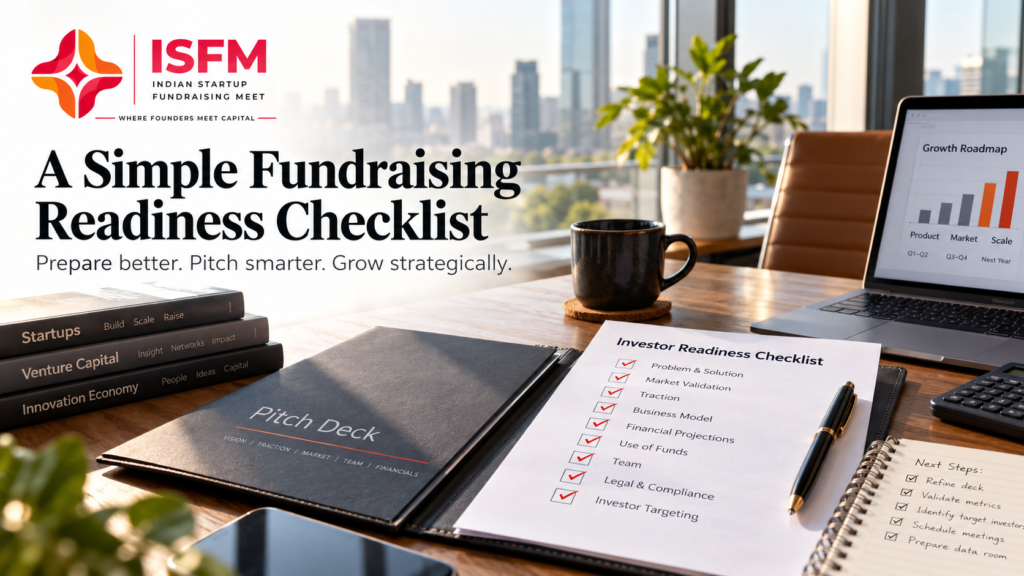
Raising capital is not only about having a good idea. It is about proving that your startup is prepared for investor evaluation, financial scrutiny and growth execution. Many founders start speaking to investors too early, before their story, numbers, documents and strategy are properly aligned.
A startup may have a strong concept, a capable team and a relevant market opportunity. But if the founder cannot clearly explain the problem, the solution, the business model, the traction, the use of funds and the expected milestones, investors may hesitate.
That is why fundraising readiness matters.
Fundraising readiness means your startup is organised, credible and prepared to present itself to investors, incubators, accelerators or funding institutions in a structured and professional way.
It does not mean your startup must be perfect.
It means you should be clear about where the business stands today, what support you need next and how external capital will help create measurable progress.
In this guide, ISFM – Indian Startup Fundraising Meet presents a simple fundraising readiness checklist to help founders understand whether they are actually prepared to raise capital.
Why Fundraising Readiness Matters
Many startups begin fundraising with enthusiasm but without preparation.
They may send a pitch deck to investors before finalising their revenue model.
They may ask for funding without calculating how much capital is actually needed.
They may talk about growth without defining traction.
They may mention customer demand without having proper evidence.
This creates confusion.
Investors are not only evaluating the business idea. They are also evaluating the founder’s clarity, discipline, honesty and execution readiness.
A startup that is well prepared can communicate with more confidence and respond to investor questions more effectively.
A startup that is not prepared may lose opportunities even if the idea itself has potential.
Fundraising readiness improves the quality of investor conversations, strengthens credibility and helps founders approach the funding process in a more strategic way.
What Does Fundraising Readiness Mean?
Fundraising readiness means the startup has prepared the key business, financial and documentation elements required to approach funding opportunities seriously.
This usually includes:
- A clearly defined problem and solution.
- A realistic business model.
- A pitch deck.
- Basic traction or validation.
- Financial projections.
- A use-of-funds plan.
- Founder and team clarity.
- Investor-relevant documentation.
- A target investor strategy.
- A basic due diligence structure.
Not every startup will have the same level of maturity.
A pre-revenue startup and a revenue-generating startup will present different evidence.
But both should still be able to explain their current stage honestly and clearly.
The Simple Fundraising Readiness Checklist
Below is a practical checklist that founders can use before approaching investors.
1. Is the Problem Clearly Defined?
Investors want to know what real problem your startup is solving.
A vague idea is not enough.
You should be able to explain:
- What problem exists.
- Who faces this problem.
- Why it matters.
- Why existing solutions are not good enough.
- Why now is the right time to solve it.
A strong startup does not just describe a product.
It explains the market pain behind the product.
Quick Check
Ask yourself:
Can I explain my startup’s problem in 2–3 simple sentences?
If the answer is unclear, your fundraising story is not ready.
2. Is the Solution Easy to Understand?
Your solution should be explained simply and directly.
Investors do not want confusion. They want clarity.
You should be able to explain:
- What your product or service is.
- How it solves the problem.
- What makes it different.
- Why customers will choose it.
- Whether it is already built, in development or being tested.
Avoid making the solution sound more advanced than it really is.
If you are still at the concept stage, say so honestly.
If you have an MVP, say that.
If you have paying customers, show it with evidence.
3. Do You Understand Your Target Market?
A startup cannot raise funds only on the basis of “everyone needs this.”
You should clearly define your target market.
This includes:
- Primary customer segment.
- Customer profile.
- Industry or category.
- Geography.
- Buying behaviour.
- Approximate market size.
- Why the market is attractive.
You do not need unrealistic billion-dollar market claims.
What matters more is whether you understand who your real customer is.
Example Questions Investors May Ask
- Who is your ideal customer?
- Who pays for this product?
- Is this B2B, B2C or B2G?
- What kind of market opportunity are you addressing?
- Why is this segment worth building for?
4. Have You Validated the Idea in Some Form?
Validation is very important.
Investors want to see evidence that the startup is not based only on assumptions.
Validation can take different forms depending on the stage.
Early-stage validation may include:
- Customer interviews.
- Survey responses.
- Prototype feedback.
- Pilot interest.
- Waitlist signups.
- Testing results.
More advanced validation may include:
- Paying customers.
- Repeat orders.
- User retention.
- Partnerships.
- Revenue.
- Product usage data.
Not every startup will have strong revenue before fundraising.
But every startup should have some form of real-world evidence supporting the opportunity.
5. Do You Have Basic Traction or Progress to Show?
Traction helps investors understand that the startup is moving forward.
Traction does not always mean large revenue.
It can also mean:
- Product development milestones.
- Pilot users.
- Active customers.
- Monthly growth.
- Technology readiness.
- Distribution progress.
- Market response.
The important thing is that your traction should be accurate, clearly defined and verifiable.
Do not overstate it.
Examples of useful traction indicators
- Number of paying customers.
- Monthly recurring revenue.
- App usage.
- Product retention.
- Conversion rate.
- Pilot results.
- Revenue growth.
- Technical completion milestones.
6. Is the Business Model Clear?
A founder must explain how the company will make money.
If investors cannot understand your revenue logic, they will not be confident in the business.
You should be able to explain:
- What exactly you are selling.
- Who pays.
- How you charge.
- Whether revenue is one-time or recurring.
- Your pricing model.
- Your gross margin logic.
- Your unit economics, where available.
Common business model types
- Subscription.
- Commission-based.
- SaaS licensing.
- Product sales.
- Service-based.
- Marketplace model.
- Freemium to paid conversion.
- Enterprise contracts.
The model does not have to be perfect, but it should make sense.
7. Do You Know How Much Funding You Need?
One of the most common founder mistakes is asking for a random amount.
A startup should not raise “₹1 crore because it sounds right.”
The funding ask should be linked to business requirements.
You should know:
- How much money is needed.
- Why that amount is needed.
- What period it should cover.
- What the money will be used for.
- What milestones it will help achieve.
A better funding explanation sounds like this:
“We are seeking ₹75 lakh to complete product development, run pilot deployments, strengthen our core team and support operations for the next 12 months.”
That is much better than:
“We want funding for growth.”
8. Do You Have a Clear Use-of-Funds Plan?
Investors want to know where the money will go.
A use-of-funds plan should show how the raised capital will be allocated.
Typical categories may include:
- Product development.
- Technology.
- Team hiring.
- Sales and marketing.
- Operations.
- Working capital.
- Compliance or certifications.
- Pilot execution.
- Contingency.
Example
| Use of Funds | Allocation |
|---|---|
| Product development | 30% |
| Team and hiring | 20% |
| Sales and business development | 20% |
| Operations and infrastructure | 15% |
| Working capital and contingency | 15% |
The categories may differ by startup, but the logic should be clear.
9. Have You Defined the Milestone This Funding Will Achieve?
Funding should lead to progress.
You should define the next milestone clearly.
Examples include:
- Build and launch MVP.
- Complete prototype testing.
- Achieve first 100 paying customers.
- Reach ₹5 lakh monthly recurring revenue.
- Enter two new markets.
- Complete regulatory approval.
- Convert pilots into commercial contracts.
If the founder cannot explain what specific milestone the capital will help achieve, the fundraising request becomes weak.
Money should not be raised for vague ambition. It should be raised for measurable business progress.
10. Are Your Financial Projections Ready?
A startup does not need perfect forecasting, but it should prepare reasonable financial projections.
Investors often want to see projections for 3 years or sometimes 5 years.
Your projections should include:
- Revenue assumptions.
- Cost structure.
- Team costs.
- Operating expenses.
- Gross margin.
- Monthly or annual burn.
- Cash runway.
- Funding requirement.
- Expected milestones.
These numbers should be based on assumptions, not imagination.
If your financial model says you will jump from zero revenue to ₹50 crore in a year, you must be able to justify it clearly.
11. Is Your Pitch Deck Ready?
Your pitch deck is one of the most important fundraising documents.
A basic investor-ready pitch deck should usually include:
- Problem.
- Solution.
- Product.
- Market opportunity.
- Business model.
- Traction.
- Competition.
- Go-to-market strategy.
- Team.
- Financial highlights.
- Funding ask.
- Use of funds.
The deck should be clear, professional and consistent with your actual stage.
Avoid over-designing it while under-preparing the content.
12. Is Your Founder Story Clear?
Investors invest in businesses, but they also invest in founders.
You should be able to explain:
- Why you started this startup.
- Why you care about this problem.
- Why your team is suited to solve it.
- What relevant background or expertise you bring.
- Why your team can execute better than others.
This does not mean inventing a dramatic story.
It means showing genuine founder-market fit where relevant.
13. Is the Team Properly Presented?
A startup does not need a large team to raise funding.
But the team should be clearly presented.
Include:
- Founder roles.
- Co-founder roles.
- Relevant domain experience.
- Technical capabilities.
- Sales or industry expertise.
- Advisors, if genuinely relevant.
If you do not yet have full leadership coverage, be honest.
You can also explain which key roles you intend to hire after funding.
14. Are Legal and Compliance Basics in Order?
Before serious fundraising, your startup should review its legal basics.
This may include:
- Entity incorporation status.
- Founders’ shareholding clarity.
- Cap table.
- Basic agreements, if applicable.
- Intellectual property ownership.
- Statutory registrations.
- Tax compliance.
- Industry-specific compliance.
Not every startup will be fully advanced in all these areas.
But if there are major gaps, founders should identify them early.
15. Is a Basic Data Room or Document Folder Ready?
Once investors become interested, they may ask for documents.
A founder should not start collecting everything only after investor interest appears.
Prepare a basic data room or organised folder including, where available:
- Pitch deck.
- Company profile.
- Financial projections.
- Cap table.
- Incorporation documents.
- Founders’ information.
- Product overview.
- Customer or traction evidence.
- Key contracts or pilot documents.
- Compliance documents.
Being organised creates a strong impression.
16. Do You Know Which Type of Capital Is Right for You?
Not every startup needs the same kind of funding.
Different routes include:
- Bootstrapping.
- Grants.
- Angel funding.
- Equity funding.
- Venture capital.
- Debt funding.
- Venture debt.
- Incubation support.
- Accelerator programmes.
Founders should think carefully about which route suits the business stage and requirement.
A startup that needs product validation may be suited for grants, incubators or early-stage angel support.
A revenue-generating startup with repayment ability may explore debt.
A fast-scaling startup may consider equity.
The capital type should match the business need.
17. Have You Identified the Right Investors or Funding Sources?
A startup should not approach every investor randomly.
You should identify relevant targets based on:
- Sector fit.
- Stage fit.
- Geography.
- Funding size.
- Investor thesis.
- Portfolio relevance.
Investor targeting is part of readiness.
Sending a pitch deck to 300 random investors does not mean the startup is prepared.
A smaller, qualified list is often much more effective.
18. Are You Personally Ready to Answer Tough Questions?
Investors will ask difficult questions.
They may ask about:
- Weak traction.
- Competition.
- Revenue assumptions.
- Team gaps.
- Customer concentration.
- Burn rate.
- Market size.
- Risk.
- Exit potential.
- Why now?
A founder should be ready to answer honestly and clearly.
Fundraising readiness is not only about documents.
It is also about founder confidence and clarity.
A Quick Fundraising Readiness Scorecard
You can use the following self-check.
| Checklist Area | Status |
|---|---|
| Problem clarity | Yes / No |
| Solution clarity | Yes / No |
| Target market defined | Yes / No |
| Validation evidence | Yes / No |
| Traction available | Yes / No |
| Business model clear | Yes / No |
| Funding amount defined | Yes / No |
| Use of funds ready | Yes / No |
| Milestone defined | Yes / No |
| Financial projections ready | Yes / No |
| Pitch deck ready | Yes / No |
| Founder story clear | Yes / No |
| Team explained | Yes / No |
| Legal basics reviewed | Yes / No |
| Data room prepared | Yes / No |
| Capital type selected | Yes / No |
| Relevant investors identified | Yes / No |
| Founder Q&A readiness | Yes / No |
If many of these answers are still “No,” the startup may need more preparation before starting active fundraising.
Common Signs That a Startup Is Not Yet Fundraising-Ready
Some warning signs include:
- The founder cannot clearly explain the funding amount.
- Financial projections are missing.
- Use of funds is vague.
- There is no proper pitch deck.
- Customer traction is unclear or exaggerated.
- Team roles are undefined.
- Legal structure is incomplete.
- No target investor list exists.
- The founder is unsure what milestone the round will achieve.
- The startup is trying to raise before basic validation.
These are not reasons to give up.
They are signals that preparation should come before fundraising outreach.
How to Improve Fundraising Readiness
If you are not fully ready, improve the basics first.
Focus areas may include:
- Refine problem and solution clarity.
- Validate customer demand.
- Strengthen traction measurement.
- Build a cleaner pitch deck.
- Prepare realistic projections.
- Clarify the funding requirement.
- Organise company documents.
- Improve founder Q&A readiness.
- Build a relevant investor list.
- Prepare a due diligence folder.
Every improvement increases credibility.
How ISFM Helps Startups Become More Fundraising-Ready
ISFM – Indian Startup Fundraising Meet is a private startup fundraising facilitation initiative focused on helping startups present themselves in a more structured and evaluation-ready manner.
Before investor engagement, startups often need clarity around:
- Business stage.
- Funding requirement.
- Documentation.
- Investor readiness.
- Pitch positioning.
- Financial projections.
- Use of funds.
- Milestone planning.
- Suitable capital pathways.
ISFM’s evaluation-oriented approach supports founders in understanding whether they are genuinely ready for funding discussions and what gaps may need to be addressed first.
ISFM is a private facilitation initiative and does not guarantee investor meetings, investment approval, grants, loans or fund disbursement.
Frequently Asked Questions
1. Does fundraising readiness mean the startup must already have revenue?
No. Some startups raise capital before revenue, especially in innovation-heavy sectors. But they should still show validation, progress and clarity.
2. Do I need a pitch deck before approaching investors?
Yes, in most cases a pitch deck is one of the basic fundraising documents you should prepare.
3. What if I do not know how much money to raise?
Then you should calculate the amount based on your costs, milestones and runway instead of guessing.
4. Can a startup raise funds without a data room?
At a very early discussion stage, maybe. But for serious investor conversations, an organised document folder is very helpful.
5. Is investor targeting part of fundraising readiness?
Yes. Knowing whom to approach is an important part of a successful fundraising process.
6. What is the most important part of fundraising readiness?
Clarity. A founder must clearly explain the business, the opportunity, the numbers and the use of funds.
Conclusion
Fundraising readiness is not about perfection.
It is about preparation, credibility and clarity.
A startup does not need to have every answer, every metric or every document perfectly polished before speaking to investors.
But it should be organised enough to explain what the business is, what has been achieved, what support is needed next and how that support will create real business progress.
The better prepared you are, the stronger your investor conversations will be.
Before raising capital, ask yourself one simple question:
If an investor asked me today why this startup deserves funding, could I answer with clarity, evidence and confidence?
If yes, you are moving closer to fundraising readiness.
If not, your next step is not investor outreach. Your next step is preparation.
ISFM – Indian Startup Fundraising Meet
Where Founders Meet Capital
Official Website: https://www.indianstartupfundraisingmeet.com
Startup Nomination: https://zfrmz.in/A1pyKmrRj1s9OIsgPR4I
Investor & Partner Collaboration: https://zfrmz.in/p5cGk97nqrKp2ZXaJqjl
WhatsApp Community: https://chat.whatsapp.com/BNFh80tJsCtJEvgCQsW2i4
Official WhatsApp Channel: https://whatsapp.com/channel/0029VbDbOmr2ZjCkYLBeIw1T
Contact: +91 7014264283
Disclaimer: This article is for general educational purposes only and does not constitute legal, financial, accounting or investment advice. Funding decisions depend on the startup’s actual business quality, documentation, investor fit and applicable approvals.