Raising Without a Clear Strategy: Why Startups Fail to Turn Funding Into Business Growth
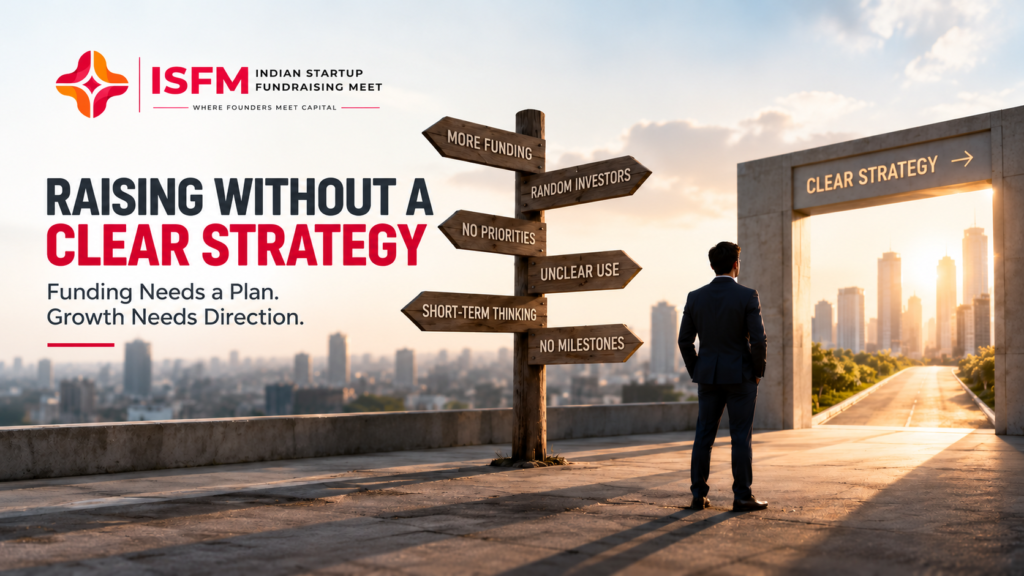
Raising startup funding without a clear strategy is one of the most expensive mistakes founders can make. Capital can support innovation, accelerate business development and create opportunities for expansion, but without a defined purpose, realistic financial planning and measurable milestones, even a successful funding round can leave a startup struggling to achieve meaningful progress.
Many entrepreneurs begin their fundraising journey with a simple objective: We need investment to grow our business.
However, investors usually need more than that statement.
They want to understand why the startup requires capital, how the amount has been calculated, which activities the money will support and what the company expects to accomplish after receiving it.
A startup seeking ₹50 lakh for prototype development requires a different strategy from a company raising ₹2 crore for commercial expansion.
Similarly, a business pursuing government grants must consider different eligibility conditions and expenditure restrictions from one approaching venture capital investors.
The fundamental question is not merely “How much funding can we raise?”
It is “What specific business progress will this funding make possible?”
In this guide, ISFM – Indian Startup Fundraising Meet explores what it means to raise capital without a clear strategy, why this approach creates problems, how founders can build a disciplined fundraising plan and what investors commonly expect from a startup seeking external capital.
What Does Raising Without a Clear Strategy Mean?
Raising without a clear strategy refers to seeking external capital before establishing a coherent plan for the funding amount, source, utilisation, timing, business milestones and financing consequences.
For example, a founder may approach investors asking for ₹1 crore without being able to explain:
- Why ₹1 crore is required.
- Whether the business needs equity, debt or grant assistance.
- How much money is needed for product development.
- What commercial activities will follow.
- How long the financing should support operations.
- What measurable milestones will be achieved.
- How ownership or repayment obligations will be affected.
- What the company will do if the fundraising process takes longer than expected.
The company may have a promising product and capable founders, but its capital-raising approach lacks a connection to the actual business plan.
A clear fundraising strategy brings these decisions together.
It connects the startup’s present position, financial needs, execution priorities and intended outcomes.
Funding should support a business strategy that already makes sense. It should not become a substitute for having one.
Why Do Startups Begin Fundraising Without a Strategy?
There are several reasons founders approach financing before completing adequate planning.
1. Pressure to Follow Other Funded Startups
Founders regularly see announcements about startups securing angel, seed or venture capital rounds.
This can create the impression that raising investment is an essential measure of entrepreneurial success.
However, another company’s financing decision does not establish the appropriate capital requirements for a different startup.
2. Limited Financial Planning Experience
First-time founders may understand their products and markets extremely well but have less experience with budgeting, cash-flow forecasting, financing structures and ownership dilution.
3. Unclear Business Priorities
Some startups have several attractive opportunities but have not determined which should be pursued first.
Without prioritisation, the funding requirement can become a collection of unrelated expenses.
4. Fear of Running Out of Money
When cash reserves decline, founders may pursue any available financing source without assessing repayment obligations, equity costs or long-term suitability.
5. Assuming More Capital Automatically Means Faster Growth
Investment can create additional operational capacity, but money alone cannot validate customer demand, improve product-market fit or establish efficient execution.
6. Treating Investor Interest as a Business Plan
A founder may adjust the funding amount and objectives repeatedly according to conversations with different investors.
Investor feedback can be valuable, but the startup must retain a coherent underlying business strategy.
Why a Clear Fundraising Strategy Matters
A fundraising strategy helps founders make financing decisions based on business requirements instead of assumptions or external pressure.
It Establishes the Purpose of Capital
The company can explain why funding is necessary and identify the activities it will finance.
It Helps Determine the Appropriate Amount
A costed execution plan provides a more credible basis for the funding request than an arbitrary figure.
It Supports the Choice of Capital Instrument
Different financing mechanisms carry different financial and legal consequences.
It Improves Investor Communication
A well-prepared founder can explain what the startup has achieved, what comes next and how capital will support that progress.
It Supports Financial Discipline
Budgeting and cash-flow planning reduce the risk of uncontrolled expenditure.
It Creates Accountability
Clear milestones enable founders to compare planned outcomes with actual performance.
It Strengthens Future Fundraising Preparation
The next funding round may depend partly on what the startup achieves with the current one.
Mistake 1: Asking for an Arbitrary Funding Amount
One of the clearest signs of an unstructured fundraising approach is a funding requirement that has not been calculated.
A founder may decide to raise ₹2 crore because it sounds like an appropriate seed round.
But the amount should be determined by the company’s intended activities and expected cash needs.
Weak Funding Request
“We want ₹2 crore for growth, technology and marketing.”
Stronger Funding Request
“We are seeking ₹2 crore to complete product commercialisation, recruit critical team members, launch in two target markets and support working capital over an 18-month operating plan.”
The second statement explains the relationship between the requested capital and the business strategy.
How to Calculate Funding Requirements
Founders can begin by estimating:
Required Capital = Planned Cash Expenditure + Appropriate Contingency − Available Funding Resources − Expected Net Operating Cash Inflows
The calculation must account for the timing of cash inflows and outflows. Projected receipts that arrive after major expenses cannot necessarily finance earlier activities.
For an actual financing plan, a month-by-month cash-flow model is more reliable than a single total.
Mistake 2: Choosing the Wrong Type of Funding
Not all capital is interchangeable.
Equity investment, conventional business debt, venture debt and grants operate under different economic arrangements.
A startup may experience problems if it selects a financing instrument that does not match its business needs.
Equity Funding
In ordinary equity financing, investors receive an ownership interest in exchange for capital.
This can support high-risk product development or growth where fixed repayment obligations would be unsuitable.
However, equity financing can dilute existing shareholders and create contractual governance rights.
Debt Funding
Debt generally requires repayment of principal, interest and applicable charges.
It may be appropriate for businesses with credible repayment capacity and identifiable capital needs.
However, borrowing without reliable cash-flow planning can create financial pressure.
Grant Funding
Grants may finance eligible project activities under specific programme rules.
They often have restrictions relating to eligibility, expenditure, reporting and utilisation.
Grant funding should not be treated as unrestricted capital.
Bootstrapping
Some businesses can finance development through founder contributions and internally generated cash.
This may preserve ownership but can limit the pace or scale of certain activities.
Funding Strategy Comparison
| Capital type | Potential suitability | Primary consideration |
|---|---|---|
| Equity | Growth, innovation and risk capital | Dilution and investor rights |
| Conventional debt | Cash-flow-supported financing needs | Repayment capacity |
| Venture debt | Eligible startups with suitable financing profiles | Debt terms, covenants and possible equity-linked rights |
| Grants | Eligible innovation or project activities | Programme eligibility and utilisation rules |
| Bootstrapping | Businesses able to grow from internal resources | Available capital and operating constraints |
The best choice depends on the company, its stage and the specific financing terms.
Mistake 3: Raising Money Without Defining Milestones
A milestone is an identifiable achievement that helps demonstrate business progress.
Founders sometimes describe their post-funding objective simply as “business expansion.”
This is too broad to guide execution.
Examples of Meaningful Milestones
Depending on the startup, milestones may include:
- Completing a functional prototype.
- Achieving specified technical testing results.
- Launching an MVP.
- Completing customer pilots.
- Validating a pricing model.
- Establishing a distribution channel.
- Reaching a defined number of paying customers.
- Improving retention or gross margin.
- Securing regulatory approvals where required.
- Demonstrating repeatable customer acquisition.
Milestones should reflect the company’s actual business model.
A biotechnology company may need to achieve technical or regulatory progress before commercial sales.
A SaaS business may focus more heavily on customer retention and recurring revenue.
A strong fundraising plan explains the journey from the company’s current position to its next meaningful business milestone.
Mistake 4: Failing to Connect Funding With Fund Utilisation
Investors generally want to understand how proposed financing will be spent.
A fund utilisation plan translates the fundraising request into operational priorities.
Illustrative ₹1 Crore Fund Utilisation Plan
| Expenditure category | Proposed budget | Allocation |
|---|---|---|
| Product development and testing | ₹30 lakh | 30% |
| Sales and market validation | ₹20 lakh | 20% |
| Team recruitment | ₹20 lakh | 20% |
| Technology and operating infrastructure | ₹15 lakh | 15% |
| Working capital and contingency | ₹15 lakh | 15% |
| Total | ₹1 crore | 100% |
These numbers are hypothetical and are not a recommended budget for every startup.
A proper utilisation plan should go beyond percentages.
For each category, founders should define the purpose, expected expenditure period, responsible team and intended outcome.
For example, allocating ₹30 lakh to product development should be supported by an estimate of engineering resources, technical costs, testing activities and delivery milestones.
Mistake 5: Ignoring Cash Runway and Burn Rate
A startup can raise substantial funding and still experience financial difficulties if it does not understand how quickly its cash will be consumed.
What Is Burn Rate?
Burn rate describes the rate at which a company uses cash over a defined period.
Net Cash Burn = Cash Outflows − Cash Inflows, when outflows exceed inflows.
This simplified definition should be applied consistently and adjusted for the relevant reporting context.
What Is Cash Runway?
Runway estimates how long the company’s available cash can support its operations under stated assumptions.
Estimated Runway = Available Unrestricted Cash ÷ Average Monthly Net Cash Burn
Example
| Metric | Illustrative amount |
|---|---|
| Available cash | ₹72 lakh |
| Monthly net cash burn | ₹6 lakh |
| Estimated runway | 12 months |
This assumes constant net burn and does not account for unexpected expenditure, changes in revenue or restricted funds.
Why This Matters
Founders should consider whether their planned financing provides enough time to achieve the next milestone and, if necessary, complete another financing process.
The appropriate runway depends on the business and financing environment.
There is no universally safe duration.
Mistake 6: Approaching Investors Without Understanding Investor Fit
A fundraising strategy should identify the types of investors most relevant to the opportunity.
A pre-revenue hardware startup and a profitable manufacturing business may require entirely different sources of capital.
Investor selection should consider:
- Sector.
- Development stage.
- Investment amount.
- Geography.
- Business model.
- Investor portfolio.
- Strategic interests.
- Financing terms.
Approaching hundreds of unsuitable investors is not a substitute for a well-researched shortlist.
Example
A startup seeking ₹50 lakh for agritech prototype validation may identify relevant early-stage investors and technology incubation programmes.
A growth-stage company requiring ₹10 crore for nationwide expansion may pursue a different set of capital providers.
The fundraising strategy should explain why the selected audience is appropriate.
Mistake 7: Raising Before the Business Is Ready
Some founders believe that financing must come before meaningful business validation.
In certain sectors, particularly research-intensive or deep-tech businesses, early external capital can be necessary.
However, the absence of revenue does not remove the need to explain technical feasibility, customer demand, team capability and development plans.
Questions to Answer Before Fundraising
What problem are we addressing?
Who are the target customers?
What evidence supports the problem?
What has been developed or validated?
What remains uncertain?
Why is external capital appropriate now?
What will financing help us prove?
A startup does not need to eliminate every risk before fundraising.
It should understand its current development stage and select financing sources accordingly.
Mistake 8: Having No Defined Go-to-Market Strategy
A startup may prepare detailed product-development budgets while leaving customer acquisition plans vague.
But commercial success depends on whether the company can reach and serve suitable customers.
Key Go-to-Market Elements
Target customer: Who is the startup initially serving?
Distribution: How will customers access the product?
Pricing: How much will customers pay, and how has pricing been validated?
Acquisition: Which channels will generate demand?
Conversion: How will potential customers become paying customers?
Retention: Why will customers continue using the solution?
Expansion: What conditions justify entering additional markets?
Investor confidence can be affected when revenue projections are disconnected from these operational assumptions.
Mistake 9: Building Financial Projections Without a Strategy
Financial forecasts should represent the business plan in numerical form.
A startup should not create an impressive revenue chart first and then invent assumptions to justify it.
Example of a Bottom-Up Revenue Model
For a subscription business:
Projected Subscription Revenue = Average Paying Customers × Average Revenue per Customer for the Period
However, actual financial projections should also consider:
- Customer additions and churn.
- Discounts.
- Contract timing.
- Revenue recognition.
- Direct costs.
- Gross margin.
- Customer acquisition expenditure.
- Payroll.
- Infrastructure.
- Capital expenditure.
- Working capital.
- Cash collection timing.
Founders should develop realistic base and downside scenarios.
The numbers should help management make decisions rather than merely make a presentation look attractive.
Mistake 10: Treating Valuation as the Only Negotiation Objective
For an equity-financed startup, valuation influences investor ownership.
However, the commercial consequences of a transaction go beyond the initial valuation.
Illustrative Valuation Example
A company negotiates a ₹4 crore pre-money valuation and raises ₹1 crore in new primary equity.
Assuming a straightforward priced round:
Post-Money Valuation = ₹5 crore
New Investor Ownership = ₹1 crore ÷ ₹5 crore × 100 = 20%
This does not account for additional securities, option-pool changes or other negotiated adjustments.
Other Terms Matter
Important financing terms may include:
- Liquidation preferences.
- Board representation.
- Reserved matters.
- Information rights.
- Anti-dilution provisions.
- Founder vesting.
- Share transfer restrictions.
- Future financing rights.
The appropriate investment agreement requires consideration of the startup’s long-term objectives and professional review.
Mistake 11: Ignoring Existing Obligations and Compliance
A company may prepare its pitch deck but neglect its corporate documentation, shareholding records, tax position or important commercial contracts.
These issues can become significant during due diligence.
What a Startup Should Review
- Incorporation and constitutional documents.
- Shareholding and cap table.
- Previous investment agreements.
- Material contracts.
- Financial statements.
- Applicable tax records.
- Intellectual property ownership.
- Relevant sector licences.
- Existing borrowing.
- Material legal disputes.
Legal obligations depend on the company’s structure, activities and financing transaction.
Qualified legal and financial professionals should review material issues before definitive agreements are signed.
Mistake 12: Having No Post-Funding Execution Plan
A startup may prepare intensely to secure investment but devote insufficient attention to what happens after the funding is received.
The resulting risk is that spending begins without clear priorities, accountability or performance measures.
Post-Funding Planning Should Include
Financial control: Who authorises expenditure?
Milestone ownership: Who is responsible for delivery?
Performance reporting: Which indicators will management review?
Hiring: When are new employees actually required?
Risk management: What happens if execution takes longer than planned?
Investor communication: What updates are required by the agreement?
Next financing: What evidence or achievements may be necessary if further investment is required?
Fundraising should lead into an execution strategy—not end with the arrival of money.
How to Build a Clear Startup Fundraising Strategy
A disciplined approach can be divided into eight stages.
Stage 1: Assess the Current Business Position
Begin with an accurate assessment of the startup.
Evaluate the product, customers, business model, commercial performance, available capital and major operational risks.
Distinguish achieved results from expected outcomes.
Stage 2: Define the Next Important Milestone
Decide what the company must accomplish next.
Examples include prototype completion, successful pilot deployment, customer validation, product launch or commercial growth.
Stage 3: Prepare a Costed Execution Plan
Identify the activities required to reach that milestone.
Estimate the timing, resources and expenditure for each activity.
Stage 4: Calculate the Financing Requirement
Use a month-by-month financial forecast.
Consider existing cash reserves, expected cash inflows, expenditure timing, financing costs and contingencies.
Stage 5: Choose the Capital Type
Determine whether equity, debt, grants, internal funding or a suitable combination is appropriate.
Review the economic and legal consequences of the proposed structure.
Stage 6: Identify Relevant Funding Sources
Research funding institutions based on their mandates, requirements and available application routes.
Do not assume that every investor or grant programme is relevant to the startup.
Stage 7: Prepare Fundraising Materials
Depending on the financing route, prepare:
- Pitch deck.
- Business plan.
- Financial projections.
- Fund utilisation statement.
- Company profile.
- Cap table, if applicable.
- Relevant supporting documents.
- Due diligence data room.
- Programme-specific applications.
Stage 8: Manage Fundraising and Execution
Track investor or institution interactions, monitor cash runway and continue operating the business.
After receiving funding, manage expenditure and report progress against approved milestones.
The Fundraising Strategy Framework
A practical fundraising strategy should answer seven fundamental questions.
| Strategic question | What the founder must establish |
|---|---|
| Why are we raising capital? | A specific business requirement |
| How much do we need? | A financially justified amount |
| When do we need it? | Timing based on cash flow and milestones |
| What kind of capital is suitable? | Appropriate financing instrument |
| Who should provide it? | Relevant investors or funding institutions |
| What will the money achieve? | Measurable business outcomes |
| What happens after funding? | Execution, reporting and next-stage plan |
If the founders cannot answer these questions, the company may need further preparation before launching a full fundraising process.
Practical Case Study: Two Startups Raising ₹1.5 Crore
Consider two fictional Indian startups developing technology for small businesses.
Both are seeking ₹1.5 crore in external funding.
Startup A: Funding Without a Clear Strategy
Startup A has developed an MVP and received encouraging feedback from potential customers.
Its founders decide to seek ₹1.5 crore because other startups in their sector have raised similar amounts.
The company has no detailed expenditure plan.
Revenue projections are optimistic, but the assumptions are unclear.
The founders approach angel investors, venture capital firms and lenders with the same presentation.
They cannot explain how much runway the financing would provide or which milestones must be achieved.
Startup B: Funding With a Defined Strategy
Startup B has also developed an MVP.
However, its founders first identify the next business milestones: product improvements, commercial customer pilots and measurable revenue validation.
They prepare a monthly financial model and calculate the capital required.
The ₹1.5 crore request is allocated among specific activities.
The founders evaluate which financing instruments are appropriate, then identify investors whose mandates align with the startup’s sector, development stage and expected round size.
They also prepare a data room and establish internal expenditure controls.
Comparison
| Area | Startup A | Startup B |
|---|---|---|
| Funding amount | Based on comparison with other startups | Based on a costed operating plan |
| Investor targeting | Broad and unfiltered | Mandate-based |
| Financial projections | Unsupported assumptions | Linked to operating assumptions |
| Capital utilisation | Broad categories | Defined activities and milestones |
| Runway | Not clearly assessed | Modelled |
| Post-funding plan | Unclear | Defined execution priorities |
| Due diligence | Reactive | Prepared in advance |
Startup B is better positioned to communicate a coherent financing opportunity.
This does not guarantee investment, but it reduces avoidable uncertainty.
A Sample 18-Month Startup Funding Roadmap
The following roadmap illustrates how founders can connect an investment round with operating milestones.
| Period | Primary objective | Evidence of progress |
|---|---|---|
| Months 1–3 | Product development and technical improvements | Completed development and testing milestones |
| Months 4–6 | Customer pilot programme | Documented user feedback and pilot results |
| Months 7–9 | Pricing and business model refinement | Commercial validation evidence |
| Months 10–12 | Initial customer acquisition | Relevant customer and revenue metrics |
| Months 13–15 | Operational improvements | Efficiency and delivery indicators |
| Months 16–18 | Evaluate scale readiness | Milestone review and updated financial plan |
This is a hypothetical example.
A hardware, biotech, consumer brand or enterprise software business may require a different timeline.
A startup should not assume that an 18-month roadmap is universally sufficient.
How to Know Whether Your Funding Strategy Is Working
Fundraising progress should be measured using more than the number of pitches sent.
Financing Preparation Metrics
- Completion of essential business documentation.
- Availability of updated financial information.
- Defined capital requirement.
- Clear use-of-funds plan.
- Qualified investor or programme shortlist.
Fundraising Process Metrics
- Relevant investor responses.
- Substantive meetings.
- Formal document requests.
- Due diligence progression.
- Financing proposals received.
- Definitive agreements completed.
- Capital actually received.
Business Execution Metrics
- Product milestones achieved.
- Customer validation results.
- Revenue and cash collection.
- Cash burn.
- Unit economics.
- Hiring against plan.
- Variance between budgeted and actual expenditure.
Founders should avoid confusing investor interest with funding approval or operational success.
When Should a Startup Reconsider Its Fundraising Strategy?
A fundraising strategy is not fixed forever.
It should be reviewed when important business conditions change.
For example:
Customer demand is weaker than expected. The startup may need more validation before expanding.
Product development is delayed. The expenditure and milestone plan may require revision.
Investor feedback reveals a recurring concern. Founders should assess whether the business or presentation needs improvement.
Market conditions change. Financing availability or investor preferences may affect the proposed round.
Cash runway declines. Management may need to adjust costs, funding timing or operating priorities.
The startup reaches a major milestone. New evidence may support a different financing strategy.
Changing strategy should be based on credible evidence and disciplined decision-making rather than reacting impulsively to every investor response.
Fundraising Strategy for Different Startup Stages
Idea-Stage Startups
The priority is often to validate the problem, define the solution and determine which resources are necessary to move toward technical or commercial feasibility.
Prototype-Stage Startups
Funding may support product testing, development and validation.
The plan should explain what technical evidence will be generated.
MVP-Stage Startups
Important objectives may include customer testing, product improvements, pricing validation and early commercial traction.
Revenue-Generating Startups
The financing strategy should increasingly consider customer acquisition economics, margins, cash flow and the costs of growth.
Growth-Stage Startups
More mature businesses may focus on capital efficiency, predictable operating performance, governance and disciplined market expansion.
Every stage requires an appropriate relationship between funding, risk and expected outcomes.
How Incubators and Accelerators Can Improve Funding Strategy
Incubators and accelerators may help startups refine their development plans and improve business readiness.
Depending on the institution, support can include:
- Business model mentoring.
- Technical and market validation.
- Financial planning guidance.
- Pitch deck review.
- Funding programme awareness.
- Investor-readiness assessment.
- Professional networking.
- Commercial development support.
However, incubation or acceleration participation does not guarantee grants, investment or financing approval.
Founders should review the specific programme and its contractual terms.
How ISFM Supports Structured Fundraising Readiness
ISFM – Indian Startup Fundraising Meet is a private startup fundraising facilitation initiative focused on structured startup assessment and relevant engagement with stakeholders across the startup ecosystem.
An important part of fundraising preparation is identifying whether the startup’s current stage and financial needs are aligned with the type of capital it intends to pursue.
Before investor discussions, founders should understand:
- The business problem and target market.
- Their current stage of development.
- Product validation and commercial traction.
- The purpose of external funding.
- Appropriate funding instruments.
- Financial forecasts and capital requirements.
- Fund utilisation and business milestones.
- Investor or programme eligibility.
- Documentation and due diligence readiness.
ISFM’s evaluation-oriented approach seeks to encourage clearer funding preparation and more relevant engagement with investors, incubators, accelerators and other ecosystem stakeholders.
ISFM is a private facilitation initiative. Startup nomination, evaluation, participation or introductions do not guarantee investor meetings, financing approval, grant selection or fund disbursement.
All funding decisions remain with the respective investors, financial institutions or programme authorities.
Frequently Asked Questions About Startup Fundraising Strategy
1. What does raising without a clear strategy mean?
It means seeking external capital without adequately defining the funding purpose, required amount, timing, financing structure, target capital providers and expected milestones.
2. Why do startups need a fundraising strategy?
A fundraising strategy connects business requirements with financial planning, suitable funding sources and measurable execution outcomes.
3. How much funding should a startup raise?
The amount should be based on a realistic operating budget, cash-flow forecast, existing resources, financial risks and the cost of achieving important milestones.
4. Should every startup raise venture capital?
No. Some businesses may be more suited to bootstrapping, grants, conventional debt or other financing routes.
5. Can a pre-revenue startup raise funding?
Yes. Some funding providers support pre-revenue businesses. However, founders still need credible evidence of the opportunity and a suitable development plan.
6. What is the difference between a fundraising plan and a business plan?
A business plan explains the overall strategy and operations of the startup. A fundraising plan focuses on the required capital, financing structure, potential sources, timing and intended use.
7. What is a fund utilisation plan?
It explains how proposed financing will be allocated to specific business activities and expenditure categories.
8. Why is runway important in fundraising?
Runway helps founders assess how long existing cash resources may support operations under stated assumptions.
9. Should founders contact every investor?
No. Founders should prioritise investors whose mandates align with the startup’s sector, stage, financing needs and geography.
10. What happens if a startup raises too much equity funding?
Depending on the valuation and terms, unnecessary equity fundraising can cause avoidable dilution and create expectations or obligations that may not align with the business.
11. Is debt funding better than equity funding?
Neither is universally better. Debt requires appropriate repayment capacity, while equity typically involves dilution and investor rights.
12. Can grants be included in a fundraising strategy?
Yes, where relevant programmes are available and the startup meets the applicable eligibility and project conditions.
13. What should founders prepare before approaching investors?
Common materials include a pitch deck, funding requirement, financial forecasts, utilisation plan, relevant business evidence and supporting diligence documents.
14. How long should a fundraising strategy cover?
The planning horizon should reflect the startup’s business milestones and financing needs. It may differ considerably across sectors and development stages.
15. Can a startup change its fundraising strategy?
Yes. Founders should review and adjust the strategy when credible business evidence, financial conditions or financing options change.
16. Does having a clear strategy guarantee funding?
No. Funding remains dependent on eligibility, investor interest, business quality, transaction terms and relevant approvals.
17. What is the biggest risk of fundraising without a strategy?
A major risk is obtaining unsuitable financing or deploying capital without achieving sufficient business progress, potentially creating financial pressure or unnecessary ownership dilution.
18. What should founders do immediately after securing funding?
They should comply with the applicable financing agreement, deploy funds for approved purposes, monitor financial performance and execute the defined business milestones.
19. Can ISFM help founders understand fundraising readiness?
ISFM focuses on structured startup evaluation and facilitating relevant ecosystem engagement, subject to its applicable processes and stakeholder interest.
20. Does ISFM guarantee investment?
No. ISFM does not guarantee funding approval, investor selection, meetings, investment amounts or disbursement.
Conclusion: Raise Capital With a Purpose, Not Just an Ambition
External funding can be an important catalyst for startup growth.
However, the value of capital depends on how effectively it supports the business.
Founders should not begin fundraising simply because other companies are raising money, because an investor expresses interest or because a particular funding amount appears attractive.
A strong fundraising process begins with business understanding.
It requires clarity about the company’s current position, the milestones it intends to achieve and the financing structure that can most appropriately support those objectives.
Financial planning, targeted investor selection, credible documentation and post-funding execution should all form part of the strategy.
The most important question is not “Can we raise money?” but “What meaningful progress will this money enable us to achieve?”
When founders can answer that question with evidence and a practical execution plan, they are better prepared to engage with potential capital providers.
Raise With a Plan. Deploy With Discipline. Grow With Purpose.
ISFM – Indian Startup Fundraising Meet
Where Founders Meet Capital
Official Website: https://www.indianstartupfundraisingmeet.com
Startup Nomination: https://zfrmz.in/A1pyKmrRj1s9OIsgPR4I
Investor & Partner Collaboration: https://zfrmz.in/p5cGk97nqrKp2ZXaJqjl
WhatsApp Community: https://chat.whatsapp.com/BNFh80tJsCtJEvgCQsW2i4
Official WhatsApp Channel: https://whatsapp.com/channel/0029VbDbOmr2ZjCkYLBeIw1T
Contact: +91 7014264283
Disclaimer: This article is for general educational purposes and does not constitute investment, legal, tax or financial advice. Funding eligibility, financing terms and regulatory requirements vary. ISFM is a private startup facilitation initiative and does not guarantee investor meetings, investment approval, grants, loans or fund disbursement.