Overstating Traction: Why Exaggerating Startup Growth Can Damage Investor Trust
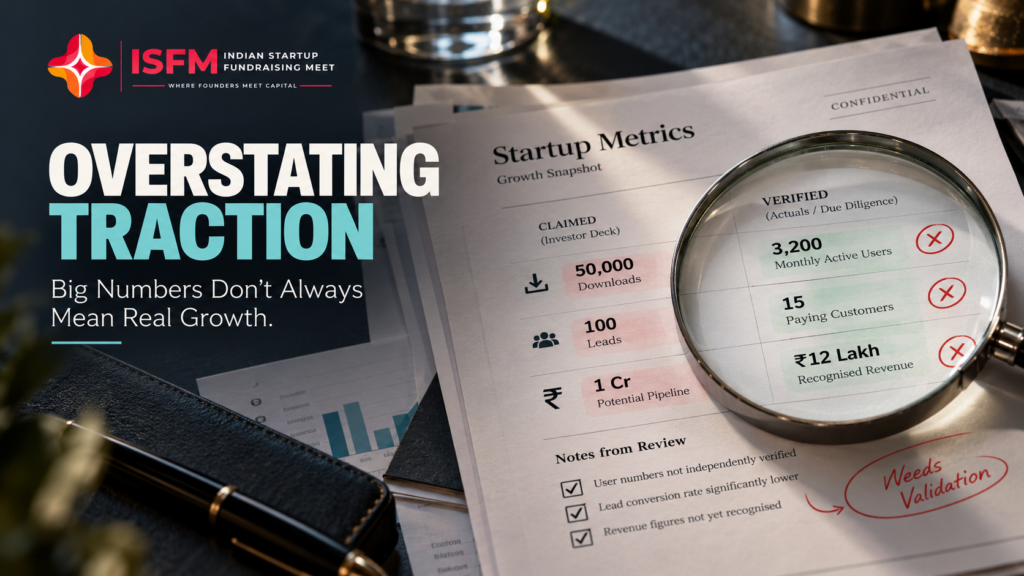
Overstating traction is one of the most damaging mistakes a startup founder can make during fundraising. Presenting inflated revenue, exaggerated customer numbers, misleading growth rates or unconfirmed partnerships as established achievements may attract initial attention, but it can create serious credibility problems when investors begin verifying the business.
Startup fundraising is built on more than an innovative idea.
Investors want to understand whether customers need the proposed solution, whether the product delivers value and whether the business is making measurable progress.
This is why traction plays an important role in investor evaluation.
A startup demonstrating genuine customer adoption, consistent engagement, commercial validation or meaningful technical progress may be better positioned to explain its growth potential.
However, many founders make a critical mistake: they confuse creating a compelling investment story with making their business appear more successful than it actually is.
A founder might describe 10,000 app downloads as 10,000 active customers.
Another might include unsigned proposals in confirmed revenue.
A startup conducting an exploratory pilot with a large corporation might announce the corporation as an established paying customer.
These representations can create a misleading impression of business performance.
When investors examine bank statements, accounting records, customer contracts, product analytics and other evidence, the differences may become apparent.
The purpose of fundraising communication should be to demonstrate genuine progress—not manufacture the appearance of traction.
In this guide, ISFM – Indian Startup Fundraising Meet explains what overstating traction means, why founders make this mistake, how investors verify startup performance, which metrics should be presented accurately and how Indian startups can build an evidence-based fundraising strategy.
What Is Startup Traction?
Startup traction is evidence that a business is making meaningful progress toward validating its product, attracting customers, developing commercial demand or establishing a repeatable business model.
The most relevant form of traction depends on the startup’s sector, development stage and operating model.
For a SaaS company, traction might include monthly recurring revenue, paying customers, retention and product usage.
For a consumer mobile application, active users, engagement and retention may be relevant.
For a manufacturing startup, completed product testing, paid orders, production capability and repeat customers may be more meaningful.
For a deep-tech startup, technical feasibility, prototype performance, independent testing and customer validation may be important.
For a pre-revenue startup, traction can include credible evidence of market need and measurable progress even before commercial sales begin.
Common Categories of Startup Traction
| Traction category | Examples |
|---|---|
| Product traction | Prototype completion, MVP launch, technical validation |
| Customer traction | Paying customers, active users, repeat purchases |
| Revenue traction | Recognised revenue, recurring revenue, revenue growth |
| Market validation | Structured customer interviews, paid trials, validated demand |
| Commercial traction | Signed contracts, completed orders, retained customers |
| Technology traction | Tested product performance, research milestones, independent validation |
| Strategic progress | Executed partnerships, authorised pilots, distribution arrangements |
These categories are not equivalent.
For example, an exploratory partnership discussion should not be represented as revenue traction.
Similarly, an app download does not automatically demonstrate continued product usage.
What Does Overstating Traction Mean?
Overstating traction means presenting a startup’s progress in a way that exaggerates, misclassifies or materially misrepresents what has actually been achieved.
This may happen through inaccurate numbers, misleading descriptions, omitted context or unsupported claims.
Examples include:
- Calling registered users active customers.
- Presenting leads as confirmed paying customers.
- Including unsigned contracts in recognised revenue.
- Describing a free pilot as a commercial deployment.
- Presenting projected sales as historical sales.
- Announcing an informal discussion as an official partnership.
- Counting one-time income as recurring revenue.
- Reporting cumulative downloads as current active users.
- Exaggerating percentage growth without disclosing the starting base.
- Presenting funding applications as approved investments.
Some inaccuracies arise from weak reporting systems rather than intentional dishonesty.
However, the effect on investor understanding can still be significant.
Founders are responsible for ensuring that important business claims are accurate, clearly defined and supported by appropriate evidence.
Why Do Founders Overstate Startup Traction?
There are several reasons founders may exaggerate or misrepresent business progress.
1. Pressure to Impress Investors
Founders may believe that investors will consider only startups showing substantial revenue or rapid growth.
This pressure can encourage them to make early progress appear more advanced than it is.
2. Comparing Their Startup With Funded Companies
Investment announcements often highlight impressive financial or operating figures.
Founders may feel that their smaller achievements are inadequate by comparison.
But businesses operate at different stages and should be evaluated according to their actual circumstances.
3. Confusing Activity With Results
Large numbers of social media followers, marketing impressions, enquiries or meetings may create substantial activity without necessarily producing paying customers.
4. Weak Financial Reporting
Some startups have not established clear accounting or operational reporting systems.
As a result, they may confuse bookings, collections, recognised revenue and projected sales.
5. Lack of Understanding of Investor Metrics
First-time founders may not understand terms such as annual recurring revenue, gross merchandise value, customer acquisition cost or customer retention.
6. Fundraising Urgency
A startup under financial pressure may be tempted to exaggerate progress to accelerate investment discussions.
7. Overenthusiastic Storytelling
Founders naturally believe in their businesses.
However, optimism about the future must be distinguished from evidence about the past.
Confidence is valuable in fundraising. Misrepresentation is not.
Why Overstating Traction Is a Serious Fundraising Mistake
Misleading traction can affect a financing process in several ways.
Loss of Investor Confidence
Investors need confidence that management reports accurate information.
A material discrepancy in one metric may lead an investor to question other representations.
More Complicated Due Diligence
Inconsistent figures can result in additional questions, verification requests or delays.
Changes to Investment Decisions
An investor may reconsider the attractiveness of a business if its actual commercial performance is materially different from the initial presentation.
Transaction and Legal Risks
Depending on the facts, financing documents and applicable law, inaccurate representations may create contractual or legal consequences.
Not every reporting error constitutes fraud, but deliberate material misrepresentations can be particularly serious.
Damage to Founder Reputation
Startup ecosystems rely heavily on professional relationships.
Credibility problems may affect future discussions with investors, partners or other stakeholders.
Poor Internal Decision-Making
Exaggerated reporting can mislead founders and their teams as well as external investors.
A company that believes its customer demand is stronger than reality may spend excessively on expansion.
12 Common Ways Startups Overstate Traction
Mistake 1: Calling Registered Users Active Users
A startup might announce:
“We have 50,000 users.”
However, this figure could refer to 50,000 historical account registrations.
Only 3,000 people may have used the product during the previous month.
Both numbers can be valid, but they describe different things.
Better Reporting
“50,000 cumulative registrations, with 3,000 monthly active users during September 2026.”
The reporting period and definition of an active user should be clear.
An active user should be measured according to a meaningful, consistently applied activity definition.
Mistake 2: Presenting Leads as Customers
A company may have 1,000 prospective customer enquiries.
That demonstrates potential interest, but it does not mean the startup has 1,000 customers.
Better Reporting
“1,000 customer enquiries generated, 150 qualified prospects and 35 paying customers during the reporting period.”
A clear distinction between leads, qualified prospects and completed sales provides a more accurate commercial picture.
Mistake 3: Treating Letters of Intent as Confirmed Revenue
A Letter of Intent (LOI) can indicate interest in a proposed business relationship.
However, its legal effect and commercial commitments depend on its wording.
An LOI is not automatically a completed sale, binding purchase order or recognised revenue.
Better Reporting
“We have received three non-binding letters of intent from potential enterprise customers and are negotiating the terms of proposed pilot projects.”
This describes the actual commercial position without suggesting that future sales are guaranteed.
Mistake 4: Presenting Free Pilots as Paying Customers
A startup may be conducting trials with several organisations.
These trials can provide useful evidence of technical or commercial validation.
But a free pilot should not be described as a paid contract.
Better Reporting
“Four organisations are participating in free product evaluation pilots, with conversion to paid deployment subject to successful testing and commercial negotiations.”
Mistake 5: Confusing Bookings With Recognised Revenue
Bookings, invoices, cash collections and accounting revenue are not interchangeable concepts.
For example, a SaaS company may sign a ₹12 lakh annual subscription agreement.
The company should not automatically recognise the entire contract value as revenue on the signing date.
Revenue recognition depends on the applicable accounting framework and the underlying transaction.
Better Reporting
Separate:
- Contracted bookings.
- Recognised revenue.
- Invoiced amounts.
- Cash collections.
- Remaining contracted obligations.
Financial reporting should reconcile with the company’s accounting records.
Mistake 6: Inflating Annual Recurring Revenue
Annual Recurring Revenue (ARR) is generally used to describe the annualised value of recurring revenue components.
Some founders incorrectly include one-time setup charges, product sales or consulting income within ARR.
Illustrative Example
A startup reports:
- Monthly recurring subscription revenue: ₹5 lakh.
- One-time implementation fees collected during the month: ₹3 lakh.
If the entire ₹8 lakh is annualised, the apparent ARR becomes ₹96 lakh.
But assuming ₹5 lakh is the normalised monthly recurring revenue, the illustrative ARR would be:
₹5 lakh × 12 = ₹60 lakh
One-time fees should not be automatically treated as recurring subscription income.
The calculation method and reporting date should be disclosed.
Mistake 7: Exaggerating Revenue Through GMV
Marketplaces and transaction platforms often report Gross Merchandise Value (GMV).
GMV is the total value of relevant transactions processed or facilitated under the platform’s defined reporting method.
It is not necessarily the company’s recognised revenue.
Example
A marketplace facilitates ₹1 crore in transaction value.
If its commercial arrangement produces a 10% commission, its gross commission opportunity may be ₹10 lakh before relevant adjustments.
The company’s recognised revenue must still be determined under the applicable accounting principles.
Claiming ₹1 crore as company revenue merely because the platform handled that transaction value can materially misrepresent the business.
Mistake 8: Claiming Partnerships That Are Not Finalised
Founders sometimes describe exploratory discussions with major corporations as confirmed partnerships.
This is particularly risky when the startup names prominent institutions or companies.
Better Reporting
Instead of:
“We are the official technology partner of Company X.”
Use an accurate description such as:
“We have initiated discussions with Company X regarding a potential technology pilot.”
Only use the term official partner when a genuine, authorised relationship supports that description.
Customer and partner logos should also be used with appropriate rights and permissions.
Mistake 9: Reporting Misleading Growth Percentages
A startup may announce:
“Revenue grew 400%!”
This sounds impressive.
However, the underlying numbers might be:
- Previous monthly revenue: ₹20,000.
- Current monthly revenue: ₹1,00,000.
The increase is ₹80,000, representing 400% growth over the starting amount.
The percentage is mathematically correct, but omitting the absolute values and reporting period can make the business appear larger than it is.
Better Reporting
“Monthly revenue increased from ₹20,000 to ₹1,00,000, representing 400% growth over the previous month.”
Report absolute figures, percentage changes and relevant context together.
Mistake 10: Using Cumulative Metrics to Suggest Current Momentum
Cumulative downloads, registrations or historical transactions generally increase over time.
They may not reveal whether current customer activity is growing or declining.
Better Reporting
Show period-specific measures such as:
- Monthly active users.
- New customers per month.
- Monthly recognised revenue.
- Repeat purchases.
- Retention by customer cohort.
A cumulative metric can be useful, but it should not replace measures of current performance.
Mistake 11: Treating Funding Applications as Confirmed Funding
A startup may apply to several investors, incubators or government-supported programmes.
It may also receive invitations to interviews or preliminary evaluation rounds.
These activities are part of the fundraising process, not evidence that capital has been committed.
Better Reporting
Distinguish between:
Applied: Application submitted.
Under Evaluation: Review in progress.
Shortlisted: Selected for a subsequent assessment stage.
Approved or Sanctioned: Formal approval issued, subject to applicable conditions.
Disbursed: Funds actually received.
An investor discussion or shortlist notification should not be described as confirmed capital.
Mistake 12: Presenting Product Development Plans as Completed Achievements
Technology startups may describe proposed features, planned prototypes or future certifications as if they already exist.
Better Reporting
Use precise stage descriptions:
- Concept developed.
- Technical feasibility under evaluation.
- Prototype completed.
- Laboratory testing in progress.
- MVP available for pilot users.
- Product commercially launched.
Separate actual accomplishments from future development plans.
Vanity Metrics vs Meaningful Traction
A vanity metric is a figure that may create an impression of progress without adequately explaining the business’s performance or underlying value.
A vanity metric is not necessarily false.
The problem arises when it is presented without sufficient context or used as a substitute for more meaningful evidence.
| Metric that may be misleading alone | More informative supporting evidence |
|---|---|
| App downloads | Active usage, engagement and retention |
| Social media followers | Qualified leads and customer conversion |
| Website visits | Conversion rate and relevant customer actions |
| Email sign-ups | Activation and customer adoption |
| Total registered accounts | Active accounts over a defined period |
| Press coverage | Measurable business outcomes from coverage |
| Gross transaction value | Recognised revenue and transaction economics |
| Customer enquiries | Qualified leads and paid conversions |
| Pilot announcements | Pilot outcomes and paid conversion |
| Percentage growth | Absolute values, timeframe and calculation |
Founders should choose metrics that reveal whether the business is actually progressing.
What Traction Do Investors Look for at Different Startup Stages?
Traction expectations depend on the startup’s maturity.
Idea Stage
A startup may not have a product or customers.
Meaningful evidence can include:
- Structured customer interviews.
- Documented problem validation.
- Relevant research.
- Founder expertise.
- Initial technical feasibility work.
- Clear development milestones.
Prototype Stage
Possible evidence includes:
- Functional prototype.
- Testing reports.
- Technical performance results.
- Initial user feedback.
- Relevant research achievements.
MVP Stage
Potential indicators include:
- Real users testing the product.
- Usage patterns.
- Activation.
- Customer retention.
- Completed pilots.
- Pricing experiments.
Early Revenue Stage
Relevant indicators may include:
- Paying customers.
- Recognised revenue.
- Customer growth.
- Repeat transactions.
- Gross margin.
- Cash collection.
- Retention.
Growth Stage
More established companies may need to demonstrate:
- Revenue quality.
- Repeatable customer acquisition.
- Gross margin.
- Retention and churn.
- Unit economics.
- Capital efficiency.
- Commercial expansion.
- Operational scalability.
There is no single traction metric or universal revenue threshold that every startup must achieve before approaching investors.
Understanding Important Startup Traction Metrics
Monthly Recurring Revenue (MRR)
MRR measures normalised recurring revenue from eligible active recurring-revenue arrangements for a particular month.
The calculation should exclude non-recurring amounts and follow a consistent methodology.
Annual Recurring Revenue (ARR)
ARR commonly annualises the current recurring revenue base.
A simple approach for a stable monthly recurring-revenue business is:
ARR = MRR × 12
However, founders should explain the calculation and ensure non-recurring revenue is not included.
Monthly Active Users (MAU)
MAU counts unique users meeting the company’s defined active-use criteria during a specified monthly period.
Definitions should be meaningful and consistent.
Daily Active Users (DAU)
DAU counts unique users meeting the defined activity threshold within a day.
DAU can be relevant for products designed for frequent use.
Customer Retention
Retention measures the extent to which customers or users remain active or continue their relationships over time.
The measurement approach should match the business model.
Customer Churn
Churn measures the loss of customers or revenue over a defined period, depending on the chosen definition.
Customer Acquisition Cost (CAC)
CAC estimates relevant acquisition expenditure relative to the number of customers acquired.
Founders should disclose or consistently apply the costs included.
Customer Lifetime Value (LTV)
LTV estimates the economic value expected from a customer relationship.
It depends on assumptions concerning margins, retention and customer behaviour.
Gross Margin
Gross margin indicates the proportion of revenue remaining after relevant direct costs.
Net Cash Burn
Net burn helps explain the rate at which the startup consumes cash.
No single metric should be interpreted without considering the overall business model.
How Investors Verify Startup Traction During Due Diligence
Investors may examine supporting documents and business systems to determine whether reported traction is credible.
Different investors use different procedures, but common reviews may include the following.
Financial Verification
Potential evidence includes:
- Financial statements.
- Accounting records.
- Relevant invoices.
- Bank statements.
- GST filings, where applicable.
- Payment gateway settlement records.
- Customer payment histories.
Customer Verification
Investors may review:
- Signed contracts.
- Purchase orders.
- Customer references.
- Paid subscription records.
- Pilot agreements.
- Renewal information.
Product Analytics
For digital startups, verification may include:
- Analytics dashboards.
- Unique user activity.
- Retention trends.
- Activation metrics.
- Subscription records.
- Usage events and reporting definitions.
Commercial Pipeline Review
Investors may examine the difference between:
- Initial leads.
- Qualified prospects.
- Commercial proposals.
- Negotiations.
- Signed contracts.
- Invoiced transactions.
- Recognised revenue.
- Collected payments.
Technical Validation
For technology companies, investors may request product demonstrations, testing reports, technical documentation or independent assessments.
Legal and Corporate Review
Claims about ownership, partnerships, intellectual property and commercial obligations may also be examined.
Investors should receive access only to information appropriately required for the evaluation, subject to confidentiality, privacy and security considerations.
Illustrative Case Study: Two Startups With Different Traction Reporting
Consider two fictional SaaS startups seeking seed investment.
Both have developed functional products and acquired early customers.
Startup A: Exaggerated Traction
Startup A reports:
“We have 25,000 customers and ₹1 crore annual revenue.”
During further review, investors discover:
- 25,000 represents total historical registrations.
- Only 1,200 users were active in the previous month.
- The ₹1 crore figure includes projected contracts and one-time implementation opportunities.
- Actual recurring revenue is materially lower.
The original description creates a misleading impression of commercial performance.
Startup B: Evidence-Based Traction
Startup B reports:
“We have 8,000 registered accounts, 2,100 monthly active users and ₹4 lakh in current monthly recurring revenue, calculated from active subscriptions as of the reporting date.”
It also explains:
- The period covered.
- The criteria defining active users.
- Historical customer growth.
- Retention and churn.
- The distinction between recurring and non-recurring income.
- Product and acquisition challenges.
Startup B’s figures may be smaller than Startup A’s promotional claims.
However, its reporting provides a clearer basis for investor evaluation.
Key Lesson
More impressive numbers are not automatically more valuable.
Credible, traceable evidence can be more persuasive than exaggerated growth claims.
How to Present Traction Honestly in a Pitch Deck
The traction slide should communicate relevant progress clearly and accurately.
Recommended Traction Slide Structure
1. Current Stage
Identify whether the product is at prototype, MVP, pilot or commercial stage.
2. Main Traction Metrics
Select a small number of measures relevant to the business model.
3. Reporting Period
Clearly state the timeframe and as-of date.
4. Evidence of Progress
Show comparative figures or relevant validation.
5. Important Definitions
Explain what the figures include and exclude.
6. Relevant Limitations
Disclose material conditions or uncertainties where necessary.
Example Traction Slide
Traction Snapshot — Illustrative SaaS Startup
| Metric | Example value |
|---|---|
| Total registered accounts | 12,000 |
| Monthly active users | 3,000 |
| Paying customers | 240 |
| Monthly recurring revenue | ₹6 lakh |
| Current annualised recurring revenue | ₹72 lakh |
| Reporting period | September 2026 |
Illustrative figures only. These are not actual performance results for any company.
This format makes it easier to understand the differences between registrations, engagement, customers and recurring revenue.
How to Present Pre-Revenue Traction Without Exaggeration
Not every startup needs to generate revenue before pursuing suitable external financing.
Some technology companies require substantial research and development before commercial launch.
For these businesses, traction may involve the quality of the validation process rather than current revenue.
What Pre-Revenue Founders Can Show
Customer Discovery: Number of interviews and what was learned.
Problem Validation: Evidence that the target customer experiences a meaningful problem.
Prototype Development: What has actually been built.
Technical Testing: Measurable test results and technical limitations.
Pilot Engagement: Nature and scope of real testing arrangements.
User Feedback: Documented responses from relevant users.
Product Roadmap: Clear upcoming milestones.
Founder Capability: Relevant experience supporting execution.
Example
Instead of claiming:
“We have strong demand from 100 companies.”
Use:
“We interviewed representatives from 100 target companies; 18 expressed interest in further evaluation, and three agreed to participate in exploratory product testing.”
The second statement is more precise, provided the figures are supported by records.
How to Build a Traction Verification System
Founders can reduce the risk of inconsistent or misleading reporting by creating a simple internal control process.
Step 1: Define Every Important Metric
Document how the company calculates active users, revenue, paying customers, churn and other indicators.
Step 2: Assign Data Ownership
Designate the team member responsible for collecting and verifying each metric.
Step 3: Identify Authoritative Sources
Examples may include accounting software, payment systems, signed contracts and reliable product analytics.
Step 4: Establish Reporting Periods
Use clearly defined monthly, quarterly or other reporting intervals.
Step 5: Reconcile Figures
Check that relevant metrics agree with supporting records.
Step 6: Separate Historical and Forecast Data
Never combine actual and projected figures without clearly distinguishing them.
Step 7: Maintain Evidence
Store supporting documents in a secure, appropriately controlled data room.
Step 8: Review External Claims
Verify important numbers before they appear in investor decks, application forms, articles or marketing materials.
Step 9: Record Corrections
If an error is found, correct the relevant reports and inform affected parties when appropriate.
Step 10: Update Reporting Consistently
Use the same definitions over time or clearly disclose methodological changes.
Startup Traction Verification Checklist
| Verification question | Required check |
|---|---|
| Are user numbers correctly defined? | Registrations vs active users |
| Are paying customers identified accurately? | Customer and payment records |
| Is revenue properly classified? | Accounting records and recognition rules |
| Is ARR based on recurring components? | Subscription and contract analysis |
| Are projections separated from actual results? | Forecast labels and reporting periods |
| Are commercial contracts signed? | Executed agreements |
| Are LOIs correctly described? | Binding or non-binding terms |
| Are pilots paid or unpaid? | Pilot agreements and commercial records |
| Are growth rates calculated correctly? | Base period and current period |
| Are customer and partner logos authorised? | Relationship and usage permissions |
| Can technical progress be demonstrated? | Testing and product evidence |
| Are funding statuses correctly presented? | Application, approval and disbursement records |
What Should Founders Do If They Have Already Overstated Traction?
If a founder discovers that an investor presentation contains a material error, the appropriate response is to address it rather than allow the inaccurate figure to continue circulating.
A practical approach may include:
- Identify which statements are inaccurate.
- Determine the correct verified information.
- Review the cause of the discrepancy.
- Update the pitch deck and supporting documents.
- Correct relevant external communications.
- Notify recipients where a material misstatement may have affected their understanding.
- Seek qualified legal or accounting advice when the circumstances warrant it.
- Establish controls to prevent recurrence.
The appropriate response depends on the seriousness of the misstatement, applicable agreements and legal obligations.
Avoid attempting to conceal an error through further misleading explanations.
Why Genuine Traction Matters More Than Impressive Numbers
Fundraising involves uncertainty.
Investors know that startups often operate with incomplete information, developing products and evolving business models.
A small startup with limited but genuine traction may still represent an attractive opportunity for an investor whose strategy matches its stage and sector.
What matters is whether the reported evidence supports the company’s actual position and potential.
For example:
- A successful prototype may establish technical progress.
- A paid pilot may provide early commercial validation.
- Repeat customer purchases may support evidence of demand.
- Improving retention may suggest increasing product value.
- Growing recurring revenue may provide evidence of commercial progress.
Every business should communicate its current achievements without implying that future milestones have already been completed.
Real traction helps investors understand the business. Exaggerated traction can prevent them from trusting it.
How ISFM Supports Evidence-Based Startup Evaluation
ISFM – Indian Startup Fundraising Meet is a private startup fundraising facilitation initiative focused on structured startup evaluation and relevant connections within the entrepreneurial and investment ecosystem.
An important aspect of fundraising readiness is the quality and credibility of information presented by founders.
A startup may have promising technology and market potential but still need to improve how it measures and communicates progress.
Relevant evaluation areas may include:
- Current product-development stage.
- Customer and market validation.
- Revenue and commercial performance.
- Financial projections.
- Business model.
- Funding requirements.
- Fund utilisation.
- Investor-readiness documents.
- Traction verification.
- Suitable investor or financing pathways.
By encouraging structured information and evidence-based assessment, ISFM aims to support more meaningful discussions between startups and relevant ecosystem stakeholders.
ISFM is a private fundraising facilitation initiative. Startup nomination, evaluation, participation or introductions do not guarantee investor meetings, investment approval, grants, loans or fund disbursement.
Founders remain responsible for the accuracy of all information submitted to relevant parties.
Frequently Asked Questions About Overstating Startup Traction
1. What does overstating traction mean?
It means exaggerating or materially misrepresenting a startup’s product, customer, revenue, commercial or operational progress.
2. Is overstating traction the same as using fake numbers?
Not always. Overstatement can also involve real numbers described inaccurately, such as calling registrations active users.
3. Do investors verify startup traction?
Investors may review financial statements, customer contracts, product analytics, commercial records and other supporting information during due diligence.
4. Can a pre-revenue startup show traction?
Yes. Relevant traction can include customer discovery, technical validation, prototype development, authentic pilots and meaningful product usage.
5. Are app downloads considered traction?
Downloads can indicate distribution or initial interest, but active usage and retention may provide better evidence of continuing product value.
6. Can leads be counted as customers?
Leads and customers should be reported separately. A prospective customer is not automatically a paying customer.
7. Is a Letter of Intent proof of confirmed revenue?
Not automatically. Its legal and commercial effect depends on the actual terms, and it does not itself establish recognised revenue.
8. What is the difference between GMV and revenue?
GMV commonly represents transaction value facilitated through a platform, whereas recognised revenue reflects the company’s income under applicable accounting principles.
9. Can a company report annual recurring revenue before receiving a full year’s payments?
ARR can be an annualised metric based on eligible current recurring revenue, but it should be clearly defined and not confused with recognised historical annual revenue.
10. Why do investors care about customer retention?
Retention helps investors understand whether customers continue using or paying for the company’s product.
11. What are vanity metrics?
Vanity metrics are figures that may appear impressive but provide limited insight into meaningful business performance when presented without appropriate context.
12. Can exaggerating traction affect a funding round?
Yes. Material discrepancies may lead to additional diligence, changes in investment decisions, transaction delays or other consequences.
13. What should founders do if an investor deck contains incorrect figures?
Verify the correct information, update the materials and address material inaccuracies appropriately, seeking professional advice where necessary.
14. Should pilot customers be listed as paying customers?
Only where the actual commercial arrangement justifies that classification. Free pilots should be identified as free.
15. Is social media growth considered startup traction?
It can indicate audience interest, but commercial value depends on whether that engagement supports meaningful customer or business outcomes.
16. How can founders present small traction numbers effectively?
Use accurate absolute values, relevant trends, reporting dates and supporting evidence. Explain what has been learned and what milestones come next.
17. Does every startup need strong revenue before raising funding?
No. Investor requirements vary by stage, sector and financing strategy.
18. Is investor shortlisting proof that funding is approved?
No. Shortlisting, evaluation, approval and disbursement are separate stages.
19. What is the most important rule for reporting traction?
Every material claim should be accurately defined, appropriately dated and supported by credible evidence.
20. Does ISFM guarantee investment after traction evaluation?
No. ISFM facilitates startup evaluation and ecosystem engagement but does not guarantee funding outcomes.
Conclusion: Never Sacrifice Credibility for Impressive Traction Numbers
Startup fundraising depends on trust, evidence and the ability to communicate a business opportunity accurately.
Founders may feel pressure to demonstrate rapid growth, large customer numbers or substantial commercial success.
However, exaggerating performance can undermine the very confidence they are trying to build.
A startup with 100 genuine customers is not automatically less promising than one claiming 10,000 registrations.
The value of traction depends on what the numbers actually represent.
Clear revenue definitions, authentic customer evidence, accurate product metrics and transparent reporting periods help investors assess an opportunity more effectively.
A founder should never make the company appear more advanced than it really is. The stronger approach is to show what has been achieved, what remains unproven and how the next milestone will be reached.
For Indian startups preparing to approach angel investors, venture capital firms, incubators or other financing institutions, credible traction reporting is an essential part of fundraising readiness.
Real Progress. Real Evidence. Stronger Investor Conversations.
ISFM – Indian Startup Fundraising Meet
Where Founders Meet Capital
Official Website: https://www.indianstartupfundraisingmeet.com
Startup Nomination: https://zfrmz.in/A1pyKmrRj1s9OIsgPR4I
Investor & Partner Collaboration: https://zfrmz.in/p5cGk97nqrKp2ZXaJqjl
WhatsApp Community: https://chat.whatsapp.com/BNFh80tJsCtJEvgCQsW2i4
Official WhatsApp Channel: https://whatsapp.com/channel/0029VbDbOmr2ZjCkYLBeIw1T
Contact: +91 7014264283
Disclaimer: This article is for general educational purposes and does not constitute legal, financial, accounting or investment advice. Actual accounting treatment, disclosure obligations and legal consequences depend on specific facts, applicable requirements and contractual terms. ISFM does not guarantee investor meetings, financing approval or fund disbursement.Overstating Traction: Why Exaggerating Startup Growth Can Damage Investor Trust
Overstating traction is one of the most damaging mistakes a startup founder can make during fundraising. Presenting inflated revenue, exaggerated customer numbers, misleading growth rates or unconfirmed partnerships as established achievements may attract initial attention, but it can create serious credibility problems when investors begin verifying the business.
Startup fundraising is built on more than an innovative idea.
Investors want to understand whether customers need the proposed solution, whether the product delivers value and whether the business is making measurable progress.
This is why traction plays an important role in investor evaluation.
A startup demonstrating genuine customer adoption, consistent engagement, commercial validation or meaningful technical progress may be better positioned to explain its growth potential.
However, many founders make a critical mistake: they confuse creating a compelling investment story with making their business appear more successful than it actually is.
A founder might describe 10,000 app downloads as 10,000 active customers.
Another might include unsigned proposals in confirmed revenue.
A startup conducting an exploratory pilot with a large corporation might announce the corporation as an established paying customer.
These representations can create a misleading impression of business performance.
When investors examine bank statements, accounting records, customer contracts, product analytics and other evidence, the differences may become apparent.
The purpose of fundraising communication should be to demonstrate genuine progress—not manufacture the appearance of traction.
In this guide, ISFM – Indian Startup Fundraising Meet explains what overstating traction means, why founders make this mistake, how investors verify startup performance, which metrics should be presented accurately and how Indian startups can build an evidence-based fundraising strategy.
What Is Startup Traction?
Startup traction is evidence that a business is making meaningful progress toward validating its product, attracting customers, developing commercial demand or establishing a repeatable business model.
The most relevant form of traction depends on the startup’s sector, development stage and operating model.
For a SaaS company, traction might include monthly recurring revenue, paying customers, retention and product usage.
For a consumer mobile application, active users, engagement and retention may be relevant.
For a manufacturing startup, completed product testing, paid orders, production capability and repeat customers may be more meaningful.
For a deep-tech startup, technical feasibility, prototype performance, independent testing and customer validation may be important.
For a pre-revenue startup, traction can include credible evidence of market need and measurable progress even before commercial sales begin.
Common Categories of Startup Traction
| Traction category | Examples |
|---|---|
| Product traction | Prototype completion, MVP launch, technical validation |
| Customer traction | Paying customers, active users, repeat purchases |
| Revenue traction | Recognised revenue, recurring revenue, revenue growth |
| Market validation | Structured customer interviews, paid trials, validated demand |
| Commercial traction | Signed contracts, completed orders, retained customers |
| Technology traction | Tested product performance, research milestones, independent validation |
| Strategic progress | Executed partnerships, authorised pilots, distribution arrangements |
These categories are not equivalent.
For example, an exploratory partnership discussion should not be represented as revenue traction.
Similarly, an app download does not automatically demonstrate continued product usage.
What Does Overstating Traction Mean?
Overstating traction means presenting a startup’s progress in a way that exaggerates, misclassifies or materially misrepresents what has actually been achieved.
This may happen through inaccurate numbers, misleading descriptions, omitted context or unsupported claims.
Examples include:
- Calling registered users active customers.
- Presenting leads as confirmed paying customers.
- Including unsigned contracts in recognised revenue.
- Describing a free pilot as a commercial deployment.
- Presenting projected sales as historical sales.
- Announcing an informal discussion as an official partnership.
- Counting one-time income as recurring revenue.
- Reporting cumulative downloads as current active users.
- Exaggerating percentage growth without disclosing the starting base.
- Presenting funding applications as approved investments.
Some inaccuracies arise from weak reporting systems rather than intentional dishonesty.
However, the effect on investor understanding can still be significant.
Founders are responsible for ensuring that important business claims are accurate, clearly defined and supported by appropriate evidence.
Why Do Founders Overstate Startup Traction?
There are several reasons founders may exaggerate or misrepresent business progress.
1. Pressure to Impress Investors
Founders may believe that investors will consider only startups showing substantial revenue or rapid growth.
This pressure can encourage them to make early progress appear more advanced than it is.
2. Comparing Their Startup With Funded Companies
Investment announcements often highlight impressive financial or operating figures.
Founders may feel that their smaller achievements are inadequate by comparison.
But businesses operate at different stages and should be evaluated according to their actual circumstances.
3. Confusing Activity With Results
Large numbers of social media followers, marketing impressions, enquiries or meetings may create substantial activity without necessarily producing paying customers.
4. Weak Financial Reporting
Some startups have not established clear accounting or operational reporting systems.
As a result, they may confuse bookings, collections, recognised revenue and projected sales.
5. Lack of Understanding of Investor Metrics
First-time founders may not understand terms such as annual recurring revenue, gross merchandise value, customer acquisition cost or customer retention.
6. Fundraising Urgency
A startup under financial pressure may be tempted to exaggerate progress to accelerate investment discussions.
7. Overenthusiastic Storytelling
Founders naturally believe in their businesses.
However, optimism about the future must be distinguished from evidence about the past.
Confidence is valuable in fundraising. Misrepresentation is not.
Why Overstating Traction Is a Serious Fundraising Mistake
Misleading traction can affect a financing process in several ways.
Loss of Investor Confidence
Investors need confidence that management reports accurate information.
A material discrepancy in one metric may lead an investor to question other representations.
More Complicated Due Diligence
Inconsistent figures can result in additional questions, verification requests or delays.
Changes to Investment Decisions
An investor may reconsider the attractiveness of a business if its actual commercial performance is materially different from the initial presentation.
Transaction and Legal Risks
Depending on the facts, financing documents and applicable law, inaccurate representations may create contractual or legal consequences.
Not every reporting error constitutes fraud, but deliberate material misrepresentations can be particularly serious.
Damage to Founder Reputation
Startup ecosystems rely heavily on professional relationships.
Credibility problems may affect future discussions with investors, partners or other stakeholders.
Poor Internal Decision-Making
Exaggerated reporting can mislead founders and their teams as well as external investors.
A company that believes its customer demand is stronger than reality may spend excessively on expansion.
12 Common Ways Startups Overstate Traction
Mistake 1: Calling Registered Users Active Users
A startup might announce:
“We have 50,000 users.”
However, this figure could refer to 50,000 historical account registrations.
Only 3,000 people may have used the product during the previous month.
Both numbers can be valid, but they describe different things.
Better Reporting
“50,000 cumulative registrations, with 3,000 monthly active users during September 2026.”
The reporting period and definition of an active user should be clear.
An active user should be measured according to a meaningful, consistently applied activity definition.
Mistake 2: Presenting Leads as Customers
A company may have 1,000 prospective customer enquiries.
That demonstrates potential interest, but it does not mean the startup has 1,000 customers.
Better Reporting
“1,000 customer enquiries generated, 150 qualified prospects and 35 paying customers during the reporting period.”
A clear distinction between leads, qualified prospects and completed sales provides a more accurate commercial picture.
Mistake 3: Treating Letters of Intent as Confirmed Revenue
A Letter of Intent (LOI) can indicate interest in a proposed business relationship.
However, its legal effect and commercial commitments depend on its wording.
An LOI is not automatically a completed sale, binding purchase order or recognised revenue.
Better Reporting
“We have received three non-binding letters of intent from potential enterprise customers and are negotiating the terms of proposed pilot projects.”
This describes the actual commercial position without suggesting that future sales are guaranteed.
Mistake 4: Presenting Free Pilots as Paying Customers
A startup may be conducting trials with several organisations.
These trials can provide useful evidence of technical or commercial validation.
But a free pilot should not be described as a paid contract.
Better Reporting
“Four organisations are participating in free product evaluation pilots, with conversion to paid deployment subject to successful testing and commercial negotiations.”
Mistake 5: Confusing Bookings With Recognised Revenue
Bookings, invoices, cash collections and accounting revenue are not interchangeable concepts.
For example, a SaaS company may sign a ₹12 lakh annual subscription agreement.
The company should not automatically recognise the entire contract value as revenue on the signing date.
Revenue recognition depends on the applicable accounting framework and the underlying transaction.
Better Reporting
Separate:
- Contracted bookings.
- Recognised revenue.
- Invoiced amounts.
- Cash collections.
- Remaining contracted obligations.
Financial reporting should reconcile with the company’s accounting records.
Mistake 6: Inflating Annual Recurring Revenue
Annual Recurring Revenue (ARR) is generally used to describe the annualised value of recurring revenue components.
Some founders incorrectly include one-time setup charges, product sales or consulting income within ARR.
Illustrative Example
A startup reports:
- Monthly recurring subscription revenue: ₹5 lakh.
- One-time implementation fees collected during the month: ₹3 lakh.
If the entire ₹8 lakh is annualised, the apparent ARR becomes ₹96 lakh.
But assuming ₹5 lakh is the normalised monthly recurring revenue, the illustrative ARR would be:
₹5 lakh × 12 = ₹60 lakh
One-time fees should not be automatically treated as recurring subscription income.
The calculation method and reporting date should be disclosed.
Mistake 7: Exaggerating Revenue Through GMV
Marketplaces and transaction platforms often report Gross Merchandise Value (GMV).
GMV is the total value of relevant transactions processed or facilitated under the platform’s defined reporting method.
It is not necessarily the company’s recognised revenue.
Example
A marketplace facilitates ₹1 crore in transaction value.
If its commercial arrangement produces a 10% commission, its gross commission opportunity may be ₹10 lakh before relevant adjustments.
The company’s recognised revenue must still be determined under the applicable accounting principles.
Claiming ₹1 crore as company revenue merely because the platform handled that transaction value can materially misrepresent the business.
Mistake 8: Claiming Partnerships That Are Not Finalised
Founders sometimes describe exploratory discussions with major corporations as confirmed partnerships.
This is particularly risky when the startup names prominent institutions or companies.
Better Reporting
Instead of:
“We are the official technology partner of Company X.”
Use an accurate description such as:
“We have initiated discussions with Company X regarding a potential technology pilot.”
Only use the term official partner when a genuine, authorised relationship supports that description.
Customer and partner logos should also be used with appropriate rights and permissions.
Mistake 9: Reporting Misleading Growth Percentages
A startup may announce:
“Revenue grew 400%!”
This sounds impressive.
However, the underlying numbers might be:
- Previous monthly revenue: ₹20,000.
- Current monthly revenue: ₹1,00,000.
The increase is ₹80,000, representing 400% growth over the starting amount.
The percentage is mathematically correct, but omitting the absolute values and reporting period can make the business appear larger than it is.
Better Reporting
“Monthly revenue increased from ₹20,000 to ₹1,00,000, representing 400% growth over the previous month.”
Report absolute figures, percentage changes and relevant context together.
Mistake 10: Using Cumulative Metrics to Suggest Current Momentum
Cumulative downloads, registrations or historical transactions generally increase over time.
They may not reveal whether current customer activity is growing or declining.
Better Reporting
Show period-specific measures such as:
- Monthly active users.
- New customers per month.
- Monthly recognised revenue.
- Repeat purchases.
- Retention by customer cohort.
A cumulative metric can be useful, but it should not replace measures of current performance.
Mistake 11: Treating Funding Applications as Confirmed Funding
A startup may apply to several investors, incubators or government-supported programmes.
It may also receive invitations to interviews or preliminary evaluation rounds.
These activities are part of the fundraising process, not evidence that capital has been committed.
Better Reporting
Distinguish between:
Applied: Application submitted.
Under Evaluation: Review in progress.
Shortlisted: Selected for a subsequent assessment stage.
Approved or Sanctioned: Formal approval issued, subject to applicable conditions.
Disbursed: Funds actually received.
An investor discussion or shortlist notification should not be described as confirmed capital.
Mistake 12: Presenting Product Development Plans as Completed Achievements
Technology startups may describe proposed features, planned prototypes or future certifications as if they already exist.
Better Reporting
Use precise stage descriptions:
- Concept developed.
- Technical feasibility under evaluation.
- Prototype completed.
- Laboratory testing in progress.
- MVP available for pilot users.
- Product commercially launched.
Separate actual accomplishments from future development plans.
Vanity Metrics vs Meaningful Traction
A vanity metric is a figure that may create an impression of progress without adequately explaining the business’s performance or underlying value.
A vanity metric is not necessarily false.
The problem arises when it is presented without sufficient context or used as a substitute for more meaningful evidence.
| Metric that may be misleading alone | More informative supporting evidence |
|---|---|
| App downloads | Active usage, engagement and retention |
| Social media followers | Qualified leads and customer conversion |
| Website visits | Conversion rate and relevant customer actions |
| Email sign-ups | Activation and customer adoption |
| Total registered accounts | Active accounts over a defined period |
| Press coverage | Measurable business outcomes from coverage |
| Gross transaction value | Recognised revenue and transaction economics |
| Customer enquiries | Qualified leads and paid conversions |
| Pilot announcements | Pilot outcomes and paid conversion |
| Percentage growth | Absolute values, timeframe and calculation |
Founders should choose metrics that reveal whether the business is actually progressing.
What Traction Do Investors Look for at Different Startup Stages?
Traction expectations depend on the startup’s maturity.
Idea Stage
A startup may not have a product or customers.
Meaningful evidence can include:
- Structured customer interviews.
- Documented problem validation.
- Relevant research.
- Founder expertise.
- Initial technical feasibility work.
- Clear development milestones.
Prototype Stage
Possible evidence includes:
- Functional prototype.
- Testing reports.
- Technical performance results.
- Initial user feedback.
- Relevant research achievements.
MVP Stage
Potential indicators include:
- Real users testing the product.
- Usage patterns.
- Activation.
- Customer retention.
- Completed pilots.
- Pricing experiments.
Early Revenue Stage
Relevant indicators may include:
- Paying customers.
- Recognised revenue.
- Customer growth.
- Repeat transactions.
- Gross margin.
- Cash collection.
- Retention.
Growth Stage
More established companies may need to demonstrate:
- Revenue quality.
- Repeatable customer acquisition.
- Gross margin.
- Retention and churn.
- Unit economics.
- Capital efficiency.
- Commercial expansion.
- Operational scalability.
There is no single traction metric or universal revenue threshold that every startup must achieve before approaching investors.
Understanding Important Startup Traction Metrics
Monthly Recurring Revenue (MRR)
MRR measures normalised recurring revenue from eligible active recurring-revenue arrangements for a particular month.
The calculation should exclude non-recurring amounts and follow a consistent methodology.
Annual Recurring Revenue (ARR)
ARR commonly annualises the current recurring revenue base.
A simple approach for a stable monthly recurring-revenue business is:
ARR = MRR × 12
However, founders should explain the calculation and ensure non-recurring revenue is not included.
Monthly Active Users (MAU)
MAU counts unique users meeting the company’s defined active-use criteria during a specified monthly period.
Definitions should be meaningful and consistent.
Daily Active Users (DAU)
DAU counts unique users meeting the defined activity threshold within a day.
DAU can be relevant for products designed for frequent use.
Customer Retention
Retention measures the extent to which customers or users remain active or continue their relationships over time.
The measurement approach should match the business model.
Customer Churn
Churn measures the loss of customers or revenue over a defined period, depending on the chosen definition.
Customer Acquisition Cost (CAC)
CAC estimates relevant acquisition expenditure relative to the number of customers acquired.
Founders should disclose or consistently apply the costs included.
Customer Lifetime Value (LTV)
LTV estimates the economic value expected from a customer relationship.
It depends on assumptions concerning margins, retention and customer behaviour.
Gross Margin
Gross margin indicates the proportion of revenue remaining after relevant direct costs.
Net Cash Burn
Net burn helps explain the rate at which the startup consumes cash.
No single metric should be interpreted without considering the overall business model.
How Investors Verify Startup Traction During Due Diligence
Investors may examine supporting documents and business systems to determine whether reported traction is credible.
Different investors use different procedures, but common reviews may include the following.
Financial Verification
Potential evidence includes:
- Financial statements.
- Accounting records.
- Relevant invoices.
- Bank statements.
- GST filings, where applicable.
- Payment gateway settlement records.
- Customer payment histories.
Customer Verification
Investors may review:
- Signed contracts.
- Purchase orders.
- Customer references.
- Paid subscription records.
- Pilot agreements.
- Renewal information.
Product Analytics
For digital startups, verification may include:
- Analytics dashboards.
- Unique user activity.
- Retention trends.
- Activation metrics.
- Subscription records.
- Usage events and reporting definitions.
Commercial Pipeline Review
Investors may examine the difference between:
- Initial leads.
- Qualified prospects.
- Commercial proposals.
- Negotiations.
- Signed contracts.
- Invoiced transactions.
- Recognised revenue.
- Collected payments.
Technical Validation
For technology companies, investors may request product demonstrations, testing reports, technical documentation or independent assessments.
Legal and Corporate Review
Claims about ownership, partnerships, intellectual property and commercial obligations may also be examined.
Investors should receive access only to information appropriately required for the evaluation, subject to confidentiality, privacy and security considerations.
Illustrative Case Study: Two Startups With Different Traction Reporting
Consider two fictional SaaS startups seeking seed investment.
Both have developed functional products and acquired early customers.
Startup A: Exaggerated Traction
Startup A reports:
“We have 25,000 customers and ₹1 crore annual revenue.”
During further review, investors discover:
- 25,000 represents total historical registrations.
- Only 1,200 users were active in the previous month.
- The ₹1 crore figure includes projected contracts and one-time implementation opportunities.
- Actual recurring revenue is materially lower.
The original description creates a misleading impression of commercial performance.
Startup B: Evidence-Based Traction
Startup B reports:
“We have 8,000 registered accounts, 2,100 monthly active users and ₹4 lakh in current monthly recurring revenue, calculated from active subscriptions as of the reporting date.”
It also explains:
- The period covered.
- The criteria defining active users.
- Historical customer growth.
- Retention and churn.
- The distinction between recurring and non-recurring income.
- Product and acquisition challenges.
Startup B’s figures may be smaller than Startup A’s promotional claims.
However, its reporting provides a clearer basis for investor evaluation.
Key Lesson
More impressive numbers are not automatically more valuable.
Credible, traceable evidence can be more persuasive than exaggerated growth claims.
How to Present Traction Honestly in a Pitch Deck
The traction slide should communicate relevant progress clearly and accurately.
Recommended Traction Slide Structure
1. Current Stage
Identify whether the product is at prototype, MVP, pilot or commercial stage.
2. Main Traction Metrics
Select a small number of measures relevant to the business model.
3. Reporting Period
Clearly state the timeframe and as-of date.
4. Evidence of Progress
Show comparative figures or relevant validation.
5. Important Definitions
Explain what the figures include and exclude.
6. Relevant Limitations
Disclose material conditions or uncertainties where necessary.
Example Traction Slide
Traction Snapshot — Illustrative SaaS Startup
| Metric | Example value |
|---|---|
| Total registered accounts | 12,000 |
| Monthly active users | 3,000 |
| Paying customers | 240 |
| Monthly recurring revenue | ₹6 lakh |
| Current annualised recurring revenue | ₹72 lakh |
| Reporting period | September 2026 |
Illustrative figures only. These are not actual performance results for any company.
This format makes it easier to understand the differences between registrations, engagement, customers and recurring revenue.
How to Present Pre-Revenue Traction Without Exaggeration
Not every startup needs to generate revenue before pursuing suitable external financing.
Some technology companies require substantial research and development before commercial launch.
For these businesses, traction may involve the quality of the validation process rather than current revenue.
What Pre-Revenue Founders Can Show
Customer Discovery: Number of interviews and what was learned.
Problem Validation: Evidence that the target customer experiences a meaningful problem.
Prototype Development: What has actually been built.
Technical Testing: Measurable test results and technical limitations.
Pilot Engagement: Nature and scope of real testing arrangements.
User Feedback: Documented responses from relevant users.
Product Roadmap: Clear upcoming milestones.
Founder Capability: Relevant experience supporting execution.
Example
Instead of claiming:
“We have strong demand from 100 companies.”
Use:
“We interviewed representatives from 100 target companies; 18 expressed interest in further evaluation, and three agreed to participate in exploratory product testing.”
The second statement is more precise, provided the figures are supported by records.
How to Build a Traction Verification System
Founders can reduce the risk of inconsistent or misleading reporting by creating a simple internal control process.
Step 1: Define Every Important Metric
Document how the company calculates active users, revenue, paying customers, churn and other indicators.
Step 2: Assign Data Ownership
Designate the team member responsible for collecting and verifying each metric.
Step 3: Identify Authoritative Sources
Examples may include accounting software, payment systems, signed contracts and reliable product analytics.
Step 4: Establish Reporting Periods
Use clearly defined monthly, quarterly or other reporting intervals.
Step 5: Reconcile Figures
Check that relevant metrics agree with supporting records.
Step 6: Separate Historical and Forecast Data
Never combine actual and projected figures without clearly distinguishing them.
Step 7: Maintain Evidence
Store supporting documents in a secure, appropriately controlled data room.
Step 8: Review External Claims
Verify important numbers before they appear in investor decks, application forms, articles or marketing materials.
Step 9: Record Corrections
If an error is found, correct the relevant reports and inform affected parties when appropriate.
Step 10: Update Reporting Consistently
Use the same definitions over time or clearly disclose methodological changes.
Startup Traction Verification Checklist
| Verification question | Required check |
|---|---|
| Are user numbers correctly defined? | Registrations vs active users |
| Are paying customers identified accurately? | Customer and payment records |
| Is revenue properly classified? | Accounting records and recognition rules |
| Is ARR based on recurring components? | Subscription and contract analysis |
| Are projections separated from actual results? | Forecast labels and reporting periods |
| Are commercial contracts signed? | Executed agreements |
| Are LOIs correctly described? | Binding or non-binding terms |
| Are pilots paid or unpaid? | Pilot agreements and commercial records |
| Are growth rates calculated correctly? | Base period and current period |
| Are customer and partner logos authorised? | Relationship and usage permissions |
| Can technical progress be demonstrated? | Testing and product evidence |
| Are funding statuses correctly presented? | Application, approval and disbursement records |
What Should Founders Do If They Have Already Overstated Traction?
If a founder discovers that an investor presentation contains a material error, the appropriate response is to address it rather than allow the inaccurate figure to continue circulating.
A practical approach may include:
- Identify which statements are inaccurate.
- Determine the correct verified information.
- Review the cause of the discrepancy.
- Update the pitch deck and supporting documents.
- Correct relevant external communications.
- Notify recipients where a material misstatement may have affected their understanding.
- Seek qualified legal or accounting advice when the circumstances warrant it.
- Establish controls to prevent recurrence.
The appropriate response depends on the seriousness of the misstatement, applicable agreements and legal obligations.
Avoid attempting to conceal an error through further misleading explanations.
Why Genuine Traction Matters More Than Impressive Numbers
Fundraising involves uncertainty.
Investors know that startups often operate with incomplete information, developing products and evolving business models.
A small startup with limited but genuine traction may still represent an attractive opportunity for an investor whose strategy matches its stage and sector.
What matters is whether the reported evidence supports the company’s actual position and potential.
For example:
- A successful prototype may establish technical progress.
- A paid pilot may provide early commercial validation.
- Repeat customer purchases may support evidence of demand.
- Improving retention may suggest increasing product value.
- Growing recurring revenue may provide evidence of commercial progress.
Every business should communicate its current achievements without implying that future milestones have already been completed.
Real traction helps investors understand the business. Exaggerated traction can prevent them from trusting it.
How ISFM Supports Evidence-Based Startup Evaluation
ISFM – Indian Startup Fundraising Meet is a private startup fundraising facilitation initiative focused on structured startup evaluation and relevant connections within the entrepreneurial and investment ecosystem.
An important aspect of fundraising readiness is the quality and credibility of information presented by founders.
A startup may have promising technology and market potential but still need to improve how it measures and communicates progress.
Relevant evaluation areas may include:
- Current product-development stage.
- Customer and market validation.
- Revenue and commercial performance.
- Financial projections.
- Business model.
- Funding requirements.
- Fund utilisation.
- Investor-readiness documents.
- Traction verification.
- Suitable investor or financing pathways.
By encouraging structured information and evidence-based assessment, ISFM aims to support more meaningful discussions between startups and relevant ecosystem stakeholders.
ISFM is a private fundraising facilitation initiative. Startup nomination, evaluation, participation or introductions do not guarantee investor meetings, investment approval, grants, loans or fund disbursement.
Founders remain responsible for the accuracy of all information submitted to relevant parties.
Frequently Asked Questions About Overstating Startup Traction
1. What does overstating traction mean?
It means exaggerating or materially misrepresenting a startup’s product, customer, revenue, commercial or operational progress.
2. Is overstating traction the same as using fake numbers?
Not always. Overstatement can also involve real numbers described inaccurately, such as calling registrations active users.
3. Do investors verify startup traction?
Investors may review financial statements, customer contracts, product analytics, commercial records and other supporting information during due diligence.
4. Can a pre-revenue startup show traction?
Yes. Relevant traction can include customer discovery, technical validation, prototype development, authentic pilots and meaningful product usage.
5. Are app downloads considered traction?
Downloads can indicate distribution or initial interest, but active usage and retention may provide better evidence of continuing product value.
6. Can leads be counted as customers?
Leads and customers should be reported separately. A prospective customer is not automatically a paying customer.
7. Is a Letter of Intent proof of confirmed revenue?
Not automatically. Its legal and commercial effect depends on the actual terms, and it does not itself establish recognised revenue.
8. What is the difference between GMV and revenue?
GMV commonly represents transaction value facilitated through a platform, whereas recognised revenue reflects the company’s income under applicable accounting principles.
9. Can a company report annual recurring revenue before receiving a full year’s payments?
ARR can be an annualised metric based on eligible current recurring revenue, but it should be clearly defined and not confused with recognised historical annual revenue.
10. Why do investors care about customer retention?
Retention helps investors understand whether customers continue using or paying for the company’s product.
11. What are vanity metrics?
Vanity metrics are figures that may appear impressive but provide limited insight into meaningful business performance when presented without appropriate context.
12. Can exaggerating traction affect a funding round?
Yes. Material discrepancies may lead to additional diligence, changes in investment decisions, transaction delays or other consequences.
13. What should founders do if an investor deck contains incorrect figures?
Verify the correct information, update the materials and address material inaccuracies appropriately, seeking professional advice where necessary.
14. Should pilot customers be listed as paying customers?
Only where the actual commercial arrangement justifies that classification. Free pilots should be identified as free.
15. Is social media growth considered startup traction?
It can indicate audience interest, but commercial value depends on whether that engagement supports meaningful customer or business outcomes.
16. How can founders present small traction numbers effectively?
Use accurate absolute values, relevant trends, reporting dates and supporting evidence. Explain what has been learned and what milestones come next.
17. Does every startup need strong revenue before raising funding?
No. Investor requirements vary by stage, sector and financing strategy.
18. Is investor shortlisting proof that funding is approved?
No. Shortlisting, evaluation, approval and disbursement are separate stages.
19. What is the most important rule for reporting traction?
Every material claim should be accurately defined, appropriately dated and supported by credible evidence.
20. Does ISFM guarantee investment after traction evaluation?
No. ISFM facilitates startup evaluation and ecosystem engagement but does not guarantee funding outcomes.
Conclusion: Never Sacrifice Credibility for Impressive Traction Numbers
Startup fundraising depends on trust, evidence and the ability to communicate a business opportunity accurately.
Founders may feel pressure to demonstrate rapid growth, large customer numbers or substantial commercial success.
However, exaggerating performance can undermine the very confidence they are trying to build.
A startup with 100 genuine customers is not automatically less promising than one claiming 10,000 registrations.
The value of traction depends on what the numbers actually represent.
Clear revenue definitions, authentic customer evidence, accurate product metrics and transparent reporting periods help investors assess an opportunity more effectively.
A founder should never make the company appear more advanced than it really is. The stronger approach is to show what has been achieved, what remains unproven and how the next milestone will be reached.
For Indian startups preparing to approach angel investors, venture capital firms, incubators or other financing institutions, credible traction reporting is an essential part of fundraising readiness.
Real Progress. Real Evidence. Stronger Investor Conversations.
ISFM – Indian Startup Fundraising Meet
Where Founders Meet Capital
Official Website: https://www.indianstartupfundraisingmeet.com
Startup Nomination: https://zfrmz.in/A1pyKmrRj1s9OIsgPR4I
Investor & Partner Collaboration: https://zfrmz.in/p5cGk97nqrKp2ZXaJqjl
WhatsApp Community: https://chat.whatsapp.com/BNFh80tJsCtJEvgCQsW2i4
Official WhatsApp Channel: https://whatsapp.com/channel/0029VbDbOmr2ZjCkYLBeIw1T
Contact: +91 7014264283
Disclaimer: This article is for general educational purposes and does not constitute legal, financial, accounting or investment advice. Actual accounting treatment, disclosure obligations and legal consequences depend on specific facts, applicable requirements and contractual terms. ISFM does not guarantee investor meetings, financing approval or fund disbursement.