Dr. Kiran Kumar Gaidhankar Joins ISFM as a Healthcare & Clinical Innovation Ecosystem Partner
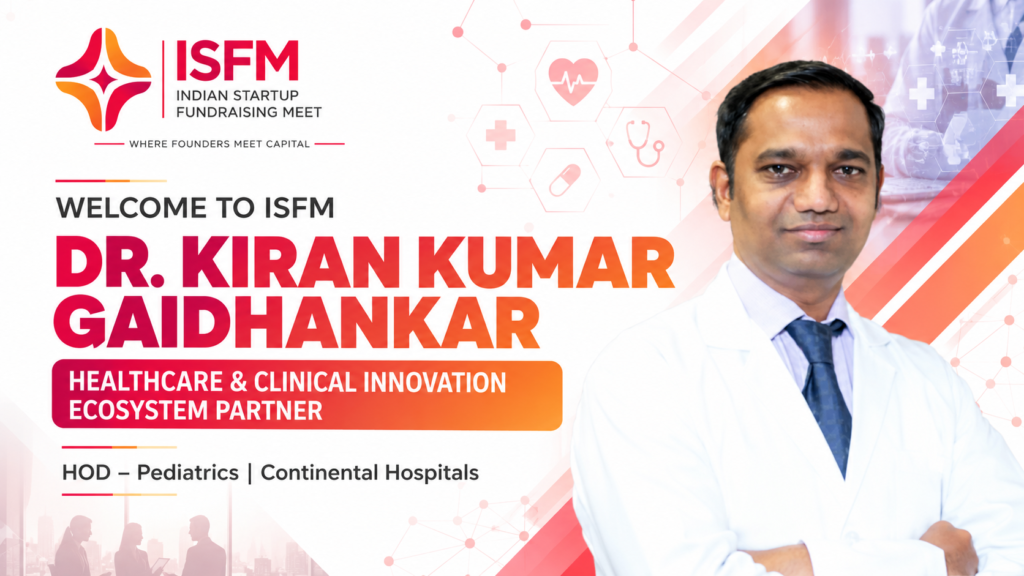
ISFM Welcomes Dr. Kiran Kumar Gaidhankar to Its Growing Startup Ecosystem
ISFM – Indian Startup Fundraising Meet is pleased to welcome Dr. Kiran Kumar Gaidhankar, HOD – Pediatrics at Continental Hospitals, Hyderabad, as a Healthcare & Clinical Innovation Ecosystem Partner.
Dr. Gaidhankar brings experience in pediatric medicine, pediatric intensive care, healthcare leadership, medical education and clinical innovation.
His association adds a healthcare-domain perspective to ISFM’s growing network of ecosystem professionals, startup evaluators, institutional participants and founders.
As technology continues to create opportunities for healthcare innovation, clinical expertise remains important when evaluating whether a proposed solution addresses genuine problems in medical practice.
For HealthTech founders, understanding the realities of patient care, healthcare delivery and clinical workflows can be as important as developing a technically sophisticated product.
Through this association, ISFM aims to explore relevant opportunities for healthcare startup engagement, founder interactions and evaluation-led ecosystem collaboration.
About Dr. Kiran Kumar Gaidhankar
Dr. Kiran Kumar Gaidhankar serves as the Head of the Department of Pediatrics and Senior Consultant in Pediatrics and Pediatric Intensive Care at Continental Hospitals, Hyderabad.
He has a professional background in general pediatrics, pediatric intensive care, pediatric emergencies and child healthcare.
His qualifications include medical training in pediatrics and a fellowship in pediatric intensive care.
His publicly available professional profile also describes experience in managing pediatric emergencies, critical care requirements and child health concerns.
In his ISFM onboarding submission, Dr. Gaidhankar identifies approximately 14 years of pediatric experience and interests extending into healthcare management, innovation, governance and leadership.
His stated professional mission includes strengthening child healthcare, encouraging evidence-based care and helping families better understand pediatric health.
Clinical Experience and Healthcare Innovation
Clinical experience contributes an important perspective to healthcare innovation because medical technologies must ultimately function within real healthcare environments.
A startup may develop a diagnostic tool, monitoring platform, clinical software product or AI-supported healthcare application. However, technical functionality alone does not establish medical usefulness.
A healthcare solution must also be considered in relation to patient needs, reliability, safety, workflow compatibility and applicable regulatory obligations.
Pediatric Healthcare and Critical Care
Dr. Gaidhankar’s professional background includes general pediatric care and pediatric intensive care.
These fields involve clinical assessment, treatment decisions, ongoing patient monitoring and coordination across healthcare teams.
For founders developing pediatric healthcare solutions, understanding how clinicians work and what patients require can help shape more relevant product development questions.
Allergy, Asthma and Nutrition
His submitted profile also identifies pediatric allergy, asthma and nutrition among his areas of interest.
Such domains may be relevant to startups exploring childhood health monitoring, patient education, nutritional assessment or digital health services.
Any clinical application or medical claim would still require appropriate validation and professional review.
Healthcare Leadership and Education
Dr. Gaidhankar also identifies healthcare leadership, medical education and innovation as professional interests.
The broader healthcare innovation ecosystem benefits from collaboration among clinicians, technologists, researchers, administrators and entrepreneurs.
Each group contributes different knowledge to the development and potential implementation of new solutions.
Why Clinical Expertise Matters for HealthTech Startups
Healthcare innovation differs from many other technology sectors because products and services may directly affect patient health.
A HealthTech startup must understand more than its software architecture or commercial opportunity.
Depending on the type of product, important considerations may include:
- The clinical problem being addressed
- Evidence supporting the proposed solution
- Patient safety and responsible use
- Healthcare workflows and practitioner requirements
- Data security and patient privacy
- Applicable regulatory classification and compliance
- Product validation and adoption considerations
- The economic realities of healthcare delivery
A clinical expert can help founders better understand which questions require attention, while recognising that formal clinical validation, regulatory approvals and medical-device assessments must follow their own applicable processes.
Identifying Meaningful Healthcare Problems
Successful problem identification begins with understanding the needs of patients, healthcare practitioners and care delivery organisations.
A startup should be able to explain the problem it is solving, why existing methods may be insufficient and how its proposed approach could create measurable value.
Understanding Clinical Workflows
Healthcare providers often work within established processes involving patient assessment, documentation, treatment, monitoring and follow-up.
A new technology that does not fit practical workflows may face adoption barriers, even if its technical features are promising.
Early clinical feedback can help founders identify assumptions that need to be tested.
Balancing Innovation With Responsibility
AI and digital health technologies can introduce new capabilities, but their limitations must also be understood.
Healthcare founders need to avoid presenting unvalidated outputs as clinically proven or implying that a proposed solution can replace professional medical judgement without supporting evidence.
Responsible product development requires appropriate expertise, evaluation and safeguards.
Dr. Gaidhankar’s Preferred Startup Interests
In the ISFM onboarding form, Dr. Gaidhankar selected Seed as his preferred startup stage.
His sector interests include:
Technology, Artificial Intelligence, Machine Learning and HealthTech.
These areas are relevant to healthcare innovation because technology and clinical practice increasingly intersect through medical software, healthcare information systems, monitoring technology and data-driven tools.
However, expressing interest in these sectors does not mean every HealthTech startup will qualify for an interaction.
The relevance of an opportunity will depend on its business model, stage, healthcare application, technical approach and the nature of the proposed engagement.
His Role Within the ISFM Ecosystem
Dr. Gaidhankar selected Ecosystem Partner as his primary association category, with additional interest in startup communities and networks.
He confirmed openness to interacting with shortlisted founders.
He also indicated interest in receiving pitch decks, online pitch-session opportunities, startup demo-day information and other relevant ecosystem opportunities.
Participation in formal startup evaluation or pitch sessions was marked subject to availability.
Therefore, his potential involvement could include healthcare-domain discussions, founder interactions and suitable evaluation-related activities where mutually agreed.
ISFM should not interpret the onboarding submission as a standing commitment to review every startup or attend every event.
How ISFM Evaluates Startup Opportunities
ISFM follows a structured approach intended to improve the relevance and readiness of startup opportunities.
The initial stage involves preliminary founder screening, during which basic business information, funding requirements, documentation and startup readiness are reviewed.
This preliminary discussion is separate from detailed independent expert evaluation.
Following nomination, startups may undergo evaluation by relevant domain experts according to applicable eligibility and assessment criteria.
The purpose is to identify strengths, gaps and factors that may influence readiness for subsequent ecosystem or investor interactions.
ISFM’s independent expert evaluation process is scheduled to commence on 3 November 2026.
For HealthTech startups, domain-relevant evaluation may help surface questions concerning clinical relevance, practical application, product maturity and market readiness.
However, expert participation depends on individual availability and the scope of the evaluation programme.
ISFM does not guarantee that a particular domain expert will review a particular startup.
What This Collaboration Could Mean for Founders
Healthcare entrepreneurs often need to work across two different environments.
The first is technology and business development, where founders focus on product design, market opportunity, commercial strategy and investment preparation.
The second is healthcare practice, where reliability, clinical relevance, safety, implementation requirements and professional responsibility are particularly important.
ISFM’s growing ecosystem aims to create opportunities for relevant engagement between these areas.
Through Dr. Gaidhankar’s participation, possible areas of collaboration may include healthcare innovation discussions, clinical-domain feedback, founder engagement and evaluation-related participation.
These remain potential opportunities rather than guaranteed mentoring, clinical endorsement or medical validation.
Healthcare Innovation and Funding Readiness
Investors evaluating healthcare startups may consider a different set of factors from those relevant to purely consumer-focused digital businesses.
Depending on the business, these may include product validation, regulatory requirements, clinical adoption, healthcare economics, business scalability and the experience of the founding team.
A founder preparing for fundraising should be able to distinguish a promising hypothesis from a validated outcome.
For example, a prototype demonstrating technical functionality is not necessarily equivalent to a clinically validated medical product.
Similarly, early user interest is not always evidence of institutional purchasing readiness or regulatory suitability.
Clear communication about the startup’s current stage can help improve the quality of fundraising discussions.
Building a More Informed Healthcare Startup Ecosystem
ISFM’s objective is not simply to introduce the largest possible number of founders to the largest possible number of investors.
The platform aims to facilitate more relevant interactions by understanding startup readiness, sector fit and the interests of participating stakeholders.
Clinical professionals, technology specialists, startup mentors, investors and institutional representatives may each contribute different perspectives to this process.
Dr. Gaidhankar’s professional background brings an important healthcare dimension to that ecosystem.
His experience in pediatrics, critical care and healthcare leadership provides a relevant foundation for potential interactions with technology and HealthTech ventures.
A Collaboration Focused on Expertise, Not Investment Commitments
Dr. Gaidhankar has explicitly stated in his ISFM onboarding form that he is currently not investing in startups but remains interested in the ecosystem.
His relationship with ISFM is therefore positioned around healthcare-domain expertise, founder engagement and possible ecosystem participation.
It should not be interpreted as a commitment to invest, provide funding, approve clinical products or offer medical endorsement.
All engagements remain subject to eligibility, suitability, mutual agreement and applicable professional considerations.
Looking Ahead
ISFM welcomes Dr. Kiran Kumar Gaidhankar as a Healthcare & Clinical Innovation Ecosystem Partner.
His clinical experience and interest in innovation add another professional perspective to ISFM’s growing network.
As ISFM progresses into independent expert evaluation and develops further ecosystem collaborations, the platform looks forward to exploring appropriate opportunities for founder engagement, healthcare-domain discussions and innovation-focused interactions.
Meaningful HealthTech innovation requires technology, clinical understanding, responsible evaluation and relevant ecosystem connections.
About ISFM – Indian Startup Fundraising Meet
ISFM is a private startup fundraising facilitation and ecosystem platform focused on preliminary founder screening, independent expert evaluation, funding-readiness assessment and relevant connections among founders, investors and ecosystem professionals.
Official Website: https://www.indianstartupfundraisingmeet.com
Startup Nomination: https://zfrmz.in/A1pyKmrRj1s9OIsgPR4I
Investor & Partner Collaboration: https://zfrmz.in/p5cGk97nqrKp2ZXaJqjl
About Dr. Kiran Kumar Gaidhankar
Dr. Kiran Kumar Gaidhankar is a pediatrician and pediatric intensivist serving as HOD – Pediatrics at Continental Hospitals, Hyderabad.
Professional Profile: https://continentalhospitals.com/doctors/dr-kiran-kumar-g/