Common Startup Fundraising Mistakes: 20 Critical Errors Founders Must Avoid When Raising Capital
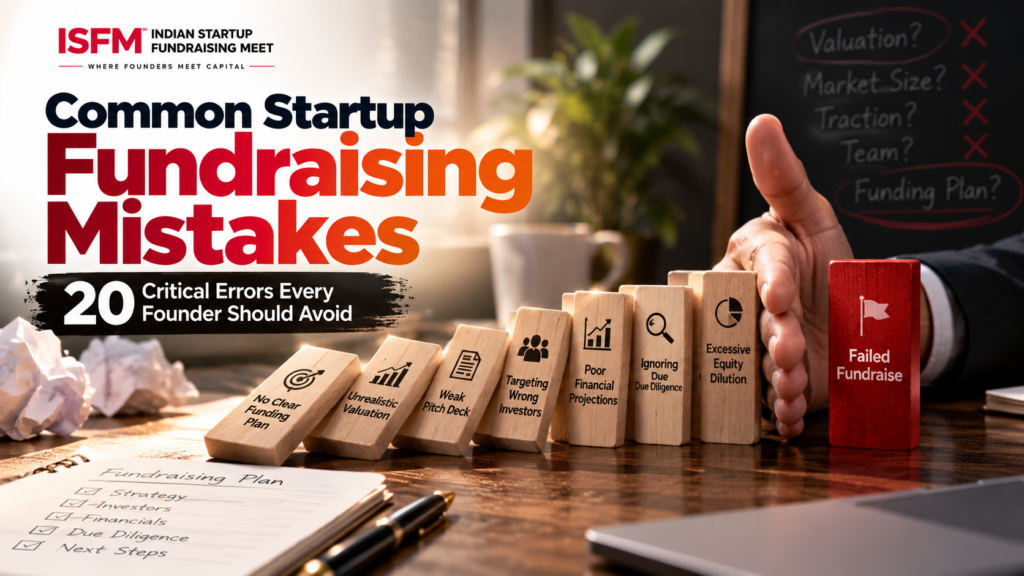
Startup fundraising is not simply about finding investors willing to provide capital. It is about demonstrating that a business has a credible opportunity, a capable team, a clear execution strategy and a funding requirement that supports measurable growth.
Every year, founders approach angel investors, venture capital firms, family offices, incubators and other funding institutions with promising ideas. Yet many fundraising conversations fail to progress—not necessarily because the underlying business lacks potential, but because the founders are inadequately prepared.
A startup might be seeking ₹50 lakh for product development, ₹2 crore for expansion or ₹10 crore for large-scale growth. Regardless of the amount, investors generally want to understand the opportunity, the risks, the expected use of capital and the evidence supporting the company’s plans.
Common fundraising mistakes include approaching investors too early, exaggerating market potential, presenting unrealistic valuations, neglecting financial projections, targeting unsuitable investors and failing to prepare for due diligence.
Understanding these mistakes can help founders approach fundraising more strategically, preserve ownership and build stronger relationships with potential capital providers.
In this comprehensive guide, we explore 20 common startup fundraising mistakes, why they matter, how they can affect investor confidence and what founders can do to avoid them.
Why Do Startups Make Fundraising Mistakes?
Fundraising requires a combination of financial understanding, communication skills, strategic planning, market awareness and execution discipline.
Many first-time founders are experts in their products or industries but have limited experience with investment negotiations.
They may understand their technology extremely well while struggling to answer questions about customer acquisition cost, working capital, market size or equity dilution.
Other founders enter fundraising because competitors have raised capital, without examining whether external investment is necessary for their own businesses.
Three misunderstandings frequently contribute to poor fundraising decisions:
Funding is mistaken for business success. Raising money provides resources, but does not automatically establish product-market fit or profitability.
Investor interest is mistaken for a funding commitment. Positive feedback, meetings and expressions of interest are not the same as signed investment agreements or money received.
A high valuation is mistaken for a good investment deal. Valuation is important, but ownership dilution, investor rights, financing terms and future funding requirements also matter.
Avoiding these assumptions is the starting point for a stronger fundraising strategy.
Mistake 1: Approaching Investors Before the Startup Is Ready
One of the most common errors is beginning investor outreach before the startup can adequately explain its product, market, business model and funding needs.
A founder may have an exciting idea but lack evidence that customers experience the proposed problem or are willing to pay for the solution.
Another may have a prototype but no clear explanation of how the company intends to generate revenue.
Early fundraising is not inherently wrong. Some investors specialise in pre-product or pre-revenue ventures, particularly where the technology, team or opportunity is exceptional.
The mistake is approaching a funding source without meeting that investor’s expectations for the startup’s stage.
How to Avoid This Mistake
Before starting outreach, founders should be able to answer:
- What specific problem are we solving?
- Who experiences that problem?
- What have we built or validated so far?
- What makes our solution credible?
- What business milestone will the funding enable?
- Why is this the appropriate time to raise capital?
A startup does not need to be perfect before approaching investors. It does need an honest and convincing account of its current readiness.
Mistake 2: Raising Money Without a Defined Business Requirement
Some startups decide to raise a particular amount because it sounds impressive or because another company in the sector has recently raised a similar round.
But investors need to understand why the capital is required.
A request for ₹2 crore should be connected to identifiable activities, estimated costs and expected outcomes.
For example, the funding may be intended to develop a commercial product, recruit technical personnel, establish a distribution network or reach a defined revenue milestone.
Weak Funding Request
“We want ₹2 crore to grow our startup.”
Stronger Funding Request
“We are seeking ₹2 crore to complete product development, expand our sales operations into three target markets and achieve defined commercial milestones over the next 18 months.”
The stronger request connects funding to execution.
How to Avoid This Mistake
Prepare a use-of-funds statement, milestone plan and financial forecast before deciding the final amount to raise.
The investment ask should emerge from business requirements rather than arbitrary expectations.
Mistake 3: Waiting Until the Startup Is Almost Out of Cash
A startup may postpone fundraising while concentrating on product development, customer acquisition or operations.
By the time the founder begins contacting investors, the company may have insufficient cash to sustain operations through a complete fundraising process.
This creates pressure.
Founders with limited runway may find it difficult to negotiate, evaluate alternatives or respond to prolonged due diligence.
Understand Cash Runway
A simplified runway calculation is:
Cash Runway (Months) = Available Cash ÷ Average Monthly Net Cash Burn
For example:
| Financial metric | Illustrative amount |
|---|---|
| Available cash | ₹60 lakh |
| Average monthly net cash burn | ₹5 lakh |
| Estimated runway | 12 months |
This example assumes that net burn remains constant and does not account for unexpected expenditure, changes in revenue or restricted cash.
A more reliable runway analysis should consider different business scenarios.
How to Avoid This Mistake
Track cash flow regularly, model alternative operating plans and begin financing preparations with enough time for investor discovery, evaluation, negotiation and closing.
There is no universal number of months that guarantees adequate preparation. The appropriate lead time depends on the business and financing environment.
Mistake 4: Targeting the Wrong Investors
Not every investor is suitable for every startup.
An early-stage agritech business may struggle to attract a venture capital fund that invests only in late-stage enterprise software.
Similarly, an investor focused on profitable family businesses may have little interest in a pre-revenue deep-tech company.
Founders who approach investors indiscriminately often waste time and receive low-quality feedback.
How to Avoid This Mistake
Evaluate each prospective investor using:
- Preferred investment stage.
- Sector and technology focus.
- Geographic investment mandate.
- Typical investment size.
- Equity or debt preferences.
- Portfolio strategy.
- Follow-on investment capacity.
- Strategic support and potential conflicts of interest.
Build an investor shortlist based on genuine alignment rather than the total number of names in a contact database.
Relevant investor outreach is generally more valuable than indiscriminate mass outreach.
Mistake 5: Creating a Pitch Deck That Explains Everything Except the Business
A startup pitch deck should communicate the investment opportunity clearly and efficiently.
Founders sometimes overload presentations with technical terminology, long paragraphs, repeated information and unnecessary background.
Others create attractive presentations that contain very little evidence.
A useful pitch deck should normally cover the company’s purpose, problem, solution, market, business model, team, competitive positioning, traction, financial expectations and funding requirement.
The exact structure can vary by funding stage and investor type.
How to Avoid This Mistake
Create a main presentation that can be understood without extensive explanation, then keep detailed technical, operational and financial material in supporting documents.
Prioritise clarity over decorative complexity.
Investors should be able to understand what the company does, why it matters and what funding is expected to achieve.
Mistake 6: Overestimating the Market Opportunity
Investors want to understand the scale of the opportunity.
However, founders sometimes present enormous market-size figures without explaining which customers they can realistically serve.
For example, a startup selling specialised logistics software should not claim that every rupee spent in the global logistics industry is part of its immediately addressable market.
TAM, SAM and SOM
| Metric | Meaning |
|---|---|
| Total Addressable Market (TAM) | The broader potential market for a solution |
| Serviceable Available Market (SAM) | The portion that the business can realistically serve with its product and operating model |
| Serviceable Obtainable Market (SOM) | The portion the business could plausibly capture within a defined period |
How to Avoid This Mistake
Use a transparent, bottom-up market assessment based on customer segments, realistic pricing, distribution capacity and plausible adoption assumptions.
Identify data sources and distinguish verified market evidence from estimates.
A smaller, credible market estimate is more useful than an unsupported claim of enormous opportunity.
Mistake 7: Claiming There Is No Competition
Founders occasionally describe their startups as having no competitors.
This can raise concerns.
Customers almost always have an alternative way of addressing a problem, even if no company offers an identical product.
Competition may include established companies, substitutes, manual processes, internal solutions or customers choosing not to purchase anything.
How to Avoid This Mistake
Identify both direct and indirect alternatives.
Explain why customers may prefer the proposed solution.
Possible advantages include cost, speed, reliability, distribution, proprietary technology, customer experience or specialised expertise.
The objective is not to prove that competition does not exist.
It is to demonstrate a credible reason for customers to choose your business.
Mistake 8: Presenting Financial Projections Without Evidence
Optimistic projections are common in startup fundraising.
A company with modest current revenue may forecast rapid growth without explaining how many customers it must acquire, how much each customer will pay or what the acquisition process will cost.
This can undermine financial credibility.
How to Avoid This Mistake
Link projections to operational assumptions.
For example:
Projected Revenue = Expected Paying Customers × Average Revenue per Customer
Where relevant, financial models should also account for:
- Customer acquisition rates.
- Conversion assumptions.
- Customer retention.
- Pricing and discounts.
- Cost of goods or service delivery.
- Staffing and overheads.
- Working capital requirements.
- Capital expenditure.
- Gross margin and cash burn.
Prepare base, optimistic and downside cases where appropriate.
Clearly separate historical results, current performance and future estimates.
Mistake 9: Ignoring Unit Economics and Cash Flow
Revenue growth alone does not establish that a business is financially sustainable.
A startup may increase sales while losing money on each transaction.
Another may report positive accounting profits but experience severe cash shortages because customers pay invoices late.
Investors often need to understand both commercial economics and cash movement.
Important Metrics
Gross Margin: Revenue remaining after relevant direct costs, expressed as a percentage of revenue.
Customer Acquisition Cost (CAC): The acquisition-related expenditure required to obtain a customer, based on a clearly defined calculation.
Customer Lifetime Value (LTV): An estimate of the economic value generated by a customer over the relationship.
Burn Rate: The rate at which the company consumes cash, measured consistently.
Runway: The estimated period the company can continue operating with its available liquidity under stated assumptions.
These metrics are not equally relevant to every business model.
How to Avoid This Mistake
Understand the economics of your specific industry.
An enterprise software startup, manufacturing company and retail platform may require different financial measures.
Use consistent definitions and explain calculation assumptions.
Mistake 10: Asking for an Unrealistic Valuation
Startup valuation is an important part of equity fundraising.
However, some founders select valuations based primarily on personal expectations or comparisons with highly funded companies.
A valuation disconnected from the company’s business stage, traction, financial position or financing conditions may create difficulties during negotiation.
Understanding Pre-Money and Post-Money Valuation
Post-Money Valuation = Pre-Money Valuation + New Equity Investment
Consider an illustrative priced equity round:
| Item | Amount |
|---|---|
| Pre-money valuation | ₹8 crore |
| New equity investment | ₹2 crore |
| Post-money valuation | ₹10 crore |
| New investor’s ownership | 20% |
This example assumes a straightforward priced round without additional adjustments such as an option-pool expansion, convertible securities or other negotiated terms.
How to Avoid This Mistake
Assess valuation in relation to business performance, credible comparables, investor expectations, expected dilution and future fundraising requirements.
Evaluate the complete investment package rather than focusing exclusively on the headline valuation.
Mistake 11: Giving Away Too Much Equity Too Early
Raising external capital usually requires founders to consider changes in ownership and control.
Excessive early dilution can reduce founder flexibility in later funding rounds.
But refusing reasonable dilution simply to preserve a particular ownership percentage can also prevent a business from accessing necessary capital.
The challenge is finding an appropriate balance.
How to Avoid This Mistake
Maintain an accurate cap table and model future financing scenarios.
Consider existing shareholder holdings, outstanding options, convertible instruments and proposed investment terms.
Before accepting an offer, understand the difference between nominal ownership, fully diluted ownership, voting rights and contractual control.
Mistake 12: Failing to Prepare for Investor Due Diligence
A strong pitch may create initial interest, but investor due diligence examines whether the startup’s representations can be supported.
Problems often arise when important company documents are missing, inconsistent or incomplete.
Examples include unclear shareholding records, unsigned founder agreements, disputed intellectual property ownership or mismatches between financial statements and pitch presentations.
How to Avoid This Mistake
Create an organised virtual data room.
Typical categories include:
| Data room category | Examples |
|---|---|
| Corporate documents | Incorporation documents, constitutional documents and statutory records |
| Ownership | Cap table, share allotment records and relevant agreements |
| Financial information | Historical accounts, bank records, budgets and projections |
| Commercial information | Material customer and vendor contracts |
| Intellectual property | Registrations, assignments, licences and related agreements |
| Team | Employment and founder agreements |
| Compliance | Relevant registrations, licences and regulatory records |
| Fundraising | Previous investment agreements and outstanding financing obligations |
The exact document requirements depend on the investor, business, jurisdiction and transaction.
Sensitive information should be shared under appropriate confidentiality and access controls.
Mistake 13: Making Unsupported Claims About Traction
Traction is evidence that a startup is progressing toward meaningful commercial or product outcomes.
Founders may exaggerate traction by describing registrations as active users, pilot discussions as signed contracts or projected revenue as actual revenue.
These inconsistencies can seriously damage credibility.
How to Avoid This Mistake
Clearly distinguish between:
- Registered users and active users.
- Leads and paying customers.
- Letters of intent and binding contracts.
- Gross merchandise value and recognised revenue.
- Bookings and collected cash.
- Pilot projects and recurring commercial deployments.
Use accurate definitions and maintain supporting evidence.
If a startup is still pre-revenue, present the strongest relevant validation available without pretending that revenue already exists.
Mistake 14: Pitching the Product but Ignoring the Business Model
Founders who are technically focused may spend most of a pitch explaining how the product works.
Although product innovation is important, investors also need to understand how the company intends to become commercially viable.
Questions to Answer
Who pays for the solution?
How is the product priced?
What is the estimated cost of delivering it?
How will customers be acquired?
Will revenue be recurring, transactional, contractual or based on another model?
What needs to happen for the business to achieve sustainable economics?
How to Avoid This Mistake
Explain the business model in simple language.
A good technical product becomes an investable business proposition when founders can connect product value with a credible commercial strategy.
Mistake 15: Ignoring Legal, Regulatory and Compliance Risks
Fundraising documents should accurately reflect the company’s legal and compliance position.
Depending on the sector, problems may arise from missing licences, unresolved ownership disputes, incomplete statutory filings, data-protection issues or unclear intellectual property rights.
These risks can delay transactions or change investors’ decisions.
How to Avoid This Mistake
Undertake an internal compliance review before fundraising.
For Indian startups, potentially relevant areas include company law compliance, applicable tax obligations, securities regulations, employment matters, sector-specific authorisations and foreign investment rules.
Requirements vary significantly by business.
Specialised legal and financial professionals should review transaction structures and regulated matters.
Mistake 16: Focusing Only on the Funding Amount Instead of the Investment Terms
Two investment offers of the same amount can create very different outcomes for founders.
Terms may influence future dilution, governance, distributions, additional funding rounds and exit arrangements.
Terms Founders Should Understand
Liquidation preference: Determines how proceeds may be distributed in defined liquidity events.
Anti-dilution protection: Can adjust an investor’s economic position following certain future financing events.
Board and governance rights: May influence oversight and important company decisions.
Information rights: Can require periodic business and financial reporting.
Reserved matters or consent rights: May require investor approval for specified company actions.
Founder vesting and transfer restrictions: Can affect founder ownership and flexibility.
Exit provisions: May establish rights or obligations linked to transfers, liquidity or exit events.
How to Avoid This Mistake
Review the full term sheet and definitive documents with qualified legal advisers.
Do not assume that the highest valuation or largest cheque automatically represents the most suitable offer.
Mistake 17: Poor Investor Communication and Follow-Up
Fundraising requires professional communication.
Founders may send lengthy messages without clearly identifying their funding request or the relevance of their startup to the recipient.
Others fail to follow up after meetings or provide inconsistent information across conversations.
Excessive messages can also damage relationships.
How to Avoid This Mistake
Use concise, personalised outreach.
A practical introductory message should ordinarily communicate:
- What the startup does.
- Which problem it solves.
- Its current stage.
- One or two meaningful achievements.
- The funding requirement.
- Why the recipient may be relevant.
- A clear next step.
Maintain a fundraising tracker recording contacts, discussions, feedback, requested documents and follow-up dates.
Investor communication should be consistent, transparent and respectful.
Mistake 18: Ignoring Investor Feedback
Rejection can be frustrating, particularly after founders have spent considerable time preparing a pitch.
However, dismissing all investor feedback can prevent useful improvement.
Repeated concerns about the same issue may reveal a weakness in the fundraising narrative or business strategy.
At the same time, feedback from one investor is not necessarily relevant to every company or financing approach.
How to Avoid This Mistake
Record the reasons for rejection where available.
Look for recurring patterns, including:
- Insufficient market validation.
- Weak customer acquisition strategy.
- Unclear differentiation.
- Inconsistent financial projections.
- Unconvincing fundraising milestones.
- Poor sector or stage alignment.
Distinguish between problems that require business changes and differences in investor preferences.
Mistake 19: Treating Fundraising as the Main Business Goal
Some founders become so focused on funding announcements, valuation discussions and investor meetings that they lose attention on customers, product quality and operating performance.
Fundraising consumes management time.
A company may create more investor interest by continuing to improve the business rather than continuously expanding an unfocused outreach process.
How to Avoid This Mistake
Establish clear fundraising responsibilities and timeframes.
Continue monitoring product, customer, revenue and execution milestones during the process.
External capital should support the business strategy—not replace it.
Mistake 20: Assuming Every Startup Needs Venture Capital
Venture capital is not appropriate for every company.
VC funding often involves expectations of significant growth and eventual liquidity opportunities.
Some businesses are better suited to bootstrapping, customer-funded growth, strategic partnerships, grants, suitable debt products or other financing models.
A profitable, steadily growing business can be successful without raising venture capital.
How to Avoid This Mistake
Compare financing options based on the company’s actual needs.
| Funding option | Common considerations |
|---|---|
| Bootstrapping | Preserves ownership but depends on available internal resources |
| Startup grants | Often project-specific and subject to strict eligibility and use-of-funds rules |
| Angel investment | May suit early-stage companies aligned with an investor’s risk preferences |
| Venture capital | Typically focuses on opportunities with significant scaling potential |
| Business debt | Requires careful consideration of repayment capacity and financing terms |
| Strategic investment | May bring commercial relationships along with financial and contractual considerations |
| Incubation or accelerator support | May offer mentorship, infrastructure, introductions or programme-specific financial assistance |
Choose a capital strategy based on business requirements rather than prestige.
Additional Mistakes Founders Often Overlook
Beyond these 20 critical errors, several practical issues can make fundraising unnecessarily difficult.
Starting Outreach Without Internal Founder Alignment
Co-founders should broadly agree on the funding objective, dilution expectations, intended use of capital and responsibilities during negotiations.
Unresolved disagreements can become a concern during diligence.
Neglecting Intellectual Property Ownership
A startup should understand whether its technology, software, designs, trademarks and other material intellectual property are properly owned or licensed.
This is especially important when contractors, former employees or outside institutions contributed to development.
Failing to Plan the Next Funding Milestone
Founders may secure enough capital to operate for a limited period without considering what measurable progress will enable the next financing round.
A strong funding plan connects expenditure to milestones that improve the company’s future options.
Accepting Unverified Financing Promises
Founders should evaluate prospective intermediaries and investors carefully.
An introduction, interview, verbal commitment or expression of interest is not equivalent to completed financing.
Requests for unusual advance payments, guaranteed returns or guaranteed funding approvals deserve additional scrutiny.
Verify the identity, authority and terms of counterparties before sharing sensitive information or transferring funds.
A Practical Startup Fundraising Readiness Checklist
Before approaching potential investors, founders can assess their preparedness using the following framework.
| Readiness area | Key question |
|---|---|
| Problem validation | Do we have evidence of a meaningful customer problem? |
| Product readiness | Can we clearly demonstrate the product or development progress? |
| Market opportunity | Can we explain the realistic target market? |
| Business model | Is the revenue strategy clear? |
| Traction | Can we substantiate our claims? |
| Financial planning | Do we understand cash burn, runway and capital requirements? |
| Funding objective | Are the proposed use of funds and milestones defined? |
| Pitch deck | Is the investment story clear and consistent? |
| Ownership | Is the cap table accurate and current? |
| Compliance | Are material legal and regulatory matters addressed? |
| Data room | Can we provide essential diligence documents? |
| Investor targeting | Have we shortlisted relevant capital providers? |
| Transaction knowledge | Do we understand dilution and important investment terms? |
This is a preparation framework rather than a scoring system or guarantee of funding eligibility.
How to Build a More Effective Fundraising Strategy
Avoiding common mistakes requires a structured process.
Phase 1: Assess the Business
Review the problem, product, market, business model, traction, financial condition and execution team.
Identify weaknesses that need to be corrected before fundraising.
Phase 2: Determine the Funding Requirement
Build the funding ask from a realistic project or growth plan.
Connect the investment amount to specific activities, expected expenses and milestones.
Phase 3: Choose the Appropriate Capital Type
Evaluate whether grants, incubation support, equity investment, debt or another structure matches the business.
Do not assume that one financing instrument is best for every company.
Phase 4: Prepare Fundraising Materials
Develop the investor presentation, financial model, cap table, due diligence documents and supporting evidence.
Phase 5: Identify Relevant Investors
Build a focused list based on sector, stage, investment size and strategic alignment.
Phase 6: Conduct Structured Outreach
Communicate consistently, track responses, manage investor meetings and respond to reasonable information requests.
Phase 7: Evaluate Offers
Assess valuation, ownership, legal obligations, investor rights, closing conditions and strategic fit.
Phase 8: Execute the Funded Plan
Following successful financing, concentrate on the promised milestones and maintain appropriate investor communication.
Illustrative Case Study: Two Startups Seeking ₹1 Crore
Consider two hypothetical technology startups.
Both are seeking ₹1 crore in external investment.
Startup A: Unstructured Fundraising
Startup A develops a useful product but approaches investors with an outdated pitch deck.
Its founders cannot explain the basis of their valuation.
The company has limited financial planning, does not track its monthly burn consistently and sends identical introductory messages to a large number of investors.
Its ₹1 crore funding request is not supported by a clear expenditure plan.
As a result, investors may find it difficult to assess the opportunity.
Startup B: Structured Fundraising
Startup B prepares a documented business plan, an evidence-based pitch deck and a financial model.
Its founders define the amount of capital required to reach specific development and commercial milestones.
The company maintains an updated cap table, distinguishes projections from actual results and approaches investors with a relevant investment mandate.
Startup B is therefore better positioned to answer diligence questions and communicate a coherent financing proposition.
The lesson is not that preparation guarantees funding. It is that preparation makes the opportunity easier to evaluate and reduces avoidable uncertainty.
What Investors Commonly Want to Understand
Although investor preferences differ, several questions frequently arise during early-stage evaluation.
Why does this problem matter? Investors want to understand the urgency and significance of the customer need.
Why is this solution valuable? The product should provide a compelling improvement over alternatives.
Why this team? Founders need to demonstrate relevant capabilities, execution commitment and an understanding of the market.
Why now? The business should have a credible explanation for its timing.
How can the business grow? The strategy should connect market opportunity to achievable execution.
What evidence exists? Investors assess development progress, market validation, commercial traction and other relevant indicators.
What will the capital accomplish? The funding request should support clear operational or financial milestones.
What could go wrong? Thoughtful acknowledgement of business risks demonstrates preparedness.
A strong pitch answers these questions without exaggeration.
The Role of Incubators, Mentors and Startup Evaluation
Founders do not need to navigate every fundraising challenge alone.
Incubators, accelerators, experienced founders, domain experts and professional advisers can help startups strengthen their business and investment readiness.
Support may include:
- Business model refinement.
- Market validation guidance.
- Pitch deck review.
- Financial model preparation.
- Governance and compliance planning.
- Mock investor presentations.
- Investor identification.
- Fundraising strategy development.
However, advisory support does not remove investment risk or guarantee positive selection decisions.
Founders should examine the credentials, scope of work, fees and contractual terms of any service provider.
How ISFM Supports Structured Startup Evaluation
ISFM – Indian Startup Fundraising Meet is a private startup fundraising facilitation initiative focused on structured evaluation and connections within India’s startup investment ecosystem.
ISFM aims to bring startups into relevant discussions with investors, incubators, accelerators, mentors and other ecosystem participants, subject to evaluation and stakeholder interest.
For founders, an important part of this process is understanding investment readiness.
Before seeking a relevant capital connection, a startup should be prepared to communicate its business opportunity, funding needs, development stage, team capabilities and financial assumptions.
Structured evaluation can also help identify areas that require improvement before investor discussions.
ISFM does not operate as a government funding scheme and does not guarantee meetings, investment approval, valuations, grants or fund disbursement. All investment decisions remain with the relevant capital providers.
Founders interested in ISFM can learn more through the official website and startup nomination process.
Frequently Asked Questions About Startup Fundraising Mistakes
1. What is the biggest mistake startups make when raising funds?
One of the most significant mistakes is raising money without clearly explaining why it is needed and which business milestones it will support. Other serious issues include poor financial preparation, unsuitable investor targeting and unsupported traction claims.
2. Can a startup raise funding without revenue?
Yes. Certain investors fund pre-revenue startups, particularly where the team, technology, innovation or early validation is compelling. The relevant requirements depend on the investor and business stage.
3. Why do investors reject startup pitches?
Possible reasons include weak market evidence, an unsuitable business model, unrealistic valuation, limited traction, concerns about execution, transaction terms or lack of alignment with the investor’s mandate.
4. How important is a pitch deck for fundraising?
A pitch deck helps founders communicate their investment opportunity. However, presentation quality alone cannot replace credible business evidence, financial understanding or due diligence readiness.
5. Should a startup approach all investors simultaneously?
Founders should approach a carefully selected group of relevant investors through a coordinated process. Indiscriminate outreach can waste time and reduce the effectiveness of follow-up.
6. How much funding should a startup raise?
The amount should reflect realistic operating requirements, intended milestones, available resources, financial risks and the financing terms being considered.
7. Can a high startup valuation become a problem?
Yes. A valuation unsupported by the business opportunity or financing environment can create negotiation difficulties and affect expectations for future financing rounds.
8. What is an investor-ready startup?
An investor-ready startup is one that can clearly communicate its opportunity, support its claims with appropriate evidence, explain its financial requirements and respond to the diligence expectations relevant to its stage.
9. What documents should startups prepare before fundraising?
Common documents include a pitch deck, financial information, cap table, corporate records, relevant contracts, intellectual property records and an organised diligence repository.
10. Is it better to raise grants or equity funding?
Neither option is universally better. Grants often support approved projects under specified eligibility and utilisation rules, whereas equity investment exchanges ownership for capital. The choice depends on business needs and financing conditions.
11. How can founders avoid excessive equity dilution?
Maintain an accurate cap table, model financing scenarios, understand the effect of convertible instruments and evaluate the full terms of proposed investments with qualified advisers.
12. Does investor interest mean that funding is confirmed?
No. A meeting, positive discussion or verbal expression of interest is not a completed funding transaction. Funding remains subject to the applicable diligence, documentation, approvals and closing requirements.
Conclusion: Fundraising Success Begins Before the Investor Meeting
The fundraising journey begins long before the first pitch.
It starts when founders understand their customers, validate their solutions, establish credible financial assumptions and determine exactly what external capital should accomplish.
Avoiding common startup fundraising mistakes can improve decision-making, reduce unnecessary delays and help founders engage with prospective investors more effectively.
Startups should focus on preparation rather than presentation alone, evidence rather than exaggeration, and capital suitability rather than funding announcements.
The objective is not simply to convince an investor to provide money. It is to build a credible business capable of using that capital responsibly and productively.
For founders preparing for their next fundraising milestone, structured business evaluation and informed capital planning can make a meaningful difference.
ISFM – Indian Startup Fundraising Meet
Where Founders Meet Capital
Website: https://www.indianstartupfundraisingmeet.com
Startup Nomination: https://zfrmz.in/A1pyKmrRj1s9OIsgPR4I
Contact: +91 92160 71818
Disclaimer: This article is for general educational purposes and does not constitute investment, legal, tax or financial advice. Fundraising terms and eligibility depend on the business, investor and applicable regulations. ISFM is a private facilitation initiative and does not guarantee investor selection or funding.