How ISFM 2026 Helps Startups Connect with Relevant Investors in India
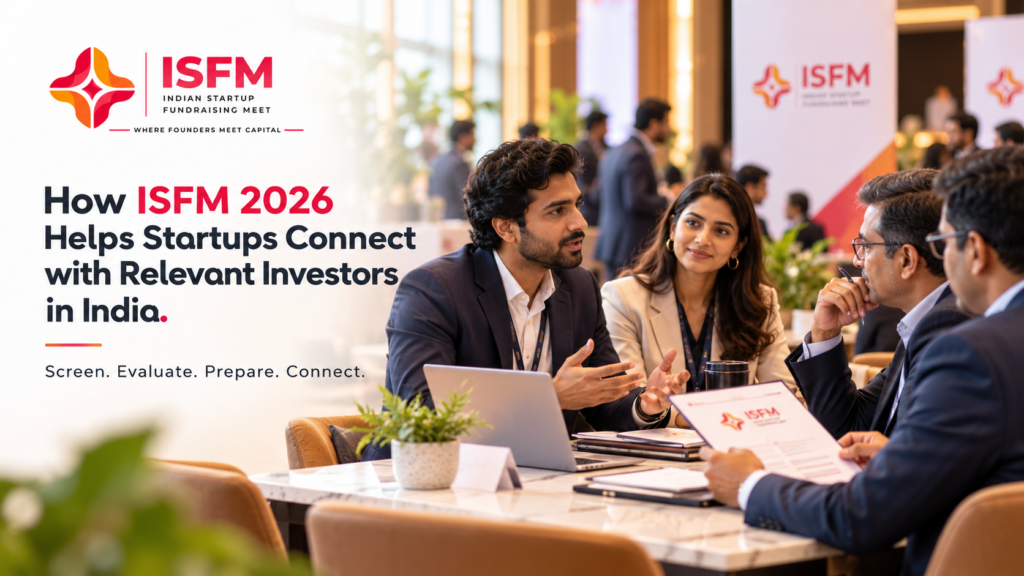
Finding investors is one of the biggest challenges for Indian startup founders. However, the real challenge is not simply discovering investors—it is identifying investors whose sector preferences, investment stage, capital requirements and business interests align with the startup.
India has a growing entrepreneurial ecosystem that includes angel investors, venture capital firms, corporate investors, family offices, incubators, accelerators and institutional stakeholders.
Despite the availability of these networks, many founders struggle to access relevant investment conversations.
They may send pitch decks to hundreds of investors without understanding their investment mandates.
Others approach investors before developing financial projections, validating their businesses or preparing essential fundraising documents.
Consequently, promising startups may encounter avoidable difficulties during investor evaluation.
ISFM 2026 – Indian Startup Fundraising Meet is designed to address these challenges through a structured approach combining startup screening, independent expert evaluation, fundraising-readiness assessment and potential connections with relevant investors and ecosystem stakeholders.
Rather than treating fundraising as a process of distributing pitch decks indiscriminately, ISFM focuses on identifying suitable startup opportunities and encouraging better preparation before investor-facing engagement.
This article explains how ISFM 2026 works, how startups can participate, what makes investor relevance important and how the platform aims to support more meaningful fundraising conversations in India.
What Is ISFM 2026 – Indian Startup Fundraising Meet?
Indian Startup Fundraising Meet (ISFM 2026) is a private startup evaluation, investor-connect and fundraising facilitation initiative operated and managed by Aspire Seed Solutions Private Limited.
Its central objective is to create a structured connection between promising Indian startups and relevant participants in the investment and entrepreneurship ecosystem.
ISFM brings together different categories of stakeholders, including:
- Startup founders and entrepreneurs.
- Angel investors and angel investor networks.
- Venture capital funds.
- Corporate and strategic investors.
- Family offices.
- Incubators and accelerators.
- Industry experts and evaluators.
- Startup mentors.
- Institutional and ecosystem partners.
Unlike an open networking event where any founder might approach any investor, ISFM’s intended process emphasises screening, evaluation, readiness and relevant engagement.
Its guiding principle is reflected in its official tagline:
ISFM – Where Founders Meet Capital.
ISFM is not a Government of India funding scheme, a government funding authority or a source of guaranteed investment.
Its role is to facilitate structured assessment and potential connections, while investors and other funding institutions make their own decisions.
Why Do Indian Startups Struggle to Connect with Relevant Investors?
Many Indian startups have innovative products, experienced founders or promising market opportunities.
However, finding the right capital provider can be difficult.
1. Different Investors Have Different Investment Mandates
Not every investor finances every kind of startup.
Some focus on pre-seed companies, while others invest in businesses generating substantial revenue.
Some prefer healthcare or deep technology. Others specialise in enterprise software, consumer businesses, manufacturing or clean energy.
An investor may also have restrictions concerning investment size and geography.
Approaching an investor without understanding these preferences can create an immediate mismatch.
2. Founders Often Lack Investor Readiness
A startup may have an innovative solution but an incomplete pitch deck, unclear financial projections or an unsupported funding requirement.
This can make serious evaluation difficult.
3. Cold Outreach Does Not Always Create Meaningful Conversations
Founders may send generic investment proposals to large contact lists.
A high volume of emails does not necessarily create relevant investment opportunities.
4. Investor Time Is Limited
Investors may receive many startup proposals and must evaluate opportunities based on their strategies and available resources.
An unstructured pipeline can require substantial time to identify suitable businesses.
5. Founders May Not Understand Their Current Funding Stage
A pre-revenue prototype-stage startup and a growth-stage company generally need different kinds of investors.
When founders do not understand their stage, they may pursue unsuitable capital.
6. Supporting Documentation May Be Incomplete
Investors may request information relating to the business model, financials, ownership, intellectual property, product validation or commercial traction.
Missing or inconsistent documents can complicate due diligence.
These challenges explain why investor discovery should be combined with startup readiness and meaningful investor matching.
How ISFM 2026 Approaches Startup–Investor Connections
ISFM follows a structured journey intended to improve the relevance and quality of startup fundraising interactions.
The broad journey can be understood as:
Startup Nomination → Preliminary Founder Screening → Independent Expert Evaluation → Readiness Gap Identification → Improvement and Applicable Re-Evaluation → Shortlisting → Investor-Facing Opportunities → Potential Funding Discussions
Not every startup progresses through every stage.
Progression depends on applicable programme requirements, eligibility, expert evaluation outcomes, investor interests and other relevant considerations.
The stages are explained below.
Stage 1: Startup Nomination and Profile Submission
The ISFM journey begins when a founder submits a startup nomination through the official application process.
This provides an initial opportunity to share information about the venture.
Depending on the application requirements, founders may need to provide:
- Startup name and legal entity information.
- Founder details.
- Industry or sector.
- Business model.
- Product or service description.
- Current development stage.
- Market opportunity.
- Existing traction.
- Funding requirement.
- Relevant fundraising documents.
The purpose of nomination is to initiate the programme’s assessment process.
Submitting a nomination does not mean that the startup has been selected for investment, shortlisted for a pitch session or approved for funding.
ISFM’s Phase 1 application window is currently described on its official website as open until further notice.
Founders should refer to official announcements for subsequent programme stages.
Stage 2: Basic Screening or Preliminary Founder Screening
After nomination, the startup may undergo an initial screening process.
This stage is referred to as Basic Screening or Preliminary Founder Screening.
It is different from formal independent expert evaluation.
Its objective is to understand the startup’s basic position and determine whether the submitted information supports progression under applicable programme requirements.
Areas considered may include:
- Nature of the business.
- Product or service concept.
- Current startup stage.
- Funding requirement.
- Pitch deck availability.
- Basic business validation.
- Previous funding history.
- Documentation readiness.
- Relevant eligibility factors.
Founders may be asked to clarify important information.
The purpose is not to declare that a startup is investment-worthy based on a short conversation.
Instead, preliminary screening establishes an initial understanding of the opportunity and its readiness for further evaluation.
Stage 3: Independent Expert Evaluation
A distinguishing part of the ISFM process is its focus on more detailed assessment by independent or domain experts.
Independent Expert Evaluation is scheduled to commence on 3 November 2026.
This formal stage is separate from preliminary founder screening.
Experts may review relevant aspects of the company’s business and assess its preparedness for potential funding discussions.
Depending on the startup’s sector and development stage, evaluation areas may include:
Business Model
How does the startup create value, generate or plan to generate revenue, and serve its customers?
Market Opportunity
Is there a clearly defined customer segment and credible market opportunity?
Innovation and Differentiation
What distinguishes the solution from existing alternatives?
Product Readiness
Is the business at the idea, prototype, MVP, commercial launch or scaling stage?
Customer and Market Validation
What evidence supports demand for the product or service?
Commercial Traction
Are reported revenue, customers, usage or other progress indicators accurate and meaningful?
Financial Readiness
Are projections, expenditure assumptions and capital requirements sufficiently explained?
Team Capability
Does the founding team possess relevant experience and execution capabilities?
Fund Utilisation
Does the proposed investment support identifiable activities and measurable milestones?
Investor Suitability
Which kinds of financing providers may be relevant to the startup’s stage and business model?
The depth of evaluation can vary according to the startup and applicable programme process.
Formal evaluation does not constitute an investment commitment or guarantee that an investor will accept the opportunity.
Stage 4: Identifying Fundraising-Readiness Gaps
An important element of ISFM’s approach is identifying areas where a startup may need improvement before investor-facing engagement.
For example, a startup might have strong technology but weak financial planning.
Another company may have paying customers but an unclear capital requirement.
A founder might have prepared a polished presentation without supporting the revenue and market claims with evidence.
Common readiness gaps include:
- Unclear business model.
- Weak pitch deck positioning.
- Incomplete market validation.
- Unsupported traction claims.
- Unrealistic financial projections.
- Unclear use of funds.
- Inaccurate cap table.
- Incomplete due diligence documents.
- Unsuitable investor targeting.
Identifying these gaps can help founders understand why their business may not yet be prepared for particular investors.
An evaluation should not simply identify potential. It should also help clarify the evidence and preparation needed for a more informed fundraising discussion.
Stage 5: Improving Fundraising Readiness
Where applicable, founders may work on identified areas and prepare for further evaluation under ISFM’s relevant programme processes.
Improvements might involve:
- Refining the business presentation.
- Collecting stronger customer validation.
- Clarifying revenue and traction metrics.
- Revising financial assumptions.
- Preparing a milestone-based funding plan.
- Organising the investor data room.
- Improving founder interview preparation.
- Updating supporting records.
The objective is to improve the quality of the underlying business case rather than merely make the presentation look more attractive.
Any personalised advisory, document preparation or done-for-you professional services should be distinguished from the programme’s evaluation activities and may be separately chargeable where offered.
A startup should not interpret guidance or an invitation to improve as a guarantee of eventual selection.
Stage 6: Shortlisting Eligible Startups
Following the applicable evaluation process, startups may be considered for progression based on relevant criteria and outcomes.
The process may consider:
- Business readiness.
- Innovation and differentiation.
- Market opportunity.
- Product maturity.
- Commercial validation.
- Financial credibility.
- Team capability.
- Funding suitability.
- Documentation readiness.
- Expert evaluation findings.
Shortlisting is an intermediate assessment outcome.
It does not mean that investment has been sanctioned or that a financing transaction will necessarily occur.
A shortlisted startup may still require additional investor evaluation, discussions, diligence and negotiations.
Stage 7: Connecting Startups with Relevant Investors
A central purpose of ISFM is to facilitate potential engagement between suitable startups and relevant participants in its investment ecosystem.
However, relevant investor connections require more than simply introducing two people.
A useful match should consider the startup’s actual financing profile.
Investment Stage
Does the investor support idea-stage, pre-seed, seed, Series A or more mature businesses?
Sector Focus
Does the investor evaluate the startup’s industry or an adjacent opportunity?
Investment Amount
Does the proposed round align with the investor’s typical investment range?
Geographic Mandate
Is the investor able and willing to consider Indian startup opportunities?
Business Model
Does the investor have relevant experience with the company’s commercial structure?
Strategic Alignment
Could the investor bring useful industry knowledge, networks or other relevant support?
Investor preferences can change, and any match must remain subject to the investor’s independent interest.
ISFM aims to make investor engagement more relevant—not to imply that every evaluated startup will receive a meeting or investment offer.
What Types of Investors and Ecosystem Partners Are Associated with ISFM?
The official ISFM investor and partner pages identify multiple categories of capital and ecosystem participants.
These include angel investors, venture capital participants, corporate investors, accelerators, incubators and domain experts.
Examples publicly listed within the ISFM ecosystem include:
Angel Investor Participants
ISFM’s investor page lists individual participants such as Arvind Rehalia, Brij Upadhya and Tanish Kanodia as angel investor partners.
Their interests and roles differ, and participation should not be interpreted as a commitment to invest in every startup.
Venture Capital Ecosystem
Finvolve is represented on the ISFM investor page through Aaditya Jain, Senior Analyst, as an investor partner.
The published profile identifies seed-to-growth-stage interests and an indicative investment range, subject to the actual opportunity and investor decisions.
Incubation and Acceleration Ecosystem
Publicly listed institutional or accelerator collaborators include AIC-BAMU Foundation, Afthonia Labs and Startup Stairs.
Such associations may support relevant ecosystem engagement, founder development or exposure to opportunities.
Domain and Strategic Partners
ISFM also lists mentors and other ecosystem professionals who may contribute experience in business strategy, investment readiness, founder engagement or evaluation.
These examples illustrate the breadth of the publicly presented ecosystem.
A listed partner’s participation does not mean that the partner has committed capital, guaranteed a startup meeting or agreed to finance every eligible business.
Founders should refer to the official ISFM website for current partner information and participation details.
Why Relevant Investor Matching Is Better Than Random Outreach
Consider a fictional startup developing an AI-enabled medical technology product.
The company is at the prototype-validation stage and is seeking early-stage risk capital.
Randomly approaching investors across unrelated sectors and financing stages may produce limited engagement.
A more structured approach would begin by identifying the company’s actual requirements:
Sector: Healthcare and technology.
Development Stage: Prototype validation.
Funding Requirement: Based on technical and commercial milestones.
Business Model: Still under validation.
Potential Investor Category: Relevant early-stage technology or healthcare investors, subject to their mandates.
The startup could also consider suitable incubation and innovation-support pathways.
This does not guarantee investor interest.
It simply creates a more rational basis for identifying potential capital providers.
Why ISFM Focuses on Investors’ Time as Well as Founders’ Needs
Startup fundraising is often discussed only from the founder’s perspective.
However, investors also face significant information and evaluation demands.
They may need to review numerous startup opportunities, many of which are outside their investment mandate or lack necessary supporting information.
ISFM’s investor-oriented approach seeks to improve the quality of opportunities progressing toward investor-facing stages.
Preliminary screening and expert evaluation can help identify:
- Startups that do not meet applicable criteria.
- Obvious investor-stage mismatches.
- Missing or inconsistent information.
- Unclear capital requirements.
- Opportunities needing further preparation.
- Startups with potentially relevant business characteristics.
This may reduce avoidable screening work and help investors focus their attention on more relevant opportunities.
The intended efficiency benefit is a programme objective, not a verified guarantee of a particular percentage reduction in investor evaluation time.
Investors retain responsibility for their own independent assessment.
What Makes a Startup More Attractive for Investor Evaluation?
There is no universal formula for an investable startup.
Nevertheless, several qualities can support credible investor discussions.
A Clearly Defined Problem
The company should explain the market problem and why customers need a solution.
A Credible Product
The product or technology should be described accurately according to its development stage.
Evidence of Demand
Customer interviews, product trials, paid pilots or commercial activity may support market validation.
Genuine Traction
Reported user numbers, revenue and commercial claims should be appropriately defined and verifiable.
Financial Clarity
Founders should understand financial assumptions, operating costs, cash burn and planned funding requirements.
Appropriate Capital Strategy
The startup should explain whether it requires equity, debt or another suitable form of financing.
A Strong Founding Team
Relevant domain knowledge, execution capability and founder commitment can influence investment assessment.
Defined Milestones
The company should explain what the proposed capital is intended to accomplish.
A startup does not necessarily need large revenues to begin exploring suitable early-stage investment opportunities, but it must make a credible case for its development stage and financing needs.
Can Pre-Revenue Startups Participate in ISFM 2026?
Pre-revenue startups may be considered for screening and evaluation where they satisfy the applicable programme requirements.
Revenue alone should not be treated as the only indicator of startup potential.
Early-stage evidence can include:
- Problem validation.
- Technical feasibility.
- Prototype development.
- MVP testing.
- Customer discovery.
- Pilot engagement.
- Founder experience.
- Defined commercialisation milestones.
However, submitting a pre-revenue startup does not guarantee that it will be eligible for every programme stage or suitable for every investor.
The outcome depends on actual readiness, expert assessment and the requirements of relevant investors or other stakeholders.
How Startups Can Prepare Before Applying to ISFM
Founders can improve the quality of their initial application by preparing relevant business information.
A useful preparation checklist includes:
| Readiness area | What to prepare |
|---|---|
| Business overview | A concise explanation of the startup |
| Problem and solution | Customer problem and proposed value |
| Product stage | Idea, prototype, MVP or commercial status |
| Market opportunity | Target customers and relevant market evidence |
| Business model | Revenue strategy and economics |
| Traction | Genuine, clearly defined progress |
| Pitch deck | A current presentation |
| Funding ask | Amount and justification |
| Fund utilisation | Proposed deployment of capital |
| Financial planning | Available actuals and forecasts |
| Team | Founders and relevant capabilities |
| Documentation | Applicable company and supporting records |
Not every document is necessarily required at the first screening stage.
Founders should follow the specific application instructions and share sensitive materials only through appropriate authorised processes.
How ISFM Differs from a Conventional Startup Networking Event
A conventional networking event may focus primarily on creating introductions.
ISFM’s stated model places greater emphasis on the sequence leading toward potentially relevant investor engagement.
| Conventional open networking | ISFM’s intended structured approach |
|---|---|
| Founders may independently approach attendees | Founders enter through a nomination and screening process |
| Investor suitability may be unclear | Investor relevance is an important consideration |
| Startup readiness may vary | Expert assessment is part of the process |
| Pitch opportunities may focus on presentation | Business evidence and funding preparation are also considered |
| Connections may occur without prior review | Later-stage engagement depends on applicable evaluation outcomes |
| Follow-up is often left entirely to participants | The programme aims to facilitate relevant ecosystem communication |
The comparison describes different operating approaches, not a claim that every traditional event lacks screening or support.
Actual ISFM opportunities depend on the programme stage, participation requirements and stakeholder availability.
What Happens After an Investor Expresses Interest?
An investor’s interest is only one step in the fundraising process.
A potential transaction may involve:
1. Introductory Discussion
The founder presents the opportunity and answers preliminary questions.
2. Business Evaluation
The investor reviews market potential, business model, team and relevant metrics.
3. Due Diligence
The investor may examine financial, legal, commercial, technical and ownership information.
4. Investment Terms
The parties may discuss valuation, investment amount, security type, governance and other conditions.
5. Definitive Agreements
If negotiations progress, the parties may prepare and execute relevant investment documents.
6. Closing and Disbursement
Funding may be completed after applicable approvals and transaction conditions are satisfied.
Not every investor discussion proceeds to these stages.
An introduction, pitch invitation, expression of interest or term sheet should not be described as completed funding.
Important Distinction: Fundraising Facilitation vs Investment Guarantee
ISFM supports the process of evaluation and potential engagement within the startup investment ecosystem.
It does not independently guarantee that a participating startup will obtain funding.
Investors maintain discretion over:
- Which startups they review.
- Whether they schedule a meeting.
- Their due diligence requirements.
- Proposed investment amounts.
- Valuation and financing terms.
- Investment committee approval.
- Final investment decisions.
Similarly, incubators, accelerators and other stakeholders retain their own selection and participation criteria.
Founders should regard ISFM as a structured potential pathway toward relevant ecosystem engagement, rather than an assured source of capital.
Frequently Asked Questions About ISFM 2026
1. What is ISFM 2026?
ISFM 2026 is the Indian Startup Fundraising Meet, a private startup screening, evaluation and fundraising facilitation initiative.
2. How does ISFM help startups connect with investors?
ISFM aims to identify and evaluate startups, assess funding readiness and facilitate potentially relevant connections with participating investors and ecosystem stakeholders.
3. Is ISFM a government funding scheme?
No. ISFM is a private initiative operated and managed by Aspire Seed Solutions Private Limited.
4. Does ISFM guarantee investor meetings?
No. Investor interactions depend on programme progression, startup relevance and investor interest.
5. Does ISFM guarantee investment?
No. All investment decisions remain with the relevant investors and financing institutions.
6. Can a pre-revenue startup participate?
A pre-revenue startup may seek nomination and be considered under the applicable criteria. Progression depends on screening and evaluation outcomes.
7. What is Basic Founder Screening?
It is an initial assessment of the startup’s basic business information, funding needs and readiness.
8. Is Basic Screening the same as Expert Evaluation?
No. Preliminary founder screening and independent expert evaluation are separate stages.
9. When does Independent Expert Evaluation begin?
The scheduled commencement date for ISFM 2026 Independent Expert Evaluation is 3 November 2026, subject to official programme updates.
10. What does independent expert evaluation consider?
It may consider business model, innovation, market opportunity, product stage, traction, financial readiness, team capability and funding requirements.
11. What happens if a startup has readiness gaps?
Where applicable under programme rules, founders may receive relevant feedback and work on identified issues before further assessment.
12. Does evaluation guarantee shortlisting?
No. Shortlisting depends on applicable criteria and evaluation outcomes.
13. Which investor types are relevant to ISFM?
The ecosystem includes categories such as angel investors, venture capital participants, corporate investors, family offices and other relevant capital stakeholders.
14. Are all ISFM partners required to invest in startups?
No. Partner participation does not automatically create an investment obligation.
15. Can ISFM assist startups outside major metro cities?
The programme is positioned around Indian startups and an ecosystem-based approach. Specific participation requirements should be checked through the official application process.
16. Is a pitch deck required?
Founders should prepare a current pitch deck and follow the documents requested during the applicable programme stage.
17. How much funding can startups receive through ISFM?
There is no guaranteed funding amount. Any potential investment depends on investor interest, independent evaluation, negotiations and applicable conditions.
18. Does paying an application or participation fee guarantee progression?
No. Payment, where applicable, does not guarantee selection, meetings or funding.
19. How can investors and ecosystem partners participate?
Interested stakeholders can explore the official investor information and strategic collaboration channels.
20. How can a startup begin the ISFM journey?
Founders can review the official website and submit their startup nomination through the designated application process.
Conclusion: Connecting the Right Founders with the Right Capital Ecosystem
Raising investment is not simply about finding someone willing to listen to a pitch.
It is about identifying the right funding pathway, preparing a credible business case and engaging with investors whose interests align with the opportunity.
For founders, this requires clarity about the business model, customer demand, development stage, financial requirements and future milestones.
For investors, it requires access to relevant and sufficiently prepared opportunities that justify further evaluation.
ISFM 2026 is designed to bring these priorities together through structured screening, independent expert evaluation, fundraising-readiness improvement and potential investor connections.
The process does not eliminate investment risk or guarantee financing.
Instead, it aims to support more informed and relevant engagement within India’s startup ecosystem.
For founders preparing to raise capital, the first step should not be sending the pitch deck to every available investor.
It should be understanding the startup’s readiness and identifying the most appropriate next opportunity.
Better Preparation. Relevant Connections. More Meaningful Capital Conversations.
ISFM – Indian Startup Fundraising Meet
Where Founders Meet Capital
Official Website: https://indianstartupfundraisingmeet.com/
Startup Nomination: https://zfrmz.in/A1pyKmrRj1s9OIsgPR4I
Strategic Collaboration Onboarding: https://zfrmz.in/p5cGk97nqrKp2ZXaJqjl
Investor Information: https://indianstartupfundraisingmeet.com/investors/
WhatsApp Community: https://chat.whatsapp.com/BNFh80tJsCtJEvgCQsW2i4
Official WhatsApp Channel: https://whatsapp.com/channel/0029VbDbOmr2ZjCkYLBeIw1T
Contact: +91 92160 71818
Disclaimer: ISFM is a private startup evaluation and fundraising facilitation initiative operated by Aspire Seed Solutions Private Limited. Nomination, screening, evaluation, shortlisting or participation does not guarantee an investor meeting, financing approval, grant, loan, investment or disbursement. Investor decisions are independent and subject to the relevant parties’ own evaluation, due diligence and agreements.