Why Are We Raising Capital? A Complete Guide to Defining Your Startup’s Fundraising Purpose
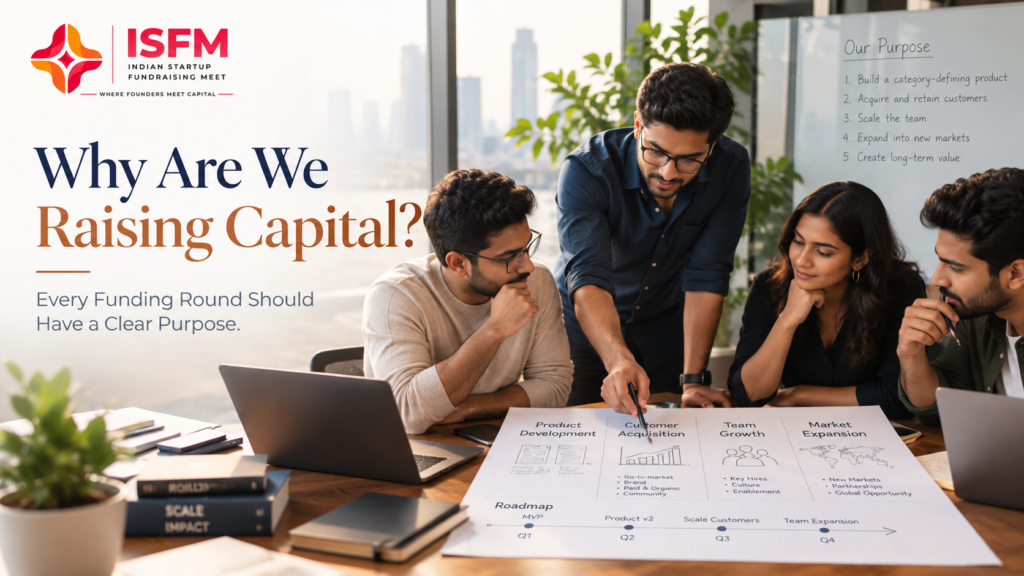
Why are we raising capital? This is one of the most important questions a founder must answer before approaching investors. A credible fundraising strategy begins with a clearly defined business objective—not simply a desire to secure investment.
Many startup founders begin their fundraising journey by deciding how much money they want to raise.
Some seek ₹50 lakh to develop their product. Others target ₹2 crore for expansion, or ₹5 crore to scale operations.
However, a successful fundraising strategy should begin with a different question:
What specific business progress are we trying to achieve, and why is external capital necessary to achieve it?
The answer should explain what the company has accomplished so far, which challenges are limiting its next stage of growth, what financing will make possible and how success will be measured.
Investors do not provide capital merely because a startup wants to grow.
They evaluate whether the proposed financing supports a credible business opportunity, whether the company is capable of executing its plan and whether the investment fits their strategy.
In this comprehensive guide, ISFM – Indian Startup Fundraising Meet explains how founders can define the purpose of fundraising, calculate their capital requirements, choose appropriate funding instruments and prepare a compelling answer to the question: “Why are we raising capital?”
What Does Raising Capital Mean for a Startup?
Raising capital means obtaining financial resources to support business activities, development, operations or expansion.
Startups can obtain capital through different financing arrangements, including equity investment, debt financing, grants and internal funding.
These arrangements have different financial consequences.
An equity investment usually involves issuing an ownership interest to investors.
Debt financing generally creates obligations to repay principal and applicable interest.
Grant funding may support eligible activities under programme-specific conditions.
Internal funding may involve founder contributions or available operating cash.
A startup should choose its financing structure based on its business model, development stage, cash-flow position and intended use of capital.
The objective is not necessarily to raise the maximum amount available. It is to obtain suitable resources for a justified business requirement.
Why Is “Why Are We Raising Capital?” an Important Investor Question?
This question helps investors understand the relationship between the financing request and the startup’s business strategy.
A founder asking for ₹1 crore should be able to explain why the company needs that amount rather than ₹40 lakh or ₹3 crore.
Investors may examine:
- What the startup has achieved using existing resources.
- Which business milestone comes next.
- What prevents the company from reaching that milestone today.
- How much capital is necessary.
- How the money will be deployed.
- How long the financing is expected to support operations.
- What risks may affect the execution plan.
- Which measurable outcomes will demonstrate progress.
A clear answer shows that the founder understands the business beyond its product or pitch deck.
It can also demonstrate financial discipline and realistic planning.
The Difference Between Wanting Funding and Needing Funding
Wanting investment and having a justified capital requirement are not the same.
Consider two statements.
Weak Fundraising Explanation
“We want to raise ₹2 crore because we are planning to grow and expand our startup.”
This statement identifies ambition but does not adequately explain the financial requirement.
Stronger Fundraising Explanation
“We are raising ₹2 crore to complete commercial product development, recruit critical team members, expand customer acquisition and finance the next 18 months of planned operations. The investment is intended to support defined product, customer and revenue milestones.”
The second explanation connects capital to activities, timelines and outcomes.
However, even this statement must be supported by a credible financial model.
A strong funding purpose is specific, financially justified and measurable.
Seven Strategic Reasons Startups Raise Capital
Startups may raise funds for different purposes depending on their stage and business requirements.
1. To Develop or Improve a Product
Early-stage companies may require funding to convert an idea into a functional product.
Capital may support:
- Research and development.
- Prototype creation.
- Engineering and technical development.
- MVP development.
- Product testing.
- Software development.
- Quality assurance.
- Applicable regulatory preparation.
For a deep-tech or medical technology startup, technical validation may be a critical milestone before commercial launch.
Founders should identify the development work remaining and the expected evidence of completion.
2. To Validate Customer Demand
Startups sometimes require capital to determine whether customers will use or purchase their proposed solution.
Funding may support controlled pilots, customer research and early commercial testing.
However, founders should distinguish between the cost of validation and the cost of full-scale expansion.
A company that has not yet established demand may need a smaller validation-focused financing plan before pursuing aggressive growth.
3. To Acquire Customers
A startup with a validated product may need capital to build a repeatable customer acquisition process.
Potential uses include sales recruitment, distribution, marketing and customer onboarding.
The proposed expenditure should be connected to realistic acquisition assumptions.
Investors may want to understand customer acquisition cost, conversion, retention and unit economics.
Increased marketing expenditure is not automatically evidence of scalable growth.
4. To Expand Operational Capacity
Certain businesses require more physical or operational resources to meet increasing demand.
Examples include:
- Manufacturing machinery.
- Inventory.
- Production facilities.
- Logistics infrastructure.
- Distribution systems.
- Technology infrastructure.
- Customer service capacity.
A startup should demonstrate why existing capacity is insufficient and how the proposed investment addresses the limitation.
5. To Recruit Critical Team Members
A founder may have strong technical expertise but lack commercial, financial or operational capabilities needed for the next stage.
Funding can support recruitment of essential personnel.
However, the hiring plan should explain why those roles are necessary and how they contribute to the business strategy.
A large team is not automatically a stronger team.
6. To Finance Working Capital
A business may need cash to operate while waiting for customer payments.
For example, a manufacturing company may receive orders but require funds to purchase raw materials before delivery and collection.
Working capital financing can help manage this timing difference.
Founders should carefully evaluate collections, inventory cycles, margins and repayment obligations before selecting an appropriate financing structure.
7. To Reach the Next Investment-Ready Milestone
Some startups raise funding to accomplish the progress needed for a later financing round.
Examples might include:
- Completing a working prototype.
- Demonstrating technical feasibility.
- Achieving commercial validation.
- Acquiring paying customers.
- Improving retention.
- Building repeatable revenue.
- Demonstrating capital efficiency.
A milestone-based fundraising approach can help explain what the current round is expected to accomplish.
Future investment is never guaranteed, so the company should also prepare for financing delays or alternative outcomes.
The Most Important Principle: Raise for a Milestone, Not Just for Expenses
Expenses describe where money will be spent.
Milestones explain what the startup expects to accomplish through that expenditure.
Both are necessary, but they serve different purposes.
For example:
Expense: ₹25 lakh for engineering.
Milestone: Complete and test a commercially usable product version.
Expense: ₹20 lakh for sales and marketing.
Milestone: Validate customer acquisition through defined channels and measure conversion performance.
Expense: ₹15 lakh for production equipment.
Milestone: Increase verified production capacity to support customer demand.
The relationship should be:
Business Objective → Required Activities → Capital Requirement → Measurable Milestone
This framework helps founders explain why the proposed financing serves a clear strategic purpose.
How Much Capital Should We Raise?
The funding amount should be calculated from the company’s operating plan and expected cash requirements.
Start with the activities required to reach the next meaningful milestone.
Then estimate their financial costs and timing.
Consider existing cash resources, realistic operating inflows, working capital requirements, financing costs and contingencies.
A simplified calculation is:
Capital Requirement = Planned Cash Expenditure + Contingency − Available Allocable Cash − Expected Cash Inflows
However, the timing of cash flows matters.
An expected customer payment arriving later cannot necessarily finance an expense due earlier.
Therefore, founders should prepare a monthly cash-flow forecast and identify the peak expected funding shortfall.
Illustrative ₹1.5 Crore Funding Plan
Consider a fictional early-stage technology company preparing for commercialisation.
| Capital allocation | Amount | Percentage |
|---|---|---|
| Product development | ₹45 lakh | 30% |
| Customer acquisition and sales | ₹37.5 lakh | 25% |
| Critical team recruitment | ₹30 lakh | 20% |
| Infrastructure and operations | ₹22.5 lakh | 15% |
| Working capital and contingency | ₹15 lakh | 10% |
| Total | ₹1.5 crore | 100% |
These figures are hypothetical.
The actual funding amount must be supported by company-specific assumptions.
The plan should explain why each category is necessary, when expenditure will occur and which outcomes it supports.
How Does Startup Stage Affect the Reason for Raising Capital?
The fundraising purpose changes as the startup develops.
Idea Stage
The company may require limited resources for market research, problem validation and early feasibility assessment.
Not every idea-stage startup needs institutional venture capital.
Prototype Stage
Capital may support prototype development, technical testing and early customer validation.
Investors may focus on founder capability, innovation and technical feasibility.
MVP Stage
The company may seek capital for user testing, product refinement, market validation and early commercial activities.
Early Revenue Stage
Funding may support customer acquisition, operational improvements and repeatable commercial growth.
Investors may place increasing emphasis on revenue quality, retention, margins and unit economics.
Growth Stage
A more established company may raise financing to increase capacity, enter new markets or scale proven business activities.
The funding purpose should reflect the actual stage rather than copying another company’s fundraising strategy.
Should We Raise Equity, Debt or Grants?
A startup should determine the type of financing after understanding its capital requirement.
| Funding type | Potentially suitable purpose | Main consideration |
|---|---|---|
| Equity | Long-term development and high-growth opportunities | Ownership dilution and investor rights |
| Debt | Financeable activities supported by repayment capacity | Interest and repayment obligations |
| Venture debt | Eligible startups seeking specialised borrowing | Covenants, repayment and possible equity-linked terms |
| Grants | Approved innovation or programme-specific projects | Eligibility, permitted use and compliance |
| Internal funding | Activities supported by existing available resources | Financial capacity and operating constraints |
A pre-revenue technology startup conducting uncertain research may find conventional repayment-based borrowing unsuitable.
A revenue-generating enterprise with predictable cash flow may have different financing options.
No funding instrument is universally the best choice.
Are We Raising Capital to Grow or to Survive?
This is an important distinction.
Some companies seek capital to exploit validated opportunities.
Others need money because existing operations are consuming more cash than the business can sustain.
Both situations require financial analysis.
Growth-Oriented Financing
Examples may include expanding production to meet documented orders or increasing commercial capacity after validating customer demand.
Survival-Oriented Financing
A company may require financing because operating losses have depleted available cash.
Such financing may be appropriate in certain circumstances, but founders must examine the underlying causes of cash consumption.
Additional capital cannot automatically solve poor customer retention, weak margins or an unsustainable business model.
Questions Founders Should Ask
- Is there genuine evidence of demand?
- Are our unit economics understood?
- What is causing the current cash shortfall?
- Will the proposed financing address the underlying issue?
- Can the business operate if future funding is delayed?
- What changes are necessary beyond obtaining more money?
Fundraising should support a credible plan, not conceal financial weaknesses.
Why Timing Matters in Startup Fundraising
Starting the fundraising process too late can create pressure.
Investor research, introductions, evaluations, due diligence, negotiations and disbursement may take substantial time.
The duration varies significantly across funding routes and transactions.
Founders should assess available cash and expected monthly burn before beginning a financing process.
Cash Runway
A simplified runway formula is:
Runway = Available Unrestricted Cash ÷ Average Monthly Net Cash Burn
Suppose a startup has ₹60 lakh in unrestricted cash and an average monthly net cash burn of ₹5 lakh.
Its illustrative runway is 12 months, assuming the burn rate remains constant.
Actual runway can change with hiring, collections, expenditure and other conditions.
The company should plan fundraising timing with reasonable contingencies.
How to Connect Funding With Measurable Outcomes
An investor should be able to understand how the startup intends to use capital and measure progress.
An illustrative milestone plan might look like this:
| Period | Main objective | Evidence of progress |
|---|---|---|
| Months 1–3 | Complete product improvements | Testing and development records |
| Months 4–6 | Validate customer demand | Documented pilots and customer feedback |
| Months 7–9 | Launch commercial operations | Paying customers and transactions |
| Months 10–12 | Improve acquisition efficiency | Conversion and retention metrics |
| Months 13–18 | Assess expansion readiness | Revenue quality and operating performance |
The exact milestones depend on the business.
For example, a biotechnology startup may prioritise laboratory and regulatory milestones rather than customer acquisition.
Founders should avoid presenting uncertain future outcomes as guaranteed achievements.
What Evidence Makes a Funding Purpose Credible?
Investors may consider several categories of supporting information.
Customer Evidence
Are there real customers, verified pilot users, contracts or meaningful expressions of demand?
Product Evidence
Has the company built and tested the proposed solution?
Market Evidence
Does the startup understand the target customers and competitive environment?
Financial Evidence
Are the operating costs, projections and capital requirements supported by reasonable assumptions?
Team Capability
Does the company have the expertise to execute its plan?
Commercial Economics
Can the business explain customer acquisition, margins, pricing and potential financial sustainability?
Risk Awareness
Does management recognise technical, financial, regulatory and execution risks?
An investment decision does not depend on one metric alone.
The relevant evidence varies by sector, stage and investor strategy.
How to Answer “Why Are You Raising Capital?” in an Investor Meeting
A strong answer can follow a five-part structure.
Part 1: Explain the Current Position
Describe what the company has already achieved.
Part 2: Identify the Next Objective
Explain the most important milestone the company intends to reach.
Part 3: Identify the Resource Gap
Describe what prevents the company from reaching that objective using current resources alone.
Part 4: Explain the Financing Requirement
State how much capital is being raised, the funding type and how it will be allocated.
Part 5: Define the Expected Outcomes
Explain the milestones, timeline and measures of progress.
Sample Investor Answer
“We have completed our MVP and conducted initial customer validation. Our next objective is to commercialise the product and establish a repeatable customer acquisition process.
We are raising ₹1 crore in equity capital to complete the remaining technology work, hire critical commercial personnel and execute a defined market-entry plan.
Our operating budget and financial model explain the proposed allocation and expected funding horizon.
The investment is intended to help us reach measurable product, customer and commercial milestones over the next 15 months.”
This is an illustrative response, not a real startup’s performance claim.
Founders should use their actual figures and evidence.
A One-Sentence Fundraising Purpose Statement
Every founder should try to complete this sentence:
“We are raising [amount] through [funding type] to achieve [specific business milestone] within [timeframe], by investing in [key activities], based on [current evidence].”
For example:
“We are raising ₹75 lakh in seed equity to complete commercial product validation within 12 months, by financing engineering, customer pilots and critical team recruitment, based on our existing prototype and documented early customer feedback.”
The sentence should be adapted to reflect actual business circumstances.
If the founder cannot complete it accurately, more preparation may be necessary.
Common Mistakes When Explaining Why Capital Is Required
1. Saying Only “We Want to Grow”
Growth is an objective, but the funding requirement needs supporting detail.
2. Asking for an Arbitrary Amount
A funding amount should come from an operating plan and financial model.
3. Copying Competitors’ Funding Rounds
Another company’s capital requirement does not establish the appropriate amount for your startup.
4. Ignoring Existing Resources
Founders should consider available cash and realistic internally generated financing.
5. Having No Specific Milestone
Without defined outcomes, it becomes difficult to evaluate the planned capital deployment.
6. Using Unrealistic Projections
Unsupported forecasts can create doubts about the entire financing strategy.
7. Choosing the Wrong Capital Instrument
Debt and equity have different financial implications.
8. Underestimating Working Capital
A startup may require more cash than expected because of payment timing, inventory or implementation costs.
9. Ignoring Dilution and Financing Terms
The amount raised should be evaluated alongside ownership and contractual obligations.
10. Assuming Investment Guarantees Growth
Financing enables activities, but execution and market demand determine results.
What If We Do Not Need External Capital Yet?
Some startups are better positioned to delay fundraising.
If a company can reach its next meaningful milestone using existing resources, postponing an external round may be a reasonable strategic choice.
Potential alternatives include:
- Revenue reinvestment.
- Founder funding.
- Cost reduction.
- A smaller initial project.
- Customer advances, where commercially appropriate.
- Suitable grants or support programmes.
- Operational improvements.
However, delaying financing can also involve opportunity costs.
A founder should assess whether external capital provides a meaningful strategic advantage over available alternatives.
The decision should be made on business evidence rather than a general preference for or against fundraising.
How ISFM Supports Fundraising Purpose and Readiness Assessment
ISFM – Indian Startup Fundraising Meet is a private startup fundraising facilitation initiative designed to support structured startup evaluation and relevant connections within the investment ecosystem.
A clear fundraising purpose is an important part of startup readiness.
Founders should understand their current business position, funding requirements, development milestones and relevant financing options before engaging with investors.
ISFM’s process begins with basic founder screening to understand the startup’s business, funding requirements and initial readiness.
This preliminary screening is distinct from formal evaluation.
Following the applicable nomination and process requirements, independent or domain experts conduct more detailed evaluations.
Progression to subsequent stages depends on relevant eligibility criteria and evaluation outcomes.
Relevant areas of review may include:
- Startup development stage.
- Business model and target market.
- Product and technical readiness.
- Customer validation.
- Traction and financial performance.
- Capital requirement.
- Fund utilisation.
- Business milestones.
- Pitch deck and documentation readiness.
- Suitable investment and financing pathways.
Through structured evaluation and ecosystem engagement, ISFM aims to encourage better-prepared, more relevant discussions between founders and potential capital providers.
Personalised mentoring, document preparation and other done-for-you professional services, where available, may be separately chargeable.
ISFM nomination, screening, evaluation or participation does not guarantee investor meetings, investment selection, financing approval, grants, loans or disbursement.
All funding decisions remain with the relevant investors and institutions.
Frequently Asked Questions
1. Why are startups raising capital?
Startups may raise capital to develop products, validate customer demand, recruit teams, finance working capital, increase operating capacity or support growth.
2. What is the best reason to raise capital?
A strong reason is a clearly defined business requirement supported by a credible expenditure plan and measurable milestones.
3. Should every startup raise funding?
No. Some startups can achieve their objectives using internal resources or revenue.
4. How much capital should a startup raise?
The amount should be based on forecast cash requirements, existing resources, project costs, milestones and appropriate contingencies.
5. Can a pre-revenue startup raise capital?
Yes. Certain investors and funding programmes support pre-revenue startups, depending on their criteria and the strength of the opportunity.
6. Why do investors ask about the use of funds?
It helps them understand how the proposed financing is intended to support business progress.
7. What is the difference between raising capital and generating revenue?
Capital raised through financing provides financial resources under an investment or borrowing arrangement. Revenue is earned through business activity under applicable accounting principles.
8. Is equity funding better than debt?
Neither is universally better. The correct option depends on the company’s stage, repayment capacity, ownership considerations and financing requirements.
9. Can grants support startup capital requirements?
Eligible grant programmes may finance approved project activities subject to their terms and conditions.
10. What are fundraising milestones?
They are measurable business outcomes the company intends to achieve through its financing and operating plan.
11. Can raising capital increase startup valuation?
Capital can support business activities that may create value, but the receipt of funding does not automatically establish a higher economic valuation.
12. How should founders justify a funding ask?
They should connect the proposed amount to current business evidence, required activities, financial assumptions and planned outcomes.
13. Can startups raise money to cover operating losses?
It may be possible, but founders should explain the underlying economics and demonstrate a credible operating and financing strategy.
14. When is the right time to raise capital?
The timing should reflect business readiness, milestones, cash runway, available financing options and expected process duration.
15. Does ISFM guarantee funding after evaluation?
No. ISFM facilitates startup screening, expert evaluation and ecosystem engagement, subject to its processes. Funding decisions remain independent.
Conclusion: Raise Capital With a Clear Business Objective
Fundraising should never begin with the assumption that more money automatically creates a better startup.
The starting point should be the business.
Founders must understand what their company has achieved, which milestone matters next and what resources are necessary to reach it.
A strong financing strategy identifies the purpose of capital, calculates the required amount, chooses a suitable funding instrument and connects expenditure to measurable outcomes.
The objective is not simply to raise money.
It is to use appropriate financing to create credible and sustainable business progress.
Before asking investors to fund your startup, make sure you can clearly explain why the capital is needed, what it will achieve and how you intend to use it responsibly.
The strongest fundraising story is not “We need investment.” It is “We know exactly what this investment is intended to accomplish.”
ISFM – Indian Startup Fundraising Meet
Where Founders Meet Capital
Official Website: https://www.indianstartupfundraisingmeet.com
Startup Nomination: https://zfrmz.in/A1pyKmrRj1s9OIsgPR4I
Investor & Partner Collaboration: https://zfrmz.in/p5cGk97nqrKp2ZXaJqjl
WhatsApp Community: https://chat.whatsapp.com/BNFh80tJsCtJEvgCQsW2i4
Official WhatsApp Channel: https://whatsapp.com/channel/0029VbDbOmr2ZjCkYLBeIw1T
Contact: +91 7014264283
Disclaimer: This article is for educational purposes and does not constitute legal, financial, tax or investment advice. Startup financing decisions depend on individual circumstances, relevant agreements and eligibility requirements. ISFM does not guarantee investor meetings, investment approval or fund disbursement.