Startup Pitch Deck: A Complete Guide to Creating an Investor-Ready Pitch Deck in India
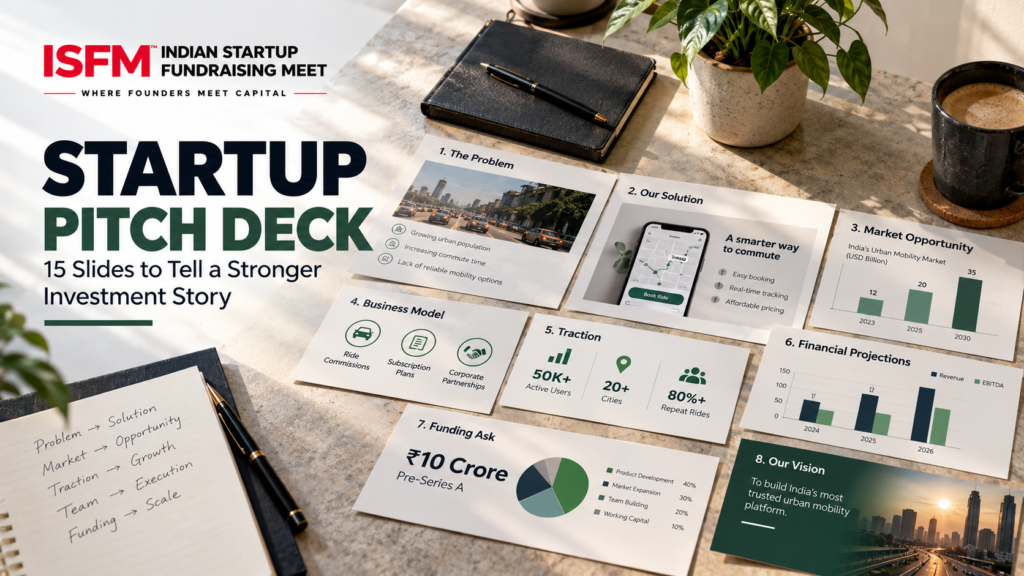
A startup pitch deck is one of the most important documents in the fundraising journey. It helps founders communicate their business opportunity, demonstrate progress, explain their financial requirements and present a compelling case to potential investors.
Whether a startup is approaching angel investors, venture capital firms, family offices, incubators or accelerators, an effective pitch deck can make the difference between a conversation that ends after an introduction and one that progresses to a serious evaluation.
However, a visually attractive presentation is not necessarily an investor-ready pitch deck.
Investors need much more than bold headlines, impressive graphics and optimistic financial projections. They want to understand the problem being solved, the business model, market opportunity, competitive positioning, team capabilities, customer validation and the milestones that investment capital could help achieve.
For founders preparing to raise funding in India, developing a strong pitch deck is an important part of becoming investment-ready.
In this comprehensive guide, ISFM – Indian Startup Fundraising Meet explains what a startup pitch deck is, how to structure it, which slides to include, how to present financial information, what investors look for, and how to avoid common fundraising presentation mistakes.
What Is a Startup Pitch Deck?
A startup pitch deck is a concise business presentation used to communicate a startup’s vision, commercial opportunity, operating strategy, progress and financing requirements.
It is generally prepared as a slide-based presentation and shared during fundraising discussions, startup evaluation processes, investment meetings or incubation applications.
An investor pitch deck helps answer several essential questions:
- What problem does the startup solve?
- Who experiences this problem?
- How does the proposed solution work?
- Why is the solution different from existing alternatives?
- How large is the realistic market opportunity?
- How will the company generate revenue?
- What progress has been achieved?
- Who is building the business?
- How much funding is required?
- What will the funding accomplish?
A pitch deck is not a substitute for a complete business plan, financial model or due diligence process.
Instead, it introduces the business opportunity in a format that investors can review and discuss efficiently.
The primary objective of a pitch deck is to help an investor understand the opportunity clearly enough to consider the next stage of evaluation.
Why Is a Pitch Deck Important for Startup Fundraising?
Fundraising usually involves multiple opportunities to explain the same business.
Founders may first approach investors through email, then participate in introductory calls, formal presentations, technical reviews and due diligence discussions.
A well-structured pitch deck helps maintain a consistent business narrative across these interactions.
1. Communicates the Startup’s Business Opportunity
A good presentation explains what the startup does and why the business matters.
It converts a complex business proposition into an understandable investment story.
2. Demonstrates Business Understanding
The quality of a pitch deck can reveal how well founders understand their customers, competition, financial model and growth strategy.
3. Supports Investor Screening
Investors often use introductory presentations to assess whether a startup aligns with their investment stage, sector and strategy.
4. Clarifies the Funding Requirement
A pitch deck should connect the amount being raised to business activities and measurable milestones.
5. Strengthens Founder Communication
Preparing a deck forces founders to organise their assumptions and explain their business in a disciplined way.
6. Supports Incubator and Accelerator Applications
Many entrepreneurship programmes ask founders to submit a pitch deck as part of their application or selection process.
7. Provides a Foundation for Due Diligence
An accurate presentation can help investors identify the business information they need to examine in greater detail.
A pitch deck cannot guarantee funding, but it can improve the clarity and quality of the fundraising discussion.
What Do Investors Look for in a Pitch Deck?
Different investors have different expectations.
An angel investor evaluating a pre-revenue technology startup may emphasise the founding team, innovation and market opportunity.
A venture capital firm evaluating a growing business may focus more heavily on commercial traction, revenue quality, retention and scaling potential.
A strategic investor may be particularly interested in technology, commercial compatibility and potential collaboration.
Nevertheless, several core evaluation areas appear frequently.
Problem and Customer Need
Does the startup address a real, meaningful and identifiable problem?
Product and Solution
Is the product credible, differentiated and relevant to the proposed customer?
Market Potential
Is the business targeting a sufficiently attractive and realistically addressable market?
Team Capability
Do the founders have the skills, experience and commitment needed to execute?
Business Model
Can the company explain how it earns or intends to earn revenue?
Validation and Traction
Is there evidence supporting the company’s assumptions?
Financial Planning
Are the startup’s historical figures, forecasts and expenditure plans credible?
Funding Requirement
Can the founders explain how much capital is required and which milestones it will enable?
Risk and Execution
Does the management team recognise the company’s operational, technical and financial risks?
Investors evaluate the business behind the presentation—not merely the appearance of the slides.
How Many Slides Should a Startup Pitch Deck Have?
There is no universally mandatory number of slides.
Many early-stage startup presentations use approximately 10–15 main slides, while more complex businesses may require additional technical or financial material.
The appropriate length depends on the startup’s stage, sector and intended audience.
A pre-seed company may present a concise deck focusing on its problem, solution, market and team.
A Series A company may need more detailed commercial performance, customer acquisition economics and financial information.
A research-driven business may require additional technical evidence.
The objective should be clarity rather than meeting an arbitrary slide count.
Founders should also maintain supporting documents that can be shared when investors request more information.
Recommended 15-Slide Startup Pitch Deck Structure
The following structure can help Indian startups prepare an investor-oriented presentation.
It is a recommended framework, not a rule that every investor requires exactly 15 slides.
| Slide | Topic | Main question answered |
|---|---|---|
| 1 | Company Introduction | What does the startup do? |
| 2 | Problem Statement | What problem exists? |
| 3 | Proposed Solution | How does the startup solve it? |
| 4 | Product and Technology | What has the company built? |
| 5 | Market Opportunity | Who will buy it and how large is the market? |
| 6 | Business Model | How will the company generate revenue? |
| 7 | Competition and Differentiation | Why would customers choose this solution? |
| 8 | Traction and Validation | What progress has been demonstrated? |
| 9 | Go-to-Market Strategy | How will the company acquire customers? |
| 10 | Team and Execution Capability | Who will build and operate the business? |
| 11 | Financial Performance and Projections | What do the numbers show? |
| 12 | Funding Requirement | How much capital is needed? |
| 13 | Fund Utilisation | Where will the investment be deployed? |
| 14 | Roadmap and Milestones | What will happen after funding? |
| 15 | Investment Opportunity and Closing | What is the next step? |
The order and emphasis can be adapted to the company’s investment story. For example, a startup with exceptional commercial traction may bring its results earlier in the presentation.
Slide 1: Company Introduction
The first slide should establish the startup’s identity and communicate its purpose.
It should normally include:
- Company name.
- Authentic company logo.
- A concise positioning statement.
- A short explanation of the product or service.
- Relevant presenter or founder information.
- Contact details where appropriate.
Example
AgriSense Technologies
Smart crop monitoring systems for small and medium-sized farms.
This introductory statement communicates the business more clearly than a generic phrase such as “Revolutionising the Future Through Innovation.”
Avoid filling the first slide with unnecessary slogans or broad claims.
An investor should quickly understand the business category and proposed value.
Slide 2: Problem Statement
A strong startup pitch begins with a clearly defined problem.
Investors should understand who experiences the problem, how frequently it occurs and why existing solutions are inadequate.
Questions to Answer
- Who is the target customer?
- What specific difficulty does the customer face?
- What are the financial, operational or practical consequences?
- How does the customer currently address the problem?
- Why are current alternatives insufficient?
Weak Problem Statement
“Farmers have many challenges.”
Stronger Problem Statement
“Small and medium-sized farms often lack affordable, timely information on soil moisture and field conditions, which can make irrigation decisions less efficient.”
The stronger description identifies a customer group and a specific operational challenge.
Where possible, support the problem statement with credible research, customer interviews or operational evidence.
Do not invent market statistics merely to make the problem appear larger.
Slide 3: Proposed Solution
The solution slide should explain how the startup addresses the identified problem.
It should describe the customer benefit rather than list every technical feature.
An effective solution statement connects three elements:
Customer Problem → Proposed Solution → Practical Benefit
Example
“Our monitoring system combines affordable field sensors with mobile-based alerts to help farmers make more informed irrigation decisions.”
This explanation focuses on the product’s function and customer value.
Detailed technical specifications can be included in a separate slide or supporting document.
Slide 4: Product and Technology
This slide provides evidence that the company can deliver its proposed solution.
Depending on the business, it may include:
- Authentic product photographs.
- Screenshots of working software.
- Prototype demonstrations.
- Technical architecture summaries.
- Product development milestones.
- Testing or validation results.
- Relevant intellectual property information.
Present the Current Stage Accurately
A startup should clearly identify whether its product is at:
- Concept stage.
- Proof-of-concept stage.
- Prototype stage.
- Minimum viable product stage.
- Pilot deployment stage.
- Commercially launched stage.
A planned prototype should never be presented as a completed product.
Similarly, pending intellectual property applications should not be described as granted patents.
Slide 5: Market Opportunity
Investors need to understand the scale of the business opportunity.
However, founders frequently overestimate the size of the market they can realistically serve.
A useful market assessment distinguishes between three concepts.
Total Addressable Market (TAM)
The broader market demand for the category of product or service.
Serviceable Available Market (SAM)
The portion of the broader market the company can serve given its product, geography and operating model.
Serviceable Obtainable Market (SOM)
The portion the company may realistically capture within a defined period.
Illustrative Market Calculation
Consider a fictional business software startup.
| Metric | Illustrative assumption |
|---|---|
| Target businesses in its initial market | 20,000 |
| Estimated annual subscription per business | ₹30,000 |
| Addressable annual subscription opportunity | ₹60 crore |
| Assumed reachable customers over the planning period | 1,000 |
| Illustrative annual revenue opportunity from those customers | ₹3 crore |
These are hypothetical figures, not verified market data.
A credible market slide should disclose sources and explain its assumptions.
Avoid claiming that a business can capture a large percentage of an industry merely because the sector is growing.
Slide 6: Business Model
The business model explains how the startup intends to earn revenue.
It should identify the paying customer, pricing approach and primary revenue sources.
Common Startup Revenue Models
Subscription Model: Customers pay recurring fees for continued access to a service.
Transaction Model: The company earns revenue from completed transactions.
Direct Product Sales: Customers purchase physical or digital products.
Licensing: The company licenses intellectual property or technology under agreed terms.
Service-Based Revenue: The company provides professional or operational services.
Marketplace Commissions: The platform receives an agreed fee associated with transactions between participants.
Usage-Based Pricing: Customers pay according to their consumption of a product or service.
Some businesses combine multiple revenue models.
Questions Investors May Ask
- Who pays for the product?
- What is the average price?
- How often does a customer purchase?
- What is the direct cost of delivery?
- How does the company acquire and retain customers?
- What affects gross margin?
- Can revenue grow without proportionate cost increases?
Where revenue has not yet begun, distinguish planned pricing from validated commercial behaviour.
Slide 7: Competition and Differentiation
Every startup competes with existing solutions, substitutes or established customer behaviour.
Claiming that a startup has no competition can signal insufficient market research.
A competition slide should explain the alternatives available to customers and why the proposed solution may be preferable.
Illustrative Comparison
| Evaluation factor | Existing solution A | Existing solution B | Proposed startup |
|---|---|---|---|
| Primary customer | Large organisations | General customers | Targeted SME segment |
| Pricing approach | Enterprise contract | Per-transaction | Proposed subscription |
| Implementation | Custom deployment | Standard service | Simplified onboarding |
| Key differentiation | Broad capabilities | Established distribution | Focused customer experience |
This is an illustrative framework, not a factual comparison of specific companies.
When identifying actual competitors, founders should use verified current information.
Potential competitive advantages may include technology, distribution, price, quality, intellectual property, customer experience or specialised expertise.
Explain why the claimed advantage is credible and sustainable.
Slide 8: Traction and Business Validation
Traction demonstrates that a startup has made meaningful progress.
The relevant indicators depend on the company’s development stage and business model.
Pre-Revenue Startup Traction
Possible indicators include:
- Functional prototype completion.
- Technical validation.
- Customer discovery interviews.
- Successful pilot projects.
- Letters of intent.
- Research milestones.
- Product testing results.
Revenue-Generating Startup Traction
Possible indicators include:
- Monthly or annual revenue.
- Paying customers.
- Repeat purchases.
- Subscription retention.
- Customer acquisition trends.
- Gross margin.
- Contracted business.
- Revenue growth.
Avoid Misleading Metrics
Founders should distinguish registered users from active users, leads from paying customers and gross transaction values from company revenue.
A letter of intent should not automatically be described as a binding customer contract.
Traction slides should identify the reporting period and use consistent definitions.
Credible evidence is more valuable than impressive-looking but unsupported numbers.
Slide 9: Go-to-Market Strategy
A go-to-market strategy explains how a startup intends to reach, acquire and retain customers.
A founder should not rely on a vague statement such as “We will use digital marketing and social media.”
The slide should identify specific distribution and acquisition channels.
Key Components
Target Customers: Which market segment will the startup approach first?
Sales Channels: Will it use direct sales, distributors, online platforms, channel partners or enterprise contracts?
Marketing Strategy: How will it create awareness and generate qualified demand?
Conversion Process: How will potential customers become paying customers?
Retention Strategy: How will the business encourage repeat purchases or continued use?
Expansion Plan: What conditions must be achieved before entering additional markets?
An effective go-to-market plan should reflect the startup’s actual capacity and budget.
Slide 10: Founder and Team Profiles
Investors frequently evaluate the founding team as closely as the product.
A startup may have a strong concept but lack the capabilities required to execute it.
The team slide should demonstrate relevant expertise and responsibilities.
Information to Include
- Founder names and roles.
- Relevant professional experience.
- Educational or technical background where meaningful.
- Industry expertise.
- Previous business achievements.
- Critical team capabilities.
- Relevant advisers or mentors, where formally associated.
Example
Founder and CEO: Responsible for product vision, commercial strategy and business development.
Co-Founder and CTO: Responsible for technology architecture, engineering and product development.
Operations Lead: Responsible for production, supply chain and execution.
The team slide should not become a collection of long resumes.
Focus on the experience that makes the team capable of solving the proposed problem.
Slide 11: Financial Performance and Projections
Financial information is essential for demonstrating business discipline.
However, financial projections should not be presented as guaranteed future performance.
The slide may include historical results, current financial indicators and forward-looking estimates.
Important Financial Metrics
- Revenue.
- Gross profit and gross margin.
- Operating expenses.
- EBITDA, where relevant.
- Net cash burn.
- Available cash.
- Customer acquisition cost.
- Working capital requirements.
- Cash runway.
- Projected revenue and expenditure.
Illustrative Three-Year Projection
| Metric | Year 1 | Year 2 | Year 3 |
|---|---|---|---|
| Revenue | ₹30 lakh | ₹90 lakh | ₹2.10 crore |
| Direct costs | ₹12 lakh | ₹36 lakh | ₹84 lakh |
| Gross profit | ₹18 lakh | ₹54 lakh | ₹1.26 crore |
| Operating expenses | ₹42 lakh | ₹66 lakh | ₹1.05 crore |
| Operating result before other adjustments | −₹24 lakh | −₹12 lakh | ₹21 lakh |
This is a hypothetical illustration, not a forecast for an actual business.
Financial projections should be supported by clear assumptions about customers, pricing, conversion, retention, operating costs and planned hiring.
Why Cash Flow Matters
A startup can report increasing revenue while experiencing cash shortages.
Founders should understand when customers pay, when expenses become due and how much cash is required to support growth.
For deeper financial reviews, maintain a separate integrated financial model.
Slide 12: Funding Requirement
Investors should clearly understand how much money the company is seeking.
A vague statement such as “We need funding for expansion” is insufficient.
The pitch deck should identify:
- Proposed fundraising amount.
- Type of funding being sought.
- Relevant investment stage.
- Intended financing period or milestone horizon.
- Key outcomes the financing should support.
Example
Funding Requirement: ₹2 Crore
Funding Type: Equity Investment
Purpose: Product Commercialisation and Market Expansion
Planning Horizon: 18 Months
This example is illustrative.
Founders should not assume an investor will agree to an investment amount simply because it appears in the presentation.
Slide 13: Fund Utilisation Plan
The use-of-funds slide explains where the proposed investment will go.
Every major expenditure category should support the startup’s development or growth plan.
Illustrative ₹2 Crore Fund Utilisation
| Expenditure category | Proposed allocation | Percentage |
|---|---|---|
| Product and technology development | ₹60 lakh | 30% |
| Sales and customer acquisition | ₹50 lakh | 25% |
| Team recruitment | ₹40 lakh | 20% |
| Infrastructure and operations | ₹30 lakh | 15% |
| Working capital and contingency | ₹20 lakh | 10% |
| Total | ₹2 crore | 100% |
The figures should be built from realistic activity-level budgets.
An investor may question an allocation that appears inconsistent with the company’s actual stage.
For example, a pre-product startup proposing to spend most of its investment on national advertising may need to explain how product readiness will be achieved.
Slide 14: Growth Roadmap and Milestones
The roadmap explains what the startup plans to accomplish after receiving capital.
It should establish measurable outcomes rather than broad promises.
Illustrative Milestone Plan
| Period | Proposed objective |
|---|---|
| Months 1–3 | Complete agreed product-development milestones |
| Months 4–6 | Begin controlled customer validation |
| Months 7–9 | Refine product and acquisition strategy |
| Months 10–12 | Expand into selected commercial channels |
| Months 13–18 | Pursue defined revenue and operating targets |
Milestones should match the company’s development stage, funding amount and execution capacity.
For a research-intensive startup, technical validation may be more relevant than rapid commercial expansion.
For a growing SaaS startup, retention, revenue quality and customer acquisition efficiency may be more important.
Connect Funding to Outcomes
A strong fundraising narrative explains:
Current Business Position → Capital Requirement → Execution Plan → Measurable Milestones
This makes the funding request easier to evaluate.
Slide 15: Investment Opportunity and Closing
The final slide should reinforce the investment proposition and establish the next step.
It may include:
- Company name and positioning.
- Proposed funding requirement.
- One or two important business achievements.
- The next milestones.
- Founder contact information.
Avoid filling the final slide with unsupported promises about returns or valuations.
A simple closing message may be:
“Building an accessible technology platform for a measurable industry challenge.”
Funding Requirement: ₹2 Crore
Next Step: Investor Discussion and Detailed Business Evaluation
The closing slide should make it easy for an interested investor to continue the conversation.
How to Make a Pitch Deck More Attractive to Investors
A pitch deck should be visually professional without becoming visually overwhelming.
Use One Main Message per Slide
Each slide should communicate a clear idea.
Avoid mixing the market problem, technical architecture, financial forecast and team profiles onto one crowded page.
Use Short, Meaningful Headlines
A heading such as “Our customer acquisition cost declined by 25% over the measured period” communicates a stronger point than the generic heading “Marketing.”
Any numerical claim must be supported by evidence.
Prefer Real Product Evidence
Use authentic product photographs, genuine screenshots, real test data and accurately labelled customer evidence where available.
Avoid decorative visuals that make an unbuilt product appear operational.
Use Readable Typography
Choose professional fonts and maintain sufficient contrast.
Tables and charts should remain readable on laptop screens and during presentations.
Apply a Consistent Design System
Maintain consistent typography, spacing, colours and logo placement.
Consistency does not require every slide to have an identical layout.
Minimise Unnecessary Effects
Excessive animation, 3D illustrations, visual clutter and unnecessary transitions can distract from the business.
Maintain Data Accuracy
Revenue, ownership, user metrics and market figures must remain consistent throughout the deck.
How to Write a Powerful Pitch Deck Story
Fundraising presentations are more effective when the information forms a coherent narrative.
A practical story can follow this structure:
1. The problem matters. Explain why the customer pain deserves attention.
2. Existing solutions are inadequate. Identify relevant gaps in the market.
3. The startup has a credible solution. Explain the product and its benefits.
4. The opportunity is attractive. Establish the realistic market potential.
5. The business can execute. Demonstrate team capabilities and progress.
6. The commercial model is understandable. Explain revenue generation and customer acquisition.
7. Capital has a defined purpose. Connect the funding request to future milestones.
This structure allows investors to follow the logic of the opportunity.
A persuasive pitch is not simply a collection of strong individual slides. It is a consistent explanation of why the business can create value.
Pitch Deck Requirements for Different Funding Stages
Startups should adjust their presentations according to their development stage.
Idea-Stage Pitch Deck
At the idea stage, a presentation may focus on:
- Problem identification.
- Customer research.
- Proposed solution.
- Founder capabilities.
- Technical or commercial feasibility.
- Planned development milestones.
The startup should not pretend it has commercial traction if no customers have been acquired.
Prototype-Stage Pitch Deck
A prototype-stage presentation should explain what has been built and tested.
Relevant evidence may include product demonstrations, performance results and next-stage development requirements.
MVP-Stage Pitch Deck
An MVP-stage startup may focus on user testing, early adoption, pricing validation and market feedback.
Revenue-Stage Pitch Deck
A revenue-generating startup should provide clearer financial and commercial data.
Investors may expect information about customers, revenue, margins, retention and growth efficiency.
Growth-Stage Pitch Deck
Growing companies may need more detailed operating metrics, market expansion plans, unit economics and capital efficiency analysis.
A pitch deck should reflect the startup’s actual maturity rather than copying the presentation of a more established company.
Pitch Deck for Equity Funding
An equity-focused pitch deck should demonstrate why investors may find the company’s ownership opportunity attractive.
The presentation should address commercial potential, business risk, growth strategy, investor fit and the funding requirement.
Important considerations may include:
- Startup valuation assumptions.
- Existing ownership structure.
- Proposed investment amount.
- Expected business milestones.
- Potential future capital requirements.
- Relevant investment terms.
A short pitch deck can introduce these subjects, while detailed cap-table and transaction information may be provided separately.
An investor-ready equity pitch deck should not promise guaranteed returns.
Pitch Deck for Government Grants
A grant-focused pitch deck often needs to emphasise different information.
Government and institutional grant programmes may prioritise technical innovation, research outcomes, project feasibility and permitted expenditure.
A grant presentation may include:
- Problem and public or industry relevance.
- Innovative solution.
- Technical feasibility.
- Current technology readiness.
- Proposed project activities.
- Research and development requirements.
- Project budget.
- Milestone-based deliverables.
- Expected outcomes.
- Team capability.
Founders should not assume that the same deck used for venture capital investment will satisfy every grant application.
The funding organisation’s prescribed format should take priority.
Pitch Deck for Debt Funding
A lender-focused presentation should place greater emphasis on the company’s ability to repay borrowed capital.
Important content may include:
- Business model and operating history.
- Revenue and cash flow.
- Existing liabilities.
- Funding purpose.
- Financial projections.
- Repayment plan.
- Working capital cycle.
- Security or guarantees, where applicable.
- Business risk assessment.
A visually attractive pitch deck cannot substitute for the financial documents and credit appraisal required by a lender.
Pitch Deck vs Business Plan vs Detailed Project Report
These documents serve different purposes.
| Document | Main purpose | Typical content |
|---|---|---|
| Pitch deck | Communicate the opportunity clearly | Concise slides covering business, market, traction and funding |
| Business plan | Explain overall strategy and operations | Business model, market, execution and financial planning |
| Detailed Project Report (DPR) | Document project feasibility and implementation | Project scope, technical requirements, costs, forecasts and execution |
| Financial model | Quantify financial performance and assumptions | Revenue, costs, cash flow, funding and scenarios |
| Investor data room | Support diligence and verification | Legal, financial, commercial and operational documents |
These materials should be consistent with one another.
For example, revenue forecasts in the pitch deck should reconcile with the financial model.
Common Startup Pitch Deck Mistakes to Avoid
1. Too Much Text
Long paragraphs make slides difficult to understand quickly.
Focus on concise explanations and meaningful supporting evidence.
2. Unclear Business Introduction
If investors cannot understand what the company does, the rest of the deck becomes less effective.
3. Unsupported Market Statistics
Use credible sources and transparent assumptions.
4. Unrealistic Financial Projections
Avoid presenting aggressive revenue forecasts without operational support.
5. Missing Competition Analysis
Explain alternatives and the startup’s differentiation.
6. Weak Business Model
Clarify how the company generates or expects to generate revenue.
7. No Evidence of Validation
Present available testing, customer research or traction.
8. Unclear Funding Requirement
State the proposed amount and its intended purpose.
9. Poor Fund Utilisation Planning
Show how expenditure supports measurable outcomes.
10. Excessive Design Elements
Avoid clutter, unnecessary animations and decorative graphics.
11. Inconsistent Financial Figures
Reconcile data across the deck, business plan and financial model.
12. Misrepresenting Product Readiness
Clearly identify whether the product is planned, in development, under testing or commercially available.
13. Missing Founder Information
Explain why the team can execute the plan.
14. Targeting the Wrong Funding Audience
Adapt the presentation for equity investors, lenders, grant committees or incubators.
15. Ignoring Investor Questions
Prepare supporting documents and explanations for important claims.
A strong pitch deck minimises avoidable uncertainty rather than attempting to hide business risks.
How to Present Your Pitch Deck to Investors
Developing the deck is only one part of the fundraising process.
Founders should also prepare to explain it effectively.
Begin With a Clear Introduction
Describe the startup and the problem being solved in simple language.
Focus on the Business, Not Just the Slides
Slides should support the founder’s explanation rather than replace it.
Understand Your Financial Numbers
Founders should be able to explain revenue assumptions, expenses, margins, funding requirements and runway.
Be Transparent About Risks
Acknowledge important technical, financial and operational uncertainties.
Prepare for Questions
Investors may examine market research, customer traction, valuation, product readiness and the proposed use of funds.
Avoid Overpromising
Do not guarantee investment returns, customer growth or future valuations.
End With a Specific Next Step
Clarify whether the purpose of the meeting is further evaluation, due diligence or another discussion.
What Questions Do Investors Ask About a Pitch Deck?
Common questions include:
- Why did you start this company?
- How did you identify the customer problem?
- What makes your solution different?
- How many customers have validated the product?
- What evidence supports the market-size estimate?
- Who are your direct and indirect competitors?
- How will you acquire customers?
- What is your revenue model?
- What are your gross margins?
- How much cash does the business currently have?
- What is the expected runway?
- Why are you raising this particular amount?
- How will the funding be used?
- What valuation are you seeking, if relevant?
- Which milestones will be achieved after funding?
- What are the most important execution risks?
- What will happen if financing takes longer than expected?
- Why is your team capable of building the business?
Founders should prepare credible, evidence-based answers rather than memorised promotional statements.
Practical Pitch Deck Preparation Checklist
Before sending a presentation, review the following areas.
| Readiness area | What to verify |
|---|---|
| Company introduction | Clear business explanation and correct company name |
| Problem | Specific, credible customer problem |
| Solution | Understandable customer benefit |
| Product | Accurate development stage |
| Market | Realistic size and sources |
| Business model | Clear revenue logic |
| Competition | Verified alternatives and differentiation |
| Traction | Evidence-backed performance indicators |
| Team | Relevant capabilities and roles |
| Financials | Consistent historical figures and projections |
| Funding requirement | Defined amount and financing purpose |
| Fund utilisation | Budget aligned with milestones |
| Roadmap | Realistic execution plan |
| Ownership | Current cap table, where relevant |
| Compliance | No materially misleading representations |
| Design | Readable, consistent and professional |
| Supporting documents | Available for further review |
Completing this checklist does not guarantee investor selection, but it helps founders identify common presentation weaknesses.
How to Improve an Existing Pitch Deck
Founders do not always need to create a completely new presentation.
An existing pitch deck can often be improved through a structured review.
Step 1: Assess the Story
Read only the slide headlines in sequence.
Do they explain the company’s opportunity logically?
Step 2: Remove Unnecessary Information
Move detailed explanations into supporting documents where appropriate.
Step 3: Verify the Numbers
Check revenue, projections, market assumptions and financial calculations.
Step 4: Improve Evidence
Replace broad claims with credible customer, technical or commercial information.
Step 5: Clarify the Funding Ask
Connect the proposed amount to expenditure and business outcomes.
Step 6: Improve Visual Consistency
Use readable typography, appropriate spacing, authentic images and consistent branding.
Step 7: Conduct a Mock Pitch
Present the deck to informed reviewers who can challenge assumptions and identify unclear sections.
Step 8: Revise Based on Feedback
Address recurring questions and factual inconsistencies before further investor outreach.
Should Startups Use AI to Create Pitch Decks?
AI-assisted tools can help founders organise information, improve language, explore layouts and create presentation structures.
However, AI-generated slides can create problems when they include invented financial figures, unverified market estimates, artificial customer testimonials or inaccurate product visuals.
Founders should remain responsible for the accuracy of their materials.
Appropriate Uses of AI
- Improving presentation structure.
- Editing grammar and readability.
- Simplifying technical explanations.
- Generating layout alternatives.
- Organising supplied business information.
- Helping identify missing sections.
What Founders Must Verify
- Market statistics.
- Financial information.
- Customer and revenue claims.
- Competitor information.
- Technical specifications.
- Product images.
- Intellectual property claims.
- Funding amounts and valuation assumptions.
AI can improve presentation quality, but it cannot replace genuine business evidence.
How a Strong Pitch Deck Supports Investor Readiness
Investor readiness involves more than having a polished presentation.
A startup should also understand its market, finances, governance, financing requirements and execution plan.
Preparing a pitch deck can expose gaps in these areas.
For example, difficulty completing the market slide may indicate that customer segmentation needs improvement.
Difficulty explaining the business model may reveal weaknesses in pricing or revenue assumptions.
An unclear funding slide may indicate that the company has not completed adequate financial planning.
Therefore, pitch deck development can be a useful internal strategic exercise.
The purpose is not merely to impress investors.
It is to create a clearer understanding of the business.
How ISFM Supports Startup Pitch Evaluation and Fundraising Readiness
ISFM – Indian Startup Fundraising Meet is a private startup fundraising facilitation initiative focused on structured startup evaluation and relevant connections within the entrepreneurial and investment ecosystem.
ISFM’s ecosystem engagement includes investors, incubators, accelerators, mentors and other startup stakeholders.
For founders preparing for fundraising, the quality of their pitch deck is an important consideration because it reflects the clarity of their business model, financial planning, development stage and capital requirements.
Structured startup evaluation may examine areas such as:
- Problem identification and solution differentiation.
- Market opportunity and competition.
- Product readiness and technical validation.
- Business model and commercial traction.
- Founder and management capabilities.
- Financial planning and projections.
- Funding requirements and utilisation.
- Valuation and ownership considerations.
- Documentation and due diligence readiness.
- Suitability for grant, debt, equity or incubation opportunities.
The objective is to help founders identify preparation gaps and support more informed discussions with relevant ecosystem stakeholders.
ISFM is not a government funding programme, lender or investment fund solely by virtue of its facilitation activities. Startup nomination, evaluation or participation does not guarantee investor meetings, investment approval, grants, financing or fund disbursement.
Investment and funding decisions remain with the respective investors, financial institutions and programme authorities.
Official and Educational Resources for Pitch Deck Preparation
Founders can explore the following resources to better understand business planning, startup development and investor communication.
Sequoia Capital – Writing a Business Plan
Sequoia’s guidance examines company purpose, customer problems, solutions, market opportunity, competition, business models, teams, financials and long-term vision.
Y Combinator – Startup Library
Y Combinator publishes educational resources covering startup development, growth and fundraising.
Startup India
Startup India provides resources related to India’s startup ecosystem, government initiatives and entrepreneurship.
Founders should use such frameworks as educational references rather than assuming that one presentation format suits every investor.
Frequently Asked Questions About Startup Pitch Decks
1. What is a pitch deck?
A pitch deck is a concise slide presentation that explains a startup’s business opportunity, market, product, team, financial information and funding requirement.
2. Why do startups need a pitch deck?
Pitch decks help founders communicate their businesses during investor outreach, funding discussions, incubation applications and startup evaluation processes.
3. How many slides should an investor pitch deck have?
There is no compulsory number. Many startups use approximately 10–15 core slides, adapting the length to their stage and investor audience.
4. What are the most important slides in a pitch deck?
Important sections usually include the problem, solution, market, business model, traction, team, financial information and funding requirement.
5. Can a pre-revenue startup create a pitch deck?
Yes. Pre-revenue startups can present customer research, technical progress, product validation, team capabilities and credible development plans.
6. Does a pitch deck guarantee startup funding?
No. Investors independently assess business opportunities, risks, financing terms and supporting evidence.
7. Should a pitch deck include financial projections?
Usually yes, where relevant. Projections should be realistic and supported by transparent assumptions.
8. Should startup valuation appear in a pitch deck?
It depends on the financing strategy and investor audience. A proposed valuation may be discussed in the deck or during subsequent investment negotiations.
9. Can one pitch deck be used for grants, equity and debt?
A core business presentation can be adapted, but different funding sources assess different requirements. Grant, lender and equity-investor materials should be tailored accordingly.
10. What is the difference between a pitch deck and a business plan?
A pitch deck summarises the business opportunity, while a business plan explains the operating and commercial strategy in greater detail.
11. Is a pitch deck required for incubator applications?
Many incubators request presentations, but requirements vary by programme.
12. What should the first slide contain?
Typically, the company name, logo, concise business description and relevant founder or presenter information.
13. What should the final slide contain?
Usually the investment proposition, funding requirement where relevant, contact information and a clear next step.
14. How should founders present competition?
Identify relevant direct and indirect alternatives and explain credible differentiation using verifiable information.
15. Is a visually attractive deck enough to convince investors?
No. Strong design supports communication, but the business model, evidence, team and financial credibility remain essential.
16. Can AI create an investor pitch deck?
AI can assist with structure and design, but founders must verify all commercial, financial and factual content.
17. What is a fund utilisation slide?
It explains how the startup intends to allocate the proposed funding across specific business activities.
18. Should founders include customer testimonials?
Only where the testimonials are authentic, appropriately authorised and accurately represented.
19. How often should a pitch deck be updated?
Update it when material business information changes, including product development, financial performance, customer traction, ownership or the funding requirement.
20. How can founders prepare for investor questions?
Understand the assumptions behind every slide, maintain relevant supporting documents and practise answering difficult business and financial questions accurately.
Conclusion: A Great Pitch Deck Begins With a Strong Business Story
A startup pitch deck is more than a collection of slides.
It is a structured explanation of the problem the company solves, the opportunity it is pursuing, the evidence supporting its business model and the capital required to achieve its next milestones.
The most effective presentations combine clear storytelling with credible financial information, genuine product evidence and realistic execution planning.
Founders should focus on clarity instead of unnecessary complexity, proof instead of exaggeration and business readiness instead of visual appearance alone.
A strong pitch deck does not guarantee investment. It gives investors a clearer reason to understand, evaluate and potentially engage with the startup.
For entrepreneurs preparing to approach angel investors, venture capital firms, incubators or other funding organisations, developing an accurate and compelling pitch deck is an essential part of fundraising preparation.
ISFM – Indian Startup Fundraising Meet
Where Founders Meet Capital
Official Website: https://www.indianstartupfundraisingmeet.com
Startup Nomination: https://zfrmz.in/A1pyKmrRj1s9OIsgPR4I
Contact: +91 92160 71818
Disclaimer: This article is for general educational and informational purposes. Pitch deck structures, investor expectations and fundraising requirements vary by company and programme. ISFM is a private startup fundraising facilitation initiative and does not guarantee investor selection, funding approval, valuation or fund disbursement.