Choose the Right Type of Capital
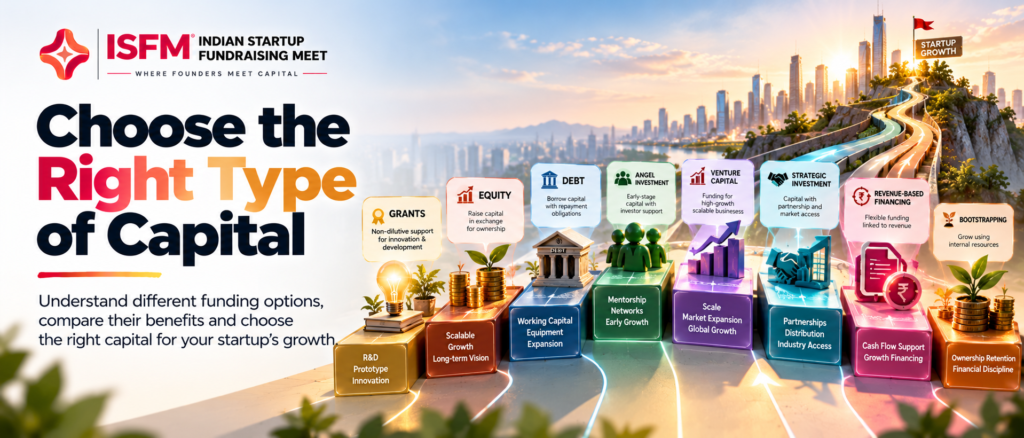
Raising money is an important decision for any startup. However, before approaching investors, applying for government grants or exploring business loans, founders need to answer a more fundamental question:
“What type of capital is actually right for our business?”
Not all funding is the same.
Some capital requires founders to give up ownership. Some creates repayment obligations. Some is available only for specific innovation or development activities. Other funding arrangements may provide strategic support, industry connections or commercial opportunities alongside financial investment.
A startup may have a promising idea, a growing customer base and a significant market opportunity, but choosing an unsuitable funding structure can create financial pressure, ownership complications or unnecessary restrictions.
The objective of fundraising should not simply be to secure money. It should be to secure the right kind of capital for the right business requirement at the right stage.
Understanding the differences between equity, debt, grants, convertible instruments and other financing options can help founders make more informed fundraising decisions.
Why Choosing the Right Type of Capital Matters
Every funding source comes with its own expectations, benefits and limitations.
For example, an early-stage technology startup developing an innovative product may not yet generate enough revenue to repay a commercial loan.
A profitable business with predictable cash flow may not want to dilute founder ownership to finance short-term working capital.
Similarly, a research-intensive startup may benefit from non-dilutive grant support before approaching equity investors.
The appropriate capital structure depends on several factors:
- Startup Stage: Idea, prototype, MVP, early revenue or growth.
- Business Model: SaaS, manufacturing, consumer products, DeepTech, services or another model.
- Revenue Position: Pre-revenue, early revenue, profitable or cash-flow negative.
- Funding Requirement: Product development, hiring, equipment, working capital or expansion.
- Repayment Capacity: Whether the business can support scheduled debt payments.
- Ownership Preferences: How much equity founders are willing to dilute.
- Risk Profile: Technology, market, execution and financial risks.
- Funding Timeline: How quickly capital is required.
- Milestones: What the funding is expected to achieve.
A good funding decision considers these factors together rather than selecting an option based only on the amount available.
1. Equity Funding: Raising Capital in Exchange for Ownership
Equity funding involves raising money by issuing an ownership interest in the company to investors.
Instead of following a conventional loan repayment schedule, the startup provides investors with shares or another agreed equity interest.
Equity investors generally expect the company to grow in value over time.
How Equity Funding Works
Suppose a startup is raising ₹2 crore at an agreed pre-money valuation of ₹8 crore.
The simplified calculation would be:
Pre-Money Valuation: ₹8 crore
Investment Amount: ₹2 crore
Post-Money Valuation: ₹10 crore
Investor Ownership: 20%
This example assumes a straightforward equity investment without additional adjustments for instruments, option pools or other transaction terms.
The founder receives capital for business development, while the investor acquires an ownership stake.
When Equity Funding May Be Suitable
Equity capital may be appropriate when:
- The startup has significant growth potential.
- Revenue is limited or still developing.
- The company needs capital for long-term product development.
- Immediate debt repayment would create financial pressure.
- The business requires substantial investment before becoming profitable.
- Founders are comfortable sharing ownership with investors.
Advantages of Equity Funding
No Conventional Monthly Loan Repayment
Unlike a standard business loan, ordinary equity investment generally does not require fixed monthly principal and interest repayments.
Potential Strategic Support
Some investors may contribute industry knowledge, networks, mentoring and future fundraising connections.
Support for Growth-Oriented Businesses
Equity capital can support companies pursuing expansion even when near-term profitability is limited.
Limitations of Equity Funding
Ownership Dilution
Founders give up a portion of company ownership.
Investor Expectations
Investors may expect substantial growth, reporting, governance rights and eventual opportunities to realise returns.
Fundraising Complexity
Equity transactions can involve valuation negotiations, due diligence, legal documentation and shareholder agreements.
Equity funding is not free money. The cost is reflected in ownership, investor rights and the potential value of equity transferred.
2. Debt Funding: Raising Capital Without Selling Equity
Debt funding involves borrowing capital that must generally be repaid according to agreed terms.
Depending on the financing arrangement, repayment may include principal, interest, fees and other charges.
Unlike equity funding, a conventional loan does not automatically transfer ownership to the lender.
Common Types of Debt Financing
Startups and businesses may explore:
- Term loans
- Working capital loans
- Cash credit facilities
- Overdraft facilities
- Equipment financing
- Invoice financing
- Purchase order financing
- Revenue-based financing
- Venture debt
These options have different eligibility requirements, costs and repayment structures.
When Debt Funding May Be Suitable
Debt may be appropriate when:
- The startup generates relatively predictable cash flow.
- The business can reasonably service repayments.
- Capital is needed for equipment, inventory or working capital.
- Founders want to limit equity dilution.
- The financing requirement has a clear repayment source.
Example of Debt Financing
Suppose a manufacturing startup requires ₹50 lakh to purchase equipment.
If the business has sufficient projected operating cash flow to support repayments, an equipment loan may be worth evaluating.
However, founders must examine the actual financing terms, including:
Interest Rate
Repayment Tenure
Processing Charges
Security or Collateral
Guarantees
Repayment Schedule
Prepayment Conditions
The total financing cost matters more than the headline loan amount.
Advantages of Debt Funding
Ownership Retention
Founders generally do not dilute equity through a conventional loan.
Defined Repayment Structure
Loan terms can provide a predictable repayment framework.
Potential Suitability for Asset Financing
Debt can be useful when financing equipment or working capital that supports identifiable business cash flows.
Limitations of Debt Funding
Mandatory Repayment
Repayment obligations generally remain even if business performance declines.
Interest and Financing Costs
Borrowing increases financial commitments.
Security Requirements
Some lenders may require collateral, guarantees or other protections.
Cash Flow Pressure
A startup with uncertain revenue may struggle to meet fixed repayment obligations.
Debt should be evaluated based on the company’s repayment capacity, not simply the lender’s willingness to provide capital.
3. Government Grants: Funding for Eligible Innovation and Development
Government grants can provide financial support for specific activities, subject to the rules of the relevant programme.
Depending on the scheme, grant support may be available for:
- Research and development
- Prototype development
- Product validation
- Technology commercialisation
- Innovation
- Pilot projects
- Market validation
- Sector-specific development
Some grants are non-dilutive, meaning founders do not have to issue equity in exchange for the grant.
However, grant funding should never automatically be treated as unrestricted or unconditional money.
How Government Grant Funding Works
Grant programmes typically define:
- Eligible applicants
- Supported sectors
- Startup age or registration requirements
- Eligible expenditure
- Maximum financial assistance
- Application procedures
- Evaluation criteria
- Milestone requirements
- Reporting obligations
- Disbursement conditions
Some programmes may release funds in stages after verification of progress.
Others may use reimbursement arrangements or require additional financial or institutional commitments.
When Grant Funding May Be Suitable
Grant support may be particularly relevant when:
- The startup is developing an innovative product.
- Technical validation is required.
- Commercial revenue has not yet started.
- Research and development expenses are significant.
- The startup meets the eligibility requirements of an active programme.
- The proposed project aligns with the programme’s objectives.
Advantages of Grant Funding
Potentially Non-Dilutive Capital
Certain grants support eligible activities without requiring equity dilution.
Support for Early Innovation
Grant programmes may support activities that are difficult to finance through traditional commercial lending.
Milestone-Based Development
Structured grants can help founders focus on defined technical or commercial outcomes.
Limitations of Grant Funding
Eligibility Restrictions
Not every startup or business activity qualifies.
Competitive Selection
Meeting eligibility conditions does not guarantee selection.
Restricted Use of Funds
Funds may only be used for approved purposes.
Documentation and Reporting
Grant recipients may need to submit progress reports, utilisation statements and other evidence.
Uncertain Timelines
Application evaluation and disbursement can take time.
Founders should also distinguish genuine grants from government-supported loans, subsidies, guarantees and equity-linked programmes.
These are not interchangeable funding structures.
4. Angel Investment: Early-Stage Capital With Investor Involvement
Angel investors are individuals who invest their own capital in businesses.
They may invest independently or participate through angel networks, syndicates or other investment structures.
Angel investment is often associated with early-stage startups, although individual investors have different preferences.
What Angel Investors May Evaluate
Angel investors may consider:
- Founder capability
- Problem-solution fit
- Market opportunity
- Product readiness
- Customer validation
- Business model
- Early traction
- Competitive differentiation
- Growth potential
Some angel investors are willing to consider companies before substantial revenue exists.
Others prefer startups with customers, revenue or stronger evidence of commercial demand.
Advantages of Angel Investment
Early-Stage Capital Access
Some angels invest at stages where institutional venture capital may not yet be available.
Mentoring and Networks
Experienced angels may help with strategy, hiring, partnerships and introductions.
Flexible Investment Structures
Depending on applicable law and agreed terms, angel investments may use equity or eligible convertible instruments.
Limitations of Angel Investment
Ownership and Investor Rights
Investments may involve dilution and negotiated shareholder protections.
Different Investor Expectations
Not all angels provide the same level of support.
Limited Follow-On Capacity
Some investors may not be able or willing to participate in future rounds.
Founders should evaluate the investor’s suitability, not just the amount offered.
5. Venture Capital: Funding for Scalable Growth
Venture capital firms invest in businesses they believe have the potential to generate substantial investment returns.
Venture capital is generally associated with companies that can scale significantly.
However, different funds focus on different stages, sectors, geographies and cheque sizes.
What Venture Capital Investors Commonly Evaluate
VC investors may assess:
- Market size
- Business scalability
- Revenue growth
- Customer acquisition
- Retention
- Unit economics
- Competitive advantage
- Founder capability
- Capital efficiency
- Exit potential
Early-stage funds may focus more heavily on team, technology and market potential.
Later-stage funds may place greater emphasis on financial performance, growth efficiency and operating metrics.
When Venture Capital May Be Suitable
VC funding may be relevant when:
- The startup operates in a potentially large market.
- The business model can scale.
- The company has a credible growth strategy.
- Additional capital can accelerate meaningful progress.
- Founders are prepared for institutional investor expectations.
Advantages of Venture Capital
Potential Access to Larger Funding Rounds
Institutional investors may provide capital appropriate for significant growth plans.
Follow-On Funding Opportunities
Some funds reserve capital for future investment rounds.
Professional Networks
VC firms may provide access to experienced operators, investors and industry contacts.
Limitations of Venture Capital
High Growth Expectations
The business may be expected to pursue ambitious expansion.
Dilution
Equity rounds affect the ownership structure.
Governance Requirements
Institutional investment may involve reporting obligations, board rights and other protections.
Selective Investment Criteria
Not every profitable or sustainable business fits a venture capital model.
A startup can be a strong business without being a suitable VC investment.
6. Convertible Instruments: Capital That May Convert Into Equity
Some startups raise funding through instruments that can convert into equity under specified conditions.
Examples in different jurisdictions include convertible notes and other legally permitted convertible securities.
These arrangements can be useful when the parties want to defer certain aspects of equity pricing.
However, the structure and availability of such instruments depend on applicable company law, securities regulations and investor eligibility.
How Convertible Financing May Work
A qualifying investor provides capital under agreed terms.
The instrument may convert into shares upon a future financing event or another defined trigger.
The agreement may address:
- Conversion events
- Valuation caps
- Discounts
- Maturity
- Interest, where applicable
- Repayment rights
- Investor protections
Advantages
Potential Flexibility
Certain terms may be settled through a later financing event.
Possible Bridge Financing
Convertible arrangements may support a company between major financing rounds.
Limitations
Future Dilution
Conversion can change the company’s ownership structure.
Legal Complexity
The terms must comply with applicable law.
Conversion Uncertainty
Different future scenarios can produce different ownership outcomes.
Indian startups should not assume that instruments commonly used in foreign startup ecosystems are automatically available on identical terms in India.
Professional legal and financial review is important.
7. Venture Debt: Financing for Eligible Venture-Backed Businesses
Venture debt is a specialised form of financing commonly associated with startups that have institutional equity backing or other characteristics acceptable to specialist lenders.
It is different from a standard business loan in its underwriting approach and commercial terms.
Depending on the lender, venture debt may be used for:
- Working capital
- Growth expenditure
- Equipment
- Runway extension
- Selected expansion requirements
Potential Benefits
Venture debt may help eligible companies obtain additional capital while limiting immediate equity dilution.
Important Considerations
Venture debt still creates contractual obligations.
It may involve:
- Interest
- Repayment schedules
- Covenants
- Security
- Fees
- Warrants or other equity-linked features
Venture debt should not be treated as risk-free non-dilutive funding.
Founders should evaluate whether expected cash flows and the company’s overall financing plan can support the obligations.
8. Revenue-Based Financing: Capital Linked to Business Revenue
Revenue-based financing generally involves receiving capital in exchange for payments linked to future revenue or collections, according to an agreed structure.
The commercial terms vary significantly between providers.
This form of financing may appeal to businesses with measurable and relatively predictable revenue streams.
When It May Be Relevant
Revenue-based financing may be considered by businesses with:
- Established sales
- Recurring revenue
- Reliable collections
- Predictable operating performance
- Identifiable growth opportunities
Advantages
Some structures may align payments more closely with revenue performance than fixed-payment loans.
Depending on the arrangement, founders may avoid immediate equity dilution.
Limitations
The financing may reduce future cash available for operations.
Total repayment costs can be substantial.
Payment formulas, collection mechanisms, security provisions and default conditions require careful review.
The legal and economic substance of the arrangement should be evaluated rather than relying only on the product’s marketing label.
9. Strategic and Corporate Investment
Some companies invest in startups because they see potential commercial or strategic value.
These investors may include established businesses, corporate venture capital units and industry-focused investment entities.
Their objectives may extend beyond purely financial returns.
Potential Strategic Benefits
Corporate or strategic investors may offer:
- Distribution access
- Industry relationships
- Technical expertise
- Manufacturing capabilities
- Commercial partnerships
- Market access
- Product integration opportunities
Important Risks
Founders should assess whether the investment agreement includes:
- Exclusivity requirements
- Commercial restrictions
- Intellectual property provisions
- Information rights
- Strategic control provisions
- Restrictions affecting future partnerships
Strategic capital can be valuable, but founders should understand whether the partnership supports or limits the startup’s long-term flexibility.
10. Bootstrapping: Growing With Internal Resources
Not every startup needs to raise external funding immediately.
Bootstrapping means developing and operating the business primarily through founder resources, internally generated cash or other non-institutional support.
Advantages of Bootstrapping
Ownership Retention
Founders can avoid early equity dilution.
Operational Independence
The business may retain greater control over its growth strategy.
Financial Discipline
Limited resources can encourage careful spending and prioritisation.
Limitations of Bootstrapping
Restricted Growth Capacity
The company may not have enough capital to pursue opportunities quickly.
Founder Financial Exposure
Using personal resources can create financial risk.
Limited Investment Capacity
Research, infrastructure or expansion may require capital beyond internal resources.
Bootstrapping is not necessarily better or worse than external funding.
It is one possible financing strategy.
11. Customer-Funded Growth: Using Commercial Revenue as Capital
Customer-funded growth occurs when a business finances operations or development through customer payments and internally generated cash.
Examples may include:
- Advance customer payments
- Paid pilots
- Subscription revenue
- Annual contracts
- Commercial pre-orders
- Milestone-based customer payments
These arrangements can reduce dependence on external capital.
However, founders must ensure that customer payments are sufficient to meet the associated delivery obligations.
Advance revenue is not automatically free cash.
The company may still need to deliver products or services, incur costs or provide refunds under contractual conditions.
Equity vs Debt vs Grant Funding: Understanding the Difference
| Factor | Equity | Debt | Grant |
|---|---|---|---|
| Ownership dilution | Usually yes | Generally no | Usually no for non-dilutive grants |
| Repayment | Generally no fixed loan repayment | Generally required | Usually not if conditions are met |
| Financial cost | Ownership and investor rights | Interest, fees and obligations | Compliance and permitted-use restrictions |
| Typical suitability | Scalable growth and risk capital | Repayable business requirements | Eligible innovation or development |
| Main consideration | Valuation and dilution | Repayment capacity | Eligibility and conditions |
| Funding certainty | Subject to investor approval | Subject to lender approval | Subject to programme selection |
The most suitable funding source depends on the startup’s actual circumstances, not simply on which option appears cheapest.
How to Choose Capital Based on Startup Stage
Different stages may require different financing approaches.
Idea Stage
At the idea stage, founders may explore:
- Bootstrapping
- Founder contributions
- Friends and family support
- Eligible innovation grants
- Incubation programmes
- Selected angel investors
The focus is often on validating the problem and developing the initial solution.
Prototype Stage
Potential options may include:
- Innovation grants
- Prototype development support
- Incubation programmes
- Angel investment
- Founder capital
- Strategic development partnerships
The objective may be to demonstrate technical feasibility and early customer relevance.
MVP Stage
Once an MVP exists, founders may evaluate:
- Angel investment
- Seed-stage equity funding
- Eligible grants
- Accelerator programmes
- Customer-funded pilots
- Strategic partnerships
The key objective is often to generate evidence of customer demand.
Early Revenue Stage
At this stage, financing options may expand to include:
- Angel funding
- Seed venture capital
- Working capital finance
- Revenue-based financing
- Selected debt products
- Strategic investment
The appropriate mix depends on cash flow, revenue predictability and growth requirements.
Growth Stage
More established startups may explore:
- Venture capital
- Growth equity
- Venture debt
- Working capital facilities
- Equipment financing
- Strategic investment
- Internally generated capital
The choice should reflect the company’s financial strength, expansion plans and ownership strategy.
Match the Type of Capital to the Business Requirement
Founders should avoid selecting a funding source before identifying the specific business requirement.
Product Development
If the company needs capital to build or improve an innovative product, possible options may include:
Equity, eligible grants, founder capital or strategic development partnerships.
Research and Development
For research-intensive projects, founders may consider:
Eligible research grants, equity funding or strategic research partnerships.
Equipment Purchase
Where the company can support repayment, possible options may include:
Equipment loans, leasing, debt or equity.
Working Capital
For businesses with predictable receivables and operating cycles:
Working capital facilities, invoice financing or other suitable short-term financing arrangements may be relevant.
Market Expansion
Depending on growth economics and financial capacity:
Equity, internally generated capital, debt or strategic investment may be considered.
Early Customer Validation
Potential sources may include:
Bootstrapping, eligible grants, angel investment or customer-funded pilots.
The important principle is:
Different capital requirements may need different capital structures.
A Startup Can Use More Than One Type of Capital
Founders do not always need to choose only equity, only debt or only grants.
Some startups use a combination of financing sources over time.
For example:
Stage 1: Founder Capital
Used to develop the initial business concept.
↓
Stage 2: Eligible Grant Support
Used for approved prototype or research activities.
↓
Stage 3: Angel Investment
Used for commercial validation and early team development.
↓
Stage 4: Venture Capital
Used for scalable expansion.
↓
Stage 5: Suitable Debt Financing
Used for identifiable working capital or asset requirements.
This is only an illustrative sequence.
Actual financing paths vary, and some sources may have restrictions affecting the use of other funding or overlapping expenditure.
The objective is to create a sustainable capital structure rather than relying on one funding source for every requirement.
Understand the True Cost of Capital
Founders often compare financing options based only on the amount available.
But the true cost of capital can be more complex.
Cost of Equity
Equity does not usually involve scheduled interest payments.
However, founders give up ownership and may agree to investor rights that affect future decisions.
Cost of Debt
Debt may involve:
- Interest
- Processing fees
- Security
- Guarantees
- Covenants
- Repayment obligations
Cost of Grants
A non-dilutive grant may not involve equity dilution or conventional repayment, but it can involve:
- Restricted expenditure
- Milestone conditions
- Reporting requirements
- Audit obligations
- Delayed disbursement
- Recovery or repayment if programme conditions are breached
Cost of Strategic Capital
Strategic funding may involve commercial commitments, exclusivity or restrictions that influence future business flexibility.
Therefore, founders should evaluate:
Financial Cost + Ownership Impact + Repayment Obligations + Restrictions + Strategic Value
Do Not Raise Equity for Every Business Requirement
Equity can be valuable for growth-oriented startups.
However, issuing equity to fund every short-term cash requirement may create unnecessary dilution.
For example, a business with reliable receivables may be able to evaluate appropriate working capital finance instead of selling additional ownership.
That does not mean debt is always preferable.
The company must still assess repayment risk, costs and financing terms.
The broader lesson is:
Match the duration and nature of the funding requirement with an appropriate financing structure.
Do Not Take Debt Without Understanding Repayment Capacity
Debt can help a business grow, but borrowing without realistic repayment planning can create significant risk.
Before accepting debt, founders should understand:
- Expected operating cash flow
- Existing financial obligations
- Repayment schedule
- Interest cost
- Debt service capacity
- Customer payment cycles
- Security requirements
- Financial downside scenarios
A company may be commercially promising and still be unsuitable for a particular loan structure.
Funding approval should not be confused with financial affordability.
Do Not Assume Grants Are Guaranteed
Government funding opportunities can be attractive, particularly for eligible innovation-driven startups.
However, founders should understand that:
Eligibility does not guarantee selection.
Selection does not always mean immediate disbursement.
Approval may be subject to conditions.
Approved funds may be restricted to specific purposes.
A startup should avoid making essential operating commitments solely on the assumption that a pending grant application will be approved.
Grant funding should be incorporated into financial planning with realistic timelines and appropriate contingency arrangements.
Consider the Timing of Capital
The timing of funding can be as important as the amount.
Suppose a startup requires ₹50 lakh within the next two months to complete a critical commercial milestone.
A funding source that may take substantially longer to evaluate and disburse might not meet that immediate requirement.
Founders should consider:
When is the capital needed?
How long might approval take?
When will funds become available?
Are there disbursement milestones?
Can the business continue operating if funding is delayed?
The appropriate financing strategy should account for both the funding amount and the timing of cash availability.
Investor Fit Is as Important as Funding Type
Even after deciding to pursue equity investment, founders still need to identify suitable investors.
Different investors have different:
- Sector preferences
- Investment stages
- Cheque sizes
- Geographic mandates
- Return expectations
- Ownership preferences
- Investment timelines
- Portfolio strategies
A startup may be suitable for equity investment but not for a particular VC fund.
Similarly, a business may be eligible for debt financing but not meet the requirements of a specific lender.
The objective should be:
Right Capital Type → Right Funding Source → Right Business Stage
Build a Capital Strategy Before Starting Fundraising
A structured capital strategy should answer several questions.
1. What Is the Funding Requirement?
Identify the exact activities requiring capital.
2. What Is the Startup’s Current Stage?
Assess product readiness, traction, revenue and operational maturity.
3. How Much Capital Is Required?
Calculate the funding requirement based on realistic expenditure and expected cash generation.
4. What Milestone Will the Capital Achieve?
Define measurable technical, commercial or operational outcomes.
5. Can the Startup Repay Debt?
Evaluate realistic cash flows and downside scenarios.
6. Is the Startup Willing to Dilute Equity?
Understand valuation, ownership and investor expectations.
7. Is the Project Eligible for Grants?
Review relevant programme conditions and permitted activities.
8. How Quickly Is Capital Needed?
Match the financing timeline to the company’s operational requirements.
9. What Restrictions Come With the Capital?
Review legal, financial, governance and commercial obligations.
10. What Funding Structure Best Supports Long-Term Growth?
Compare available options based on the company’s strategy.
The objective is to make the funding decision before entering negotiations, rather than allowing the first available offer to determine the startup’s financing structure.
A Practical Capital Selection Framework
Founders can use the following sequence:
Step 1: Identify the Business Requirement
What exactly needs funding?
↓
Step 2: Assess Startup Readiness
Idea, prototype, MVP, early revenue or growth.
↓
Step 3: Calculate Capital Requirement
How much funding is needed, and for how long?
↓
Step 4: Evaluate Cash Flow
Can the business support repayment obligations?
↓
Step 5: Evaluate Ownership Preferences
What level of equity dilution is acceptable?
↓
Step 6: Assess Grant Eligibility
Does the proposed project qualify for suitable programmes?
↓
Step 7: Compare Financing Structures
Equity, debt, grants, convertible instruments or internal capital.
↓
Step 8: Identify Suitable Funding Sources
Investors, lenders, incubators, grant programmes or strategic partners.
↓
Step 9: Evaluate Terms and Restrictions
Understand the true cost and obligations.
↓
Step 10: Select the Appropriate Capital Strategy
Choose the structure that best supports the next meaningful business milestone.
Business Requirement → Capital Need → Funding Structure → Funding Source → Execution → Milestone
Example: Choosing Capital for Different Startups
Consider three illustrative startups with different financing requirements.
Startup A: Early-Stage HealthTech Company
Current Stage: Prototype
Revenue: Pre-revenue
Requirement: ₹40 lakh for product validation and technical development
Potential options may include:
- Eligible innovation grants
- Angel investment
- Incubation support
- Strategic development partnerships
Conventional debt may be difficult to support without sufficient cash flow or other repayment resources.
Startup B: Revenue-Generating Manufacturing Company
Current Stage: Commercial operations
Requirement: ₹1 crore for equipment and working capital
Financial Position: Established customer orders and operating revenue
Potential options may include:
- Equipment financing
- Working capital facilities
- Suitable business loans
- Equity investment
The financing decision should depend on repayment capacity, costs, security requirements and expansion objectives.
Startup C: Growing SaaS Company
Current Stage: Revenue-generating growth
Requirement: ₹3 crore for team expansion, product development and customer acquisition
Potential options may include:
- Venture capital
- Angel or growth-oriented equity investment
- Revenue-based financing, where suitable
- Venture debt, if eligible
- Internally generated capital
The right structure would depend on growth efficiency, revenue predictability, valuation and long-term plans.
These examples illustrate why the same funding amount can require different financing strategies across businesses.
Common Mistakes Founders Make When Choosing Capital
Choosing Funding Based Only on Availability
The first available funding offer is not necessarily the most suitable.
Treating Every Government Programme as a Grant
Government-supported financing may include loans, subsidies, guarantees, grants or equity-linked support.
Ignoring Equity Dilution
Founders should understand how ownership may change after investment.
Taking Debt Without Cash Flow Planning
Repayment obligations should be evaluated under realistic financial assumptions.
Ignoring Funding Conditions
Grants, loans and investments may all involve restrictions.
Raising Capital Without a Defined Milestone
The funding requirement should be connected to measurable business progress.
Ignoring the Next Funding Round
Today’s financing structure may influence future fundraising options.
Comparing Only Funding Amounts
A larger offer is not necessarily better if the associated terms create greater risk or restrictions.
Questions Founders Should Answer Before Choosing Capital
Before finalising a fundraising strategy, founders should ask:
- What stage is our startup currently at?
- Why do we need external capital?
- How much money do we actually require?
- What milestone will this capital help achieve?
- How much runway do we currently have?
- Do we have predictable cash flow?
- Can we support debt repayments?
- Are we comfortable with equity dilution?
- Are we eligible for relevant grant programmes?
- Do we need capital immediately or over multiple stages?
- What are the financing costs and restrictions?
- What strategic value can the funding source provide?
- How will this financing affect future funding rounds?
- What happens if business performance is weaker than expected?
- Does the proposed financing structure support long-term sustainability?
Clear answers to these questions can make fundraising discussions more productive.
The Right Capital Should Support the Right Milestone
The purpose of financing is not simply to increase the company’s bank balance.
Capital should help the startup achieve something meaningful.
That could include:
Completing a Prototype
Validating Customer Demand
Launching a Commercial Product
Increasing Revenue
Expanding Production
Improving Technology
Entering New Markets
Strengthening Working Capital
Building a Scalable Business
Different milestones may require different capital structures.
Founders should therefore connect:
Type of Capital + Amount of Capital + Timing of Capital + Expected Milestone
When these elements are aligned, financing becomes part of the business strategy rather than a reaction to financial pressure.
Final Thoughts
Choosing the right type of capital is one of the most important financial decisions a startup can make.
Equity funding may support scalable growth without conventional loan repayments, but it involves ownership dilution.
Debt funding may help finance assets, working capital and expansion while retaining ownership, but it creates repayment obligations.
Government grants may support eligible innovation and development activities, but they involve selection criteria, conditions and restrictions.
Angel investors and venture capital firms may provide both capital and strategic support, but their investment expectations and mandates differ.
Convertible financing, venture debt, revenue-based financing and strategic investment may provide additional options for businesses with suitable characteristics.
Bootstrapping and customer-funded growth can also be valuable ways to finance development without immediately pursuing institutional capital.
There is no universally superior funding structure.
The right choice depends on the startup’s:
Stage
Business Model
Revenue
Cash Flow
Growth Potential
Ownership Preferences
Capital Requirement
Funding Timeline
Risk Profile
Next Milestone
Before approaching investors, lenders or grant programmes, founders should answer one question:
“Which type of capital will help us achieve our next meaningful business milestone without creating unnecessary financial, ownership or operational pressure?”
That is the foundation of a more informed fundraising strategy.
Indian Startup Fundraising Meet (ISFM) works to facilitate structured connections between startups and the wider fundraising ecosystem, including relevant investors, incubators, accelerators and ecosystem participants.
Through fundraising-focused insights and startup evaluation initiatives, ISFM encourages founders to approach capital decisions with stronger preparation, clearer business requirements and a better understanding of investor readiness.
ISFM — Where Founders Meet Capital.
Frequently Asked Questions
What are the main types of startup funding?
Common startup financing options include equity investment, debt financing, government grants, angel investment, venture capital, convertible instruments, venture debt, revenue-based financing, strategic investment and bootstrapping.
Which type of funding is best for an early-stage startup?
The appropriate funding type depends on the startup’s stage, innovation, capital requirement and financial position. Early-stage businesses may explore bootstrapping, eligible grants, angel investment, incubation support or other suitable financing sources.
What is the difference between equity and debt funding?
Equity funding generally involves issuing ownership interests to investors, while conventional debt funding involves borrowing money that must be repaid under agreed terms.
Is government grant funding better than equity investment?
Not necessarily. Eligible grants may provide non-dilutive support for approved activities, while equity investment may provide more flexible growth capital and strategic support. The better option depends on the business requirement and the funding terms.
Can a startup raise funding without giving equity?
Yes. Depending on eligibility and financial circumstances, startups may explore loans, eligible non-dilutive grants, customer-funded growth and other financing arrangements that do not require issuing ordinary equity.
Can a pre-revenue startup get funding?
Yes. Some pre-revenue startups may qualify for angel investment, eligible grants, incubation programmes or other early-stage financing. Selection depends on the relevant investor or programme requirements.
Is debt funding suitable for every startup?
No. Debt is generally more appropriate when the business has sufficient repayment capacity or other acceptable financial support. Startups with uncertain cash flows should carefully evaluate repayment risks.
Can startups combine equity, debt and grants?
Potentially, yes. Some businesses use multiple capital sources over time. However, founders must review eligibility conditions, overlapping expenditure restrictions, existing financing agreements and applicable legal requirements.
Does venture capital require giving up ownership?
Traditional venture capital financing generally involves equity ownership or instruments that may convert into equity, although individual transaction structures differ.
What should founders consider before accepting investment?
Founders should review valuation, dilution, governance rights, repayment obligations where applicable, funding conditions, investor expectations, legal documentation and the impact on future fundraising.
Is raising more capital always better?
No. A larger funding round may increase available resources but can also create additional dilution, financing costs, growth expectations or operating pressure. Capital should match a realistic execution plan.
What is the most important factor when choosing startup capital?
The most important consideration is whether the financing structure is appropriate for the startup’s current stage, financial capacity, business requirements and next meaningful milestone.