Do Not Wait Until the Startup Is Almost Out of Cash
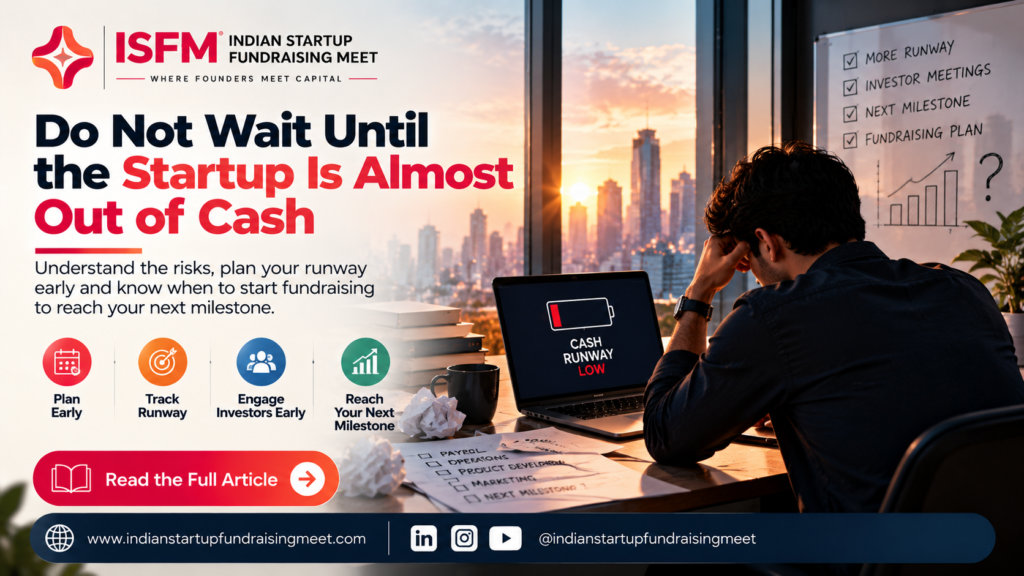
Running out of cash is one of the most obvious reasons a startup may need funding.
But it is also one of the worst moments to begin thinking about fundraising.
When founders wait until the company has only a few weeks or months of runway remaining, fundraising can quickly shift from a strategic decision to an emergency.
The conversation changes from:
“What capital does the business need to achieve its next milestone?”
to:
“How quickly can we get money into the bank?”
That difference matters.
Fundraising takes time. Investors may need to understand the business, evaluate the opportunity, conduct due diligence, discuss terms and complete documentation before capital is actually available.
There is also no guarantee that a fundraising process will result in investment.
For this reason, founders should not treat their bank balance as the trigger for beginning fundraising.
A better approach is to understand the startup’s runway, milestones, funding requirements and fundraising readiness well before cash becomes critical.
The objective is not to raise money as early as possible.
The objective is to avoid reaching a position where lack of time begins controlling fundraising decisions.
Running Out of Cash Is Different From Needing Funding
These two situations may sound similar, but strategically they are very different.
A startup may need funding because it has identified a meaningful opportunity to:
- Complete product development
- Conduct commercial pilots
- Expand production capacity
- Hire critical talent
- Enter a new market
- Build distribution
- Meet working capital requirements
- Complete regulatory or technical milestones
- Scale customer acquisition
- Reach the next stage of commercial validation
That is a business requirement.
Running out of cash, on the other hand, is a liquidity problem.
The strongest fundraising rationale is usually not:
“We need funding because we are running out of money.”
It is:
“We have reached this stage, we have this evidence, this is our next milestone, and this capital is required to reach it.”
The distinction helps founders approach fundraising as part of business planning rather than as an emergency response.
What Is Startup Runway?
Startup runway is generally the amount of time a company can continue operating before its available cash is exhausted, assuming its current cash inflows and outflows continue.
A simplified way to think about runway is:
Cash Available ÷ Monthly Net Cash Burn = Approximate Runway
For example, if a startup has ₹30 lakh available and is using approximately ₹5 lakh of net cash every month, the simplified runway would be approximately:
₹30 lakh ÷ ₹5 lakh = 6 months
However, real startup cash flows are rarely perfectly constant.
Expenses may increase.
Revenue may change.
Customers may delay payments.
Hiring may accelerate.
Unexpected costs may appear.
Therefore, runway should be actively monitored and regularly updated, not calculated once and forgotten.
Why Waiting Until Cash Is Almost Finished Can Be Dangerous
Fundraising is not an instant transaction.
Even if an investor is interested, multiple steps may still remain before capital reaches the company.
Depending on the round and investor, the process may involve:
Initial Introduction
↓
Founder Meeting
↓
Pitch
↓
Follow-Up Discussions
↓
Business Evaluation
↓
Due Diligence
↓
Investment Discussions
↓
Term Negotiation
↓
Documentation
↓
Closing and Fund Transfer
Not every startup or investment follows exactly this sequence, and timelines can vary considerably.
The important point is simple:
Investor interest today does not necessarily mean cash in the bank tomorrow.
If the startup begins fundraising only when its runway is already critically short, every delay becomes more significant.
Fundraising Under Pressure Changes Founder Behaviour
When founders have sufficient runway, they can evaluate whether an investor is genuinely suitable for the company.
When cash becomes critical, the priority may shift toward simply completing a transaction.
That pressure can affect decisions around:
- Valuation
- Dilution
- Investment structure
- Investor fit
- Negotiation
- Governance terms
- Funding amount
- Strategic alignment
- Timing
This does not mean founders should reject necessary compromises.
It means that time pressure can reduce the number of choices available.
More runway does not guarantee a successful fundraise, but it can give founders more space to evaluate decisions carefully.
Do Not Use a Fixed Number of Months as a Universal Rule
Founders often ask:
“How many months of runway should we have before starting fundraising?”
There is no single number that works for every startup.
The appropriate timing depends on factors such as:
- Stage of the company
- Monthly burn
- Revenue
- Sector
- Funding amount
- Type of investor
- Existing investor relationships
- Complexity of due diligence
- Regulatory requirements
- Current market conditions
- Upcoming business milestones
- Whether bridge capital is available
- Whether the business can reduce expenditure if necessary
A startup raising a relatively small angel round may face a very different process from a company pursuing a larger institutional round.
Instead of following a universal countdown, founders should work backwards from their own circumstances.
Work Backwards From the Funding Requirement
A useful fundraising planning process begins with the milestone the startup wants to achieve.
Ask:
What stage are we at today?
↓
What is the next meaningful milestone?
↓
What resources are required to reach it?
↓
How much capital will those resources require?
↓
How long could the fundraising process reasonably take?
↓
How much runway should remain while that process is happening?
This creates a more structured fundraising timeline.
The decision to raise is then connected to the company’s strategy rather than simply its remaining bank balance.
The Best Time to Prepare Is Before You Need the Money
There is an important difference between preparing for fundraising and actively raising funding.
A startup does not need to be in the market asking investors for capital every month.
But fundraising preparation can begin much earlier.
Founders can prepare:
- Pitch deck
- Financial model
- Cap table
- Use-of-funds plan
- Business metrics
- Market analysis
- Customer evidence
- Product information
- Legal documents
- Incorporation records
- Intellectual property information
- Existing investment documents
- Data room
- Funding milestone plan
Preparing these materials early can make the eventual fundraising process more organised.
It can also expose gaps that need to be addressed before investor discussions begin.
Build Investor Relationships Before the Emergency
Fundraising should not always begin with:
“Hello, we need money.”
Founders can build relevant ecosystem relationships before launching a formal round.
Depending on the startup, these relationships may include:
- Angel investors
- Venture capital funds
- Family offices
- Accelerators
- Incubators
- Strategic investors
- Industry mentors
- Other founders
- Startup ecosystem organisations
Relationship building can help investors become familiar with the founder, business and progress over time.
A founder may be able to share periodic progress such as:
Prototype completed
↓
Pilot launched
↓
First paying customers
↓
Revenue milestone
↓
New partnership
↓
Fundraising round opened
By the time a formal raise begins, some potential investors may already understand the company’s journey.
Your Next Milestone Should Influence Fundraising Timing
Runway is important, but it should not be considered in isolation.
Suppose a startup currently has an MVP and expects to complete several meaningful customer pilots in the coming months.
The founder faces a strategic question:
Should we raise immediately, or can we reach the pilot milestone first and then approach investors with stronger evidence?
The answer depends on available runway and resources.
If the startup can safely reach a materially stronger milestone before raising, waiting may improve the fundraising story.
But if waiting for that milestone would leave the company with dangerously little runway, the risk may outweigh the benefit.
The founder therefore needs to balance:
Runway + Evidence + Milestone + Funding Timeline
rather than optimising only one of them.
Do Not Assume the Fundraise Will Close on Schedule
One of the most dangerous assumptions is:
“We will raise the round within the next two months.”
A founder may create a plan based on that expectation.
But fundraising contains variables the startup does not fully control.
An investor may:
- Take longer to evaluate
- Request additional information
- Change investment priorities
- Delay an investment committee decision
- Negotiate different terms
- Decide not to proceed
- Ask the startup to reach another milestone first
The company should therefore avoid building its survival plan around a single expected closing date.
A fundraising target is not the same as committed capital.
Investor Interest Is Not Cash
Founders should distinguish between different levels of investor engagement.
These are not equivalent:
“The investor liked our pitch.”
“The investor wants another meeting.”
“The investor has started due diligence.”
“We are discussing terms.”
“We have received a formal commitment.”
“The transaction has closed.”
“Funds have been received.”
Progress in investor discussions is valuable, but operational planning should not treat early interest as completed funding.
This distinction becomes particularly important when runway is short.
Track Cash More Frequently as Runway Becomes Shorter
Early-stage founders should understand their cash position continuously.
Important information may include:
- Current bank balance
- Monthly fixed costs
- Monthly variable costs
- Payroll
- Receivables
- Payables
- Expected customer collections
- Committed expenditure
- Debt obligations
- Planned hiring
- One-time expenses
- Monthly burn
- Expected revenue
- Available runway
As the cash position becomes tighter, these numbers become increasingly important.
Founders should know not only:
“How much money is in the bank?”
but also:
“What commitments already exist against that money?”
Revenue Does Not Automatically Eliminate Runway Risk
A startup can generate revenue and still face a cash shortage.
This can happen when:
- Customers pay slowly
- Inventory must be purchased upfront
- Growth requires working capital
- Receivables increase
- Manufacturing costs occur before collections
- Hiring happens ahead of revenue
- Gross margins are low
- Expansion increases operating costs
For example, a startup may record increasing sales while still experiencing cash pressure because customers pay 60 or 90 days after invoicing.
Founders therefore need to distinguish between:
Revenue
Profitability
and
Cash Flow
They are related, but they are not the same thing.
Growth Can Increase the Need for Cash
It may seem counterintuitive, but rapid growth can sometimes create additional cash requirements.
Consider a company that receives a large order.
To fulfil it, the startup may need to:
- Purchase raw materials
- Increase inventory
- Hire temporary staff
- Pay logistics costs
- Expand production
- Extend customer credit
If those costs occur before the customer pays, the company may need working capital.
This means a startup should not wait for cash pressure to become visible before thinking about funding.
Future growth requirements should be incorporated into cash planning.
Funding Should Be Connected to a Defined Business Requirement
A startup should ideally be able to explain why it needs capital beyond simply extending survival.
Instead of:
“We need ₹1 crore for runway.”
a more structured explanation might be:
“We are raising capital to complete product development, execute commercial pilots, strengthen the core team and reach our next defined commercial milestone.”
The funding request now connects:
Capital → Execution → Milestone → Business Progress
This makes the purpose of the round clearer.
What Specific Milestone Will the Funding Help Achieve?
A fundraising round should ideally move the startup from one meaningful stage to another.
Examples might include:
Prototype → MVP
MVP → Commercial Product
Commercial Product → Paying Customers
Pilot → Commercial Contract
₹X Revenue → ₹Y Revenue
Single Market → Multi-Market Expansion
Manual Operations → Scalable Technology Infrastructure
Prototype → Manufacturing Readiness
The appropriate milestone depends on the business.
The important question is:
“What should be materially different about the company after this capital has been deployed?”
If founders cannot answer that clearly, the funding plan may need further work.
Raise From a Position of Progress, Not Just Pressure
Whenever possible, founders should aim to enter fundraising conversations with evidence of progress.
That evidence may include:
- Product development
- Customer growth
- Revenue
- Retention
- Successful pilots
- Technology validation
- Partnerships
- Intellectual property
- Regulatory progress
- Improved unit economics
- Market expansion
Compare two fundraising narratives.
Narrative A
“We have two months of cash left and need funding urgently.”
Narrative B
“Over the last six months, we completed our MVP, converted initial customers and validated our core use case. We are now raising capital to reach the next commercial milestone.”
Both companies may need money.
But the second narrative connects the funding requirement to progress and future execution, rather than only financial urgency.
What If the Startup Is Already Running Low on Cash?
Sometimes founders are already in this situation.
The priority then becomes understanding the company’s actual position clearly.
Founders may need to evaluate:
- Exact available runway
- Essential versus non-essential expenditure
- Customer collections
- Revenue opportunities
- Existing investor conversations
- Current shareholders
- Financing alternatives
- Strategic partnerships
- Whether the planned funding amount should change
- Whether the next milestone can be reached differently
The objective is not to panic.
It is to make decisions using accurate information.
A founder who does not know the exact cash position cannot effectively manage a short runway.
Cost Cutting Should Be Strategic
When runway becomes tight, reducing expenditure may be necessary.
But founders should distinguish between:
Reducing waste
and
Removing capabilities necessary for the business to progress.
Cutting every expense indiscriminately can sometimes damage the very milestones required to improve the company’s position.
For example, removing a critical product engineer may extend runway but delay product completion.
The relevant question is:
“Which expenses are essential to reaching the next meaningful milestone?”
Cash preservation and business progress need to be considered together.
Do Not Raise More Simply Because More Capital Is Available
Avoiding a cash emergency does not mean raising the largest possible round.
More capital can also create:
- Additional dilution
- Higher expectations
- Pressure to scale
- Larger teams
- Higher burn
- More complex governance
The appropriate funding amount should be linked to the resources needed to reach a meaningful next stage.
The goal is not:
Maximum Capital
It is:
Appropriate Capital for the Next Stage
Build a Fundraising Readiness Dashboard
Founders can periodically track a simple set of indicators.
Cash Position
How much unrestricted cash is actually available?
Monthly Burn
How much net cash is being used each month?
Runway
How long can current operations continue?
Next Milestone
What meaningful business outcome are we working toward?
Milestone Cost
How much capital is required to reach it?
Fundraising Readiness
Are the pitch deck, financials, data room and supporting evidence ready?
Investor Pipeline
Have relevant investors been identified and relationships started?
Contingency
What happens if fundraising takes longer than expected?
Reviewing these areas can help founders identify funding requirements earlier.
A Simple Fundraising Timing Framework
Founders can use this sequence:
1. Understand the Cash Position
How much capital is actually available today?
↓
2. Calculate Runway
How long can the business continue under realistic assumptions?
↓
3. Identify the Next Milestone
What should the startup achieve next?
↓
4. Calculate the Capital Requirement
What resources are required to reach that milestone?
↓
5. Assess Current Evidence
What progress can we demonstrate to investors?
↓
6. Prepare Fundraising Materials
Are the deck, financials, data room and supporting documents ready?
↓
7. Build the Investor Pipeline
Which investors are relevant to our stage, sector and funding requirement?
↓
8. Allow for Uncertainty
What happens if the process takes longer than expected?
↓
9. Start Before Urgency Controls the Decision
Begin the process while the startup still has strategic flexibility.
The overall logic becomes:
Runway → Milestone → Requirement → Preparation → Investor Engagement → Funding → Execution
Warning Signs That You May Be Starting Too Late
Founders should pay attention when:
- Payroll depends on closing the round
- The company cannot tolerate an investor delay
- Investor meetings are being pursued purely because cash is nearly exhausted
- There is no contingency if the round does not close
- The founder is willing to accept almost any investment structure because of urgency
- Business decisions are being postponed until funding arrives
- The startup has stopped investing in important milestones purely to survive
- The entire operating plan depends on one investor saying yes
These signals do not mean funding is impossible.
They indicate that fundraising risk and operating risk may have become tightly connected.
Questions Founders Should Ask Before Runway Becomes Critical
Before starting a fundraising round, ask:
- How much cash do we actually have?
- What is our realistic monthly burn?
- How many months of runway remain?
- What could cause burn to increase?
- What revenue or collections can reasonably be expected?
- What milestone are we trying to achieve?
- How much will reaching that milestone cost?
- Why do we need external capital?
- What evidence can we show investors today?
- Would reaching another milestone strengthen our fundraising position?
- Do we have enough runway to reach that milestone safely?
- How long might our fundraising process take?
- What happens if it takes longer?
- Are our fundraising materials ready?
- Do we already know relevant investors?
- What is our contingency plan if the round does not close?
The answers can help founders decide when fundraising preparation should turn into active fundraising.
So, When Should a Startup Start Fundraising?
There is no universal date or runway number that applies to every startup.
The right timing depends on:
Available Runway
Current Evidence
Next Milestone
Capital Requirement
Business Model
Investor Type
Fundraising Complexity
and
Available Alternatives
But one principle is broadly useful:
Do not wait until lack of cash becomes the primary reason you are fundraising.
Start planning while you still have enough time to understand the requirement, prepare properly, approach relevant investors and manage delays.
Fundraising is generally more strategic when founders have time and options.
Final Thoughts
A startup should not begin thinking about fundraising only when the bank balance becomes uncomfortable.
Good fundraising planning starts earlier.
Founders should understand:
Where the company is today.
How much runway remains.
What milestone comes next.
What resources are required.
Why external capital is needed.
How long the fundraising process may take.
What happens if funding takes longer than expected.
The purpose is not to create fear around running out of money.
It is to recognise that capital planning is part of business planning.
Do not ask only:
“How much cash do we have left?”
Also ask:
“What needs to happen before that cash runs out, and when should we begin preparing for the capital required to reach the next stage?”
The strongest fundraising process is rarely the one that begins with:
“We urgently need money.”
It is the one that begins with:
“We understand our current position, we know our next milestone, and we know why capital is required to reach it.”
Indian Startup Fundraising Meet (ISFM) focuses on creating structured opportunities for startups to engage with the fundraising ecosystem while helping founders better understand fundraising preparation, investment readiness and investor engagement.
Frequently Asked Questions
What is startup runway?
Startup runway generally refers to how long a company can continue operating before its available cash is exhausted, based on its current or expected cash burn.
How is startup runway calculated?
A simplified calculation is:
Available Cash ÷ Monthly Net Cash Burn = Approximate Runway
However, founders should also consider expected revenue, receivables, upcoming expenditure and changes in burn.
How many months before running out of cash should a startup raise funding?
There is no universal number that applies to every startup. Fundraising timelines vary depending on the stage, sector, round size, investor type, due diligence and market conditions. Founders should work backwards from their own runway and funding process.
Should a startup wait until it needs money before contacting investors?
Not necessarily. Founders can build relevant investor and ecosystem relationships before formally opening a fundraising round.
Does investor interest mean the startup can count on the funding?
No. Interest, meetings and due diligence are signs of progress, but founders should distinguish them from a completed investment and funds actually received.
Should fundraising be based only on runway?
No. Runway is important, but fundraising timing should also consider the startup’s next milestone, current evidence, capital requirement and ability to reach a stronger position before raising.
What should startup funding be used for?
Funding should ideally address defined business requirements and help the company reach meaningful milestones, such as product development, commercial validation, customer growth, production capacity or market expansion.
What should founders do if runway is already short?
They should first understand the exact cash position, burn, commitments and expected collections, then evaluate essential expenditure, funding options, current investor conversations and contingency plans.
What is the most important fundraising timing question?
Instead of asking only:
“When will we run out of money?”
founders should also ask:
“When should we begin preparing and raising so that we still have enough time and strategic flexibility if the process takes longer than expected?”