Dashfit: Shaswat Dash’s Muscle-First Fitness & Preventive Healthtech Startup Story
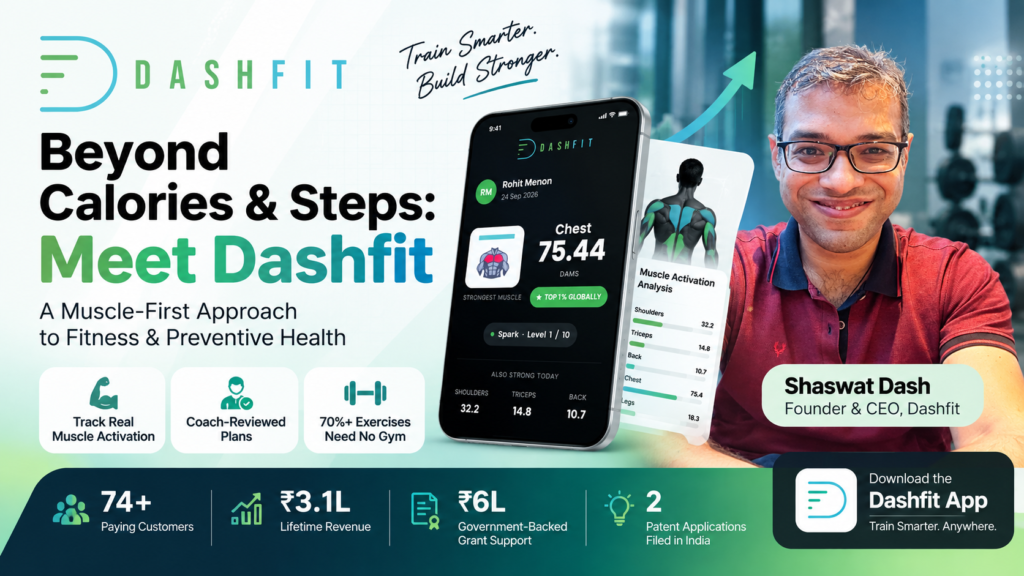
For years, fitness tracking has largely revolved around familiar numbers—steps walked, calories burned, sleep scores and heart rate. But what if a workout could also tell you which muscles were actually activated?
That is the idea behind Dashfit, a Mumbai-based fitness and preventive healthtech startup founded by Shaswat Dash.
At the centre of Dashfit’s approach is DAMS — the Dashfit Activated Muscle Score, which the startup describes as a comparable measure of muscle activation during exercise. Dashfit combines this measurement approach with weekly coach-reviewed workout planning, designed to adapt according to an individual’s body and progress.
According to information shared by the startup, Dashfit has worked with 74 paying customers, generated approximately ₹3.1 lakh in lifetime revenue, received ₹6 lakh in government-backed grant support, and filed two patent applications in India.
The Story Behind Dashfit
The idea behind Dashfit grew from founder Shaswat Dash’s personal experience with fitness and injury.
According to information shared by the founder, Shaswat has spent more than 14 years around fitness and wellness, including professional experience as a product lead in the industry and earlier experience as a competitive kickboxer.
Despite his athletic background, a back injury led to an unexpected observation: his back muscles were weak.
That experience led him to question the way fitness progress is commonly measured.
Nutrition has calories. Cardio has steps. Recovery can be represented through sleep-related metrics. But in Shaswat’s view, there was no similarly understandable metric that could tell an individual whether specific muscles were actually being trained and strengthened.
That gap became the foundation for Dashfit.
Rather than building another fitness platform centred primarily around calorie expenditure, Dashfit set out to explore a muscle-first approach to fitness measurement and training.
The Problem Dashfit Is Addressing
Dashfit is particularly focused on a challenge the founder associates with working professionals and people spending long periods at desks.
The startup argues that while people can easily track steps, calories and other general fitness metrics, they often have much less visibility into which muscles are being trained effectively and which may remain comparatively weak.
The company connects this challenge with posture, back and muscle-related discomfort among desk-based professionals, describing the broader problem as “desk job damage” and work-related musculoskeletal issues.
Instead of asking only:
“How many calories did I burn?”
Dashfit wants users to be able to answer another question:
“Which muscles did this workout actually train?”
That question sits at the centre of the startup’s product proposition.
How Dashfit Is Solving It
At the core of Dashfit’s solution is DAMS — the Dashfit Activated Muscle Score.
According to the startup, DAMS provides a comparable number intended to indicate how much each muscle was activated during a workout. The company says the measurement is calibrated using factors including the user’s height, weight and range of motion.
But Dashfit’s approach does not stop at providing users with a score.
The startup combines its technology with a human coaching layer. Each week, a coach reviews the user’s DAMS report and rebuilds the workout plan around the results, allowing the training programme to continue adapting over time.
Dashfit also states that more than 70% of the exercises in its library require no gym, potentially making the programme accessible to users who prefer exercising at home or outside a traditional gym environment.
The resulting model brings together three core elements:
- Muscle-activation measurement
- Adaptive workout planning
- Personalised human coaching
Business Model and Target Market
Dashfit currently serves paying customers through its fitness offering and coaching-led model.
Based on information shared by the startup, its target audience includes working professionals seeking a more structured understanding of muscular fitness, particularly people whose lifestyles involve prolonged periods of desk work.
The company’s large proportion of no-gym exercises also allows it to position its offering beyond customers who regularly use conventional fitness centres.
Dashfit’s longer-term roadmap could extend beyond its direct relationship with individual users.
The startup says it is developing DAMS so that other fitness and wellness platforms may eventually be able to integrate its muscle-first measurement approach into their own offerings.
This could potentially create another dimension to the business alongside its existing customer-facing fitness and coaching model.
Traction, Achievements and Early Milestones
According to information shared by Dashfit, the startup has worked with 74 paying customers and generated approximately ₹3.1 lakh in lifetime revenue.
The company states that this traction was achieved without paid marketing.
Instead, Dashfit says it relied on:
- Networking events
- WhatsApp groups
- Personal outreach
- Customer referrals
- Organic social-media activity
According to the startup, close to one-third of its customers have come through referrals.
Dashfit also reports a significant change in customer retention following improvements to its onboarding process.
According to the company, its fourth-month customer retention increased from 33% to 75% after the onboarding changes.
Beyond customer traction, Dashfit states that it has received ₹6 lakh in government-backed grant support and is DPIIT-recognised as a startup.
On the intellectual-property side, the company says it has filed two patent applications in India relating to its muscle-activation measurement and adaptive workout technology. The startup states that these applications have been filed but have not yet been granted.
These company-specific figures and milestones are based on information provided by Dashfit and should not be interpreted as independently verified by ISFM.
Technology and Competitive Differentiation
Dashfit’s proposed differentiation goes beyond simply showing users which muscles were involved in a workout.
The company acknowledges that other fitness applications can provide muscle heatmaps.
Dashfit positions DAMS differently.
Its objective is to create a portable and comparable muscle-activation score that can retain meaning across different types of exercise.
For example, the startup wants the underlying measurement to remain comparable whether a person performs a push-up at home or a bench press in a gym.
The second part of Dashfit’s differentiation is the human layer.
Rather than providing users only with data, a coach reviews the resulting information and adapts the individual’s workout programme each week.
Dashfit therefore describes its differentiation as the combination of a consistent muscle measurement unit and coach-led adaptive planning, rather than simply another fitness dashboard.
Meet the Founder: Shaswat Dash
Shaswat Dash is the Founder & CEO of Dashfit, based in Mumbai, Maharashtra.
His journey into building Dashfit combines personal athletic experience, professional exposure to the fitness and wellness sector, and his own experience with injury.
Before building Dashfit, Shaswat had experience as a competitive kickboxer and later worked professionally within the fitness and wellness industry.
His back injury eventually became an important catalyst for questioning conventional fitness tracking.
The experience raised a fundamental question: if fitness technology can measure calories, steps and recovery, why should understanding muscular progress remain difficult?
That question ultimately contributed to the development of Dashfit and DAMS.
The startup also states that a fractional technology adviser has supported the development of its AI and computer-vision engine on a pro-bono basis since its early stages.
Dashfit further reports that it has been developing relationships with mentors and early investors as the business grows.
Dashfit’s Funding Journey
Dashfit states that it has received ₹6 lakh in government-backed grant support to date.
The company is also in the early stages of raising a small funding round intended to support the expansion of its coaching team and presence across more cities.
The founder has requested that the exact current fundraising amount, investor names and certain internal financial details should not be disclosed publicly. Those details have therefore not been included in this feature.
For Dashfit, the broader fundraising objective is connected to expanding the reach of its current model while retaining the personalised coaching component as the customer base grows.
What Comes Next for Dashfit?
Over the next 12–24 months, Dashfit has set itself a target of reaching 1,000 paying customers.
The company views this milestone as an important test of whether its muscle-first fitness approach can operate at a larger scale.
As its customer base expands, Dashfit plans to grow its coaching team so that users can continue receiving individualised workout plans rather than relying entirely on generic workout templates.
The startup’s ambitions also extend beyond its own platform.
Dashfit is working towards making DAMS available for integration with other fitness and wellness platforms, potentially allowing its muscle-measurement approach to reach users beyond Dashfit’s own ecosystem.
The next phase of the startup’s journey will therefore involve testing whether its combination of technology, muscle measurement and personalised coaching can translate into a larger and more scalable fitness platform.
Founder’s Vision
Shaswat summarises the motivation behind Dashfit in his own words:
“I built Dashfit because I was tired of fitness apps telling me how many calories I’d burned and never telling me whether my muscles were actually getting stronger.”
For the founder, the underlying question is straightforward: after completing a workout, can a person understand what it actually did for their muscles?
Dashfit is being built around answering that question through a muscle-first approach to fitness measurement.
About Dashfit
Dashfit is a Mumbai-based fitness and preventive healthtech startup founded by Shaswat Dash.
Its platform centres on DAMS — the Dashfit Activated Muscle Score and combines muscle-activation measurement with coach-reviewed adaptive workout planning.
The startup is working towards expanding its customer base and coaching capacity while developing DAMS for potential integration with other fitness and wellness platforms.